.png)
Press freedom review: Global media remains under pressure
JournalismPakistan.com | Published: 12 April 2026 | JP News Desk
Join our WhatsApp channel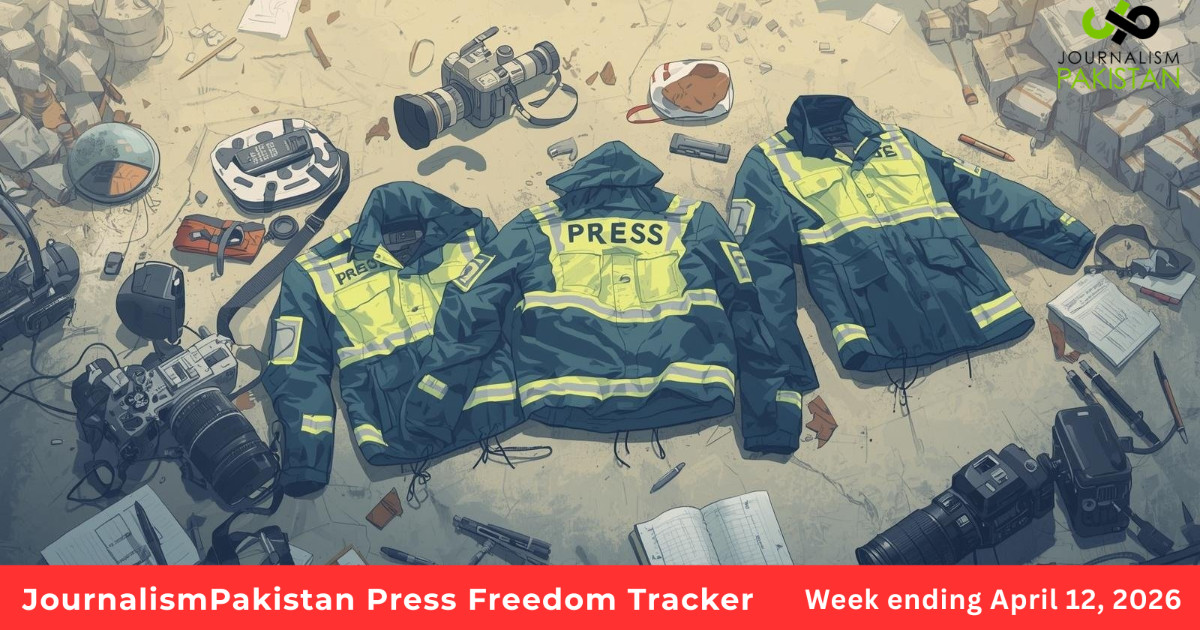
The Press Freedom Tracker records rising legal actions, arrests, and detentions of journalists and growing physical threats in conflict zones. It also finds expanded state and non-state digital surveillance and cyberattacks against media workers.Summary
Editor’s note
This week’s Press Freedom Tracker highlights intensifying legal pressure on journalists, rising physical risks in conflict zones, and expanding digital surveillance and cyberattacks targeting media professionals. Alongside arrests and detentions in multiple countries, the data reflects growing restrictions on access to information and increasing state and non-state interference in journalistic work, particularly around politically sensitive reporting and conflict coverage. The combined trends point to a global environment in which both physical safety and information integrity for journalists remain under sustained pressure.
Arrests, detentions, and kidnappings
IRAQ — American freelance journalist Shelly Kittleson, abducted in Baghdad on March 31, 2026, was released on April 7 following a militia statement and a possible prisoner swap, underscoring ongoing threats to journalists in Iraq. (Washington Post; Al Monitor, April 7, 2026)
EGYPT — Authorities detained political commentator Ahmed Douma after interrogation on charges of publishing “false news” related to an article and social media posts; he was ordered held for four days pending investigation. (Committee to Protect Journalists, April 7, 2026)
IRAN — A Japanese journalist, reportedly an NHK bureau chief, was released on bail but remains under a travel ban while facing trial on security-related charges. (NHK; Reuters, April 2026)
RUSSIA — Security forces raided Novaya Gazeta’s newsroom on April 9 and detained investigative journalist Oleg Roldugin over alleged misuse of personal data, with reports of restricted access to legal counsel following the detention. (Reuters, April 9, 2026)
Legal and regulatory pressure
PAKISTAN — Authorities have registered 187 cases under PECA Section 26A, a law criminalizing digital misinformation, with several journalists among those booked, including Khalid Jamil, Waheed Murad, and Farhan Mallick. (National Assembly, April 7, 2026; media reports 2025–2026)
THAILAND — A senior cabinet minister filed criminal defamation lawsuits against two journalists over reporting on an alleged bribery case, raising concerns about legal pressure on investigative reporting. (Human Rights Watch, April 9, 2026)
Attacks, threats, and harassment
STATE OF PALESTINE — Israeli forces carried out 53 violations against Palestinian journalists in March 2026, including two killings, multiple detentions, assaults, equipment seizures, and attempts to block coverage. The Palestinian Journalists’ Syndicate called for international protection of media workers. (Middle East Monitor, April 8, 2026)
GAZA/LEBANON — Three journalists, including an Al Jazeera Mubasher correspondent, were killed in Israeli strikes in Gaza and Lebanon, with at least one incident reported as a targeted attack amid escalating regional hostilities. (Committee to Protect Journalists, April 9, 2026)
Censorship and digital restrictions
No new incidents reported in this section during the period under review.
Policy and court developments
PAKISTAN — A health insurance scheme for journalists has seen low utilization, with 187 of 4,537 enrolled media workers receiving benefits under the Prime Minister’s Health Insurance Program. The government plans to expand coverage to 10,000 journalists, with eligibility and verification managed by the Press Information Department. (JournalismPakistan, April 7, 2026)
UNITED STATES — A federal judge ruled that the Pentagon violated a court order restricting journalists’ access and directed the Defense Department to restore full press access and submit compliance reporting by April 16, affecting major media outlets including The New York Times. (Reuters, April 10, 2026)
UNITED STATES — The U.S. State Department entered a consent decree settlement with conservative media organizations in a censorship lawsuit over alleged government influence on social media content moderation related to COVID-19 and elections, with the court imposing restrictions on future agency-platform communications. (U.S. federal court filings, April 2026)
Media labor and union activity
PAKISTAN — The Rawalpindi-Islamabad Union of Journalists (RIUJ) condemned fresh layoffs at Aaj News Islamabad involving 14 staff members, citing unpaid salaries and newsroom restructuring, and urged reinstatement along with government intervention to address growing labor concerns in the media industry. (JournalismPakistan; RIUJ statement, April 2026)
Media operations and industry pressures
PAKISTAN — Veteran journalist Abbas Nasir ended his long-running Dawn column, citing financial constraints and reduced advertising linked to editorial independence, highlighting continued pressure on media operations. (Dawn, April 2026)
UNITED STATES — The Associated Press plans dozens of U.S. job cuts as part of a restructuring aimed at shifting focus from local print reporting to video and national coverage. (Axios, April 5, 2026)
PAKISTAN — Lawmakers’ inquiries into government advertising allocations and payments to media outlets and influencers went unanswered by the Ministry of Information and Broadcasting, raising transparency concerns. (JournalismPakistan, April 7, 2026)
PAKISTAN — Authorities announced visa-on-arrival facilitation for foreign journalists attending the Islamabad Talks 2026, while reports indicated restrictions on local media coverage of the negotiations, including limits on live broadcasting and independent reporting. (Ishaq Dar statement on X, April 10, 2026; local media reports, April 10, 2026)
PAKISTAN — Journalists reported restricted and unclear access arrangements for upcoming Iran–US-related diplomatic engagements in Islamabad, citing difficulties in obtaining accreditation and invitations to press briefings, while official media authorities have not publicly clarified procedures. (JournalismPakistan, April 11, 2026)
PAKISTAN — Journalists covering the US–Iran talks in Islamabad were assigned to a designated media center at the Jinnah Convention Centre, located away from the main venue at the Serena Hotel, with movement restricted under security protocols and real-time access to information limited during coverage of the diplomatic event. (JournalismPakistan, April 12, 2026)
Press freedom and journalist safety
PAKISTAN — Authorities blocked access to the Karachi Press Club for several hours to prevent a reported PTI protest, with KPC officials condemning road closures that restricted journalists and disrupted press activity. (KPC statement, April 5, 2026)
UNITED STATES — President Trump publicly threatened an unnamed journalist with jail unless they revealed a source for a story on a missing U.S. airman in Iran, raising concerns about press freedom and protection of confidential sources. (Reuters, April 6, 2026)
EGYPT/LEBANON — Journalists were targeted in coordinated spear-phishing attacks on their personal and professional email and cloud accounts, potentially exposing sources and sensitive communications. The attacks are believed to involve a South Asia-based cyber-espionage group, possibly operating through hack-for-hire services. (Committee to Protect Journalists; Access Now; SMEX, April 8, 2026)
Global context
Across regions, press freedom continues to face escalating pressure from legal actions, security risks, and digital surveillance. Governments are increasingly using misinformation laws, defamation cases, and administrative restrictions to control media narratives, while conflict zones remain extremely dangerous for journalists, with killings and targeted attacks continuing. At the same time, cyber intrusions and phishing campaigns are emerging as a growing transnational threat to newsroom security and source protection. Together, these developments reflect a widening global challenge to independent journalism, access to information, and journalist safety.
For additional context, readers can review last week’s Press Freedom Tracker.
(This Press Freedom Tracker is produced by JournalismPakistan, which verifies, curates, and synthesizes reporting from credible international media outlets, press freedom organizations, and official statements. Where applicable, JournalismPakistan’s original reporting is included alongside external sources. The tracker provides a clear, accurate, and accountable record of developments affecting journalists and media worldwide.)
Key Points
- Rising legal pressure documented, including arrests, detentions, and prosecutions of journalists.
- Physical risks are increasing in conflict zones, with cases of abduction and hostage releases reported.
- Expanded digital surveillance and a rise in cyberattacks targeting media professionals and newsrooms.
- Notable incidents: abduction and release of Shelly Kittleson in Iraq; detention of Ahmed Douma in Egypt; NHK journalist released on bail in Iran.
- Raids on newsrooms and detention of investigative journalists highlight growing state and non-state interference.
Key Questions & Answers
What are the main threats to journalists noted in the review?
Legal actions, arrests and detentions, physical risks in conflict zones, and digital surveillance and cyberattacks are the primary threats documented.
Which recent incidents does the review highlight?
It cites the abduction and release of Shelly Kittleson in Iraq; detention of Ahmed Douma in Egypt; an NHK bureau chief in Iran under travel ban; and a Novaya Gazeta raid in Russia.
How are digital threats affecting media professionals?
The review reports expanded state and non-state surveillance and an uptick in cyberattacks that compromise reporters, newsrooms, and information integrity.
What is the broader impact on journalism and information?
Increasing restrictions and interference limit access to information and undermine journalists' safety and the reliability of public reporting.
Relevant Topics
Ask AI: Understand this story your way
AI EnabledDig deeper, ask anything — get instant context, background, and clarity.
Disclaimer: This feature is powered by AI and is intended to help readers explore and understand news stories more easily. While we strive for accuracy, AI-generated responses may occasionally be incomplete or reflect limitations in the underlying model. This feature does not represent the editorial views of JournalismPakistan. For our full, verified reporting, please refer to the original article.