.png)
Publishers split between lawsuits and AI licensing deals
JournalismPakistan.com | Published: 26 June 2026 | JP Global Monitoring
Join our WhatsApp channel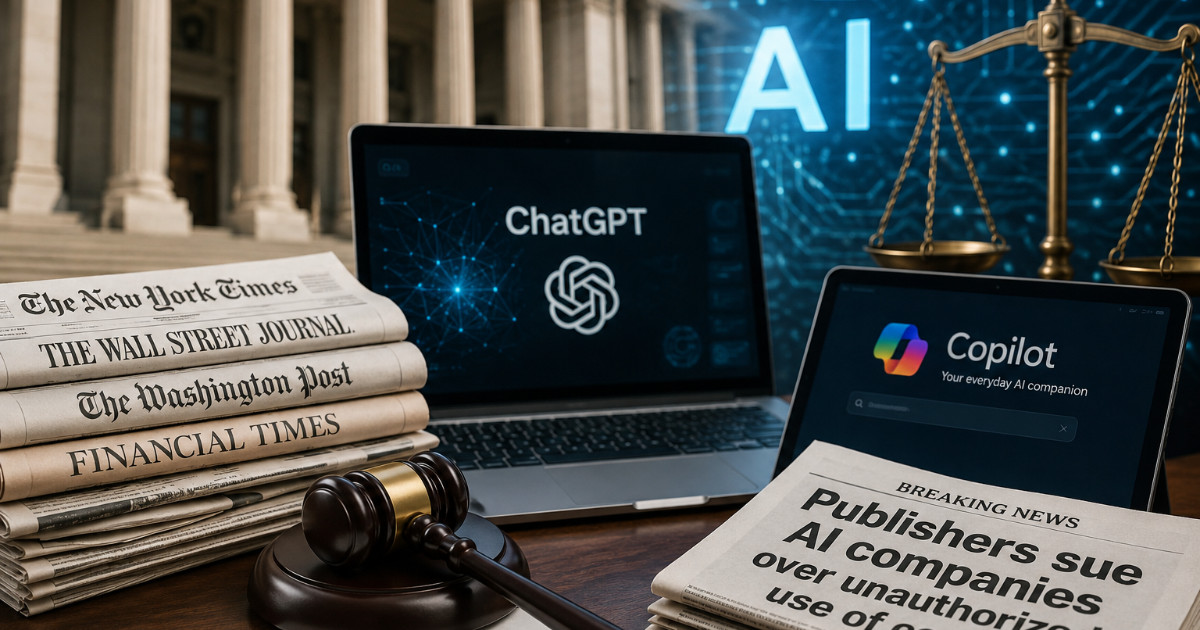
News publishers are split between suing AI firms for allegedly using copyrighted reporting without permission and striking licensing deals to secure payment and access; recent suits name OpenAI and Microsoft, while deals involve News Corp and Meta.Summary
NEW YORK — The relationship between news publishers and artificial intelligence companies is becoming increasingly divided, with media organizations simultaneously pursuing copyright lawsuits and signing commercial licensing agreements as they seek to protect journalism while adapting to the AI era.
The latest escalation came as a coalition of more than 30 U.S. local newspaper companies, representing nearly 400 newspaper titles, filed a federal lawsuit against OpenAI and Microsoft. The publishers allege the companies used copyrighted reporting without authorization to develop products including ChatGPT and Microsoft Copilot, marking one of the largest coordinated legal actions yet involving local news organizations.
Publishers pursue courts and commercial deals
The lawsuit highlights a growing divide across the news industry. While some publishers are asking courts to determine whether AI companies unlawfully copied their reporting, others are choosing to license their journalism in exchange for compensation and access to AI technologies.
Among the latest developments, Brazilian newspaper Folha settled its legal dispute with OpenAI by signing a commercial agreement shortly after announcing a separate partnership with Google. Meanwhile, Wall Street Journal owner News Corp reached a deal reportedly worth up to $50 million annually for Meta to use its journalism across AI products.
At the same time, CNN has become the latest major news organization to sue AI search startup Perplexity, alleging the unauthorized reproduction and distribution of its copyrighted reporting. Perplexity has denied wrongdoing, arguing that facts themselves cannot be copyrighted.
Legal battle expands across the media industry
The legal disputes have accelerated since late 2023, when The New York Times launched its landmark copyright lawsuit against OpenAI and Microsoft. Since then, publishers, broadcasters, dictionaries, magazine companies, and other content creators have filed a growing number of cases against AI developers, including OpenAI, Perplexity, Anthropic, and Cohere.
Current plaintiffs include The New York Times, Ziff Davis, Indian news publishers, Canadian media organizations, Encyclopedia Britannica, Merriam-Webster, Getty Images, and several newspaper groups owned by Alden Global Capital. Separate lawsuits have also been brought against Perplexity by organizations including News Corp and CNN.
Industry executives argue the cases will help define whether AI companies must compensate publishers for using copyrighted journalism to train large language models and generate AI-powered responses.
Licensing agreements gather pace
Alongside the litigation, publishers continue to strike commercial agreements with AI companies.
OpenAI has secured partnerships with organizations including the Financial Times, Associated Press, Vox Media, Hearst, The Atlantic, News Corp, The Washington Post, Guardian Media Group, and several European publishers. Microsoft has signed agreements with publishers including Axel Springer, Reuters, Financial Times parent organizations, and Informa.
Other technology companies have also expanded their publisher partnerships. Google has announced AI-related agreements with publishers through commercial partnerships linked to Google News Showcase, while Amazon has signed content agreements with publishers, including Reach, for use in Nova AI and Alexa. Meta has also expanded licensing deals with publishers, including Reuters and News Corp.
The growing list of agreements suggests many publishers are pursuing a dual strategy, challenging unauthorized use through the courts while monetizing their journalism through negotiated licensing arrangements.
As copyright cases move through U.S. courts, their outcomes are expected to influence how AI companies obtain training data and how news organizations are compensated for original reporting, with implications for the future economics of journalism worldwide.
WHY THIS MATTERS: The parallel rise of lawsuits and licensing agreements signals that the news industry is no longer responding to AI with a single strategy. For publishers, newsroom leaders, and journalists, the legal decisions and commercial partnerships emerging over the next few years are likely to shape copyright standards, revenue opportunities, and the future relationship between journalism and generative AI.
ATTRIBUTION: Reporting by JournalismPakistan, based on publicly available reports by Tomorrow's Publisher (June 25, 2026), Reuters (May 28, 2026), and Bloomberg Law (June 25, 2026).
PHOTO: AI-generated; for illustrative purposes only.
Key Points
- News organisations are pursuing two paths: copyright litigation and commercial licensing with AI companies.
- A coalition of more than 30 U.S. local newspaper companies has sued OpenAI and Microsoft over alleged use of reporting.
- Some publishers, including News Corp and Brazil's Folha, have negotiated commercial deals with major tech firms.
- Major outlets such as CNN have filed separate lawsuits against AI startups like Perplexity for alleged unauthorized reproduction.
- The split reflects publishers' efforts to obtain compensation while retaining control over their journalism in the AI era.
Key Questions & Answers
Why are publishers split between lawsuits and licensing?
Publishers seek both legal clarity and compensation: some pursue courts to stop alleged unauthorized use, while others negotiate licenses to obtain payment and controlled access to AI tools.
Which companies are being sued?
Recent coordinated lawsuits name OpenAI and Microsoft, and separate suits have targeted AI startups such as Perplexity, with claims of using copyrighted reporting without permission.
What do licensing deals typically provide publishers?
Licensing agreements usually offer publishers financial compensation, data access or technology partnerships, and terms governing how AI firms may use their journalism.
How could these actions affect news consumers?
Outcomes may influence how AI products use and display news content; licensing could ensure attribution and access, while litigation could limit some AI uses pending court decisions.
Relevant Topics
Ask AI: Understand this story your way
AI EnabledDig deeper, ask anything — get instant context, background, and clarity.
Disclaimer: This feature is powered by AI and is intended to help readers explore and understand news stories more easily. While we strive for accuracy, AI-generated responses may occasionally be incomplete or reflect limitations in the underlying model. This feature does not represent the editorial views of JournalismPakistan. For our full, verified reporting, please refer to the original article.