.png)
England 2026: The founders reclaim the Beautiful Game
JournalismPakistan.com | Published: 29 June 2026 | Dr. Nauman Niaz (TI)
Join our WhatsApp channel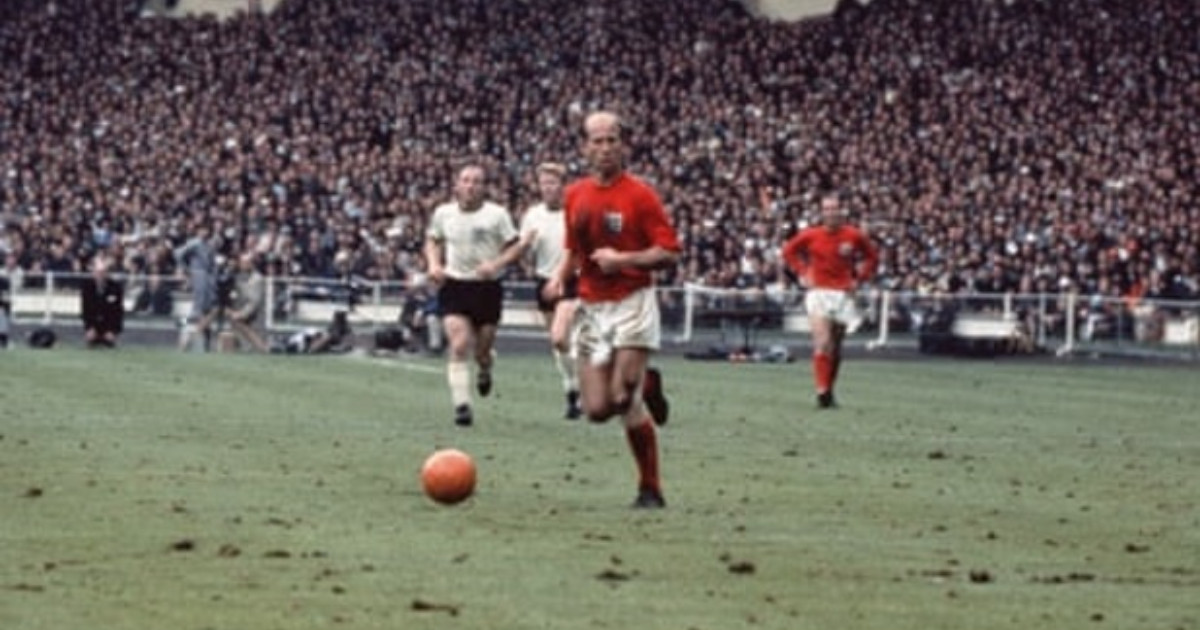
The article traces England's complex relationship with the World Cup, from Victorian codification and early absences to public humiliations like the 1950 loss to the United States. It argues these setbacks forged a prolonged struggle to regain international footballing stature ahead of 2026.Summary
There is a particular kind of nation that invents a thing and then spends the next century being humbled by it. England is such a nation, and football is its lovely, ruinous gift to the world. The English codified the game in the smoke of Victorian schoolrooms, drew its first laws upon paper, set eleven men against eleven, and called it civilisation at play. Having made the thing, they then declined, with the haughtiness of an heir who will not deign to attend the reading of his own will, to compete in the first three editions of its grandest tournament. The World Cups of 1930, 1934, and 1938 passed without an English boot upon them. The founders stayed home, certain that the championship of the planet was a provincial affair beneath their notice.
The story of England at the World Cup begins, therefore, not with triumph but with absence, and the absence tells you something true about the temperament that follows. This is a country that has always believed itself the rightful proprietor of the game and has spent six decades being taught, painfully and in public, that ownership and mastery are not the same currency. The Football Association had withdrawn from FIFA in 1928 over a quarrel about payments to amateurs, a dispute conducted in the register of men who think themselves too grand for the room they are standing in. When at last the English arrived, at the 1950 tournament in Brazil, the humiliation was swift and almost biblical in its irony. They lost to a part-time side from the United States, a result so improbable that English newspapers, receiving the score by wire, are said to have assumed a transmission error and printed it as a comfortable home win. The founders had come to the feast and been served their own hats.
And yet to read English football history only as a chronicle of comeuppance is to miss its deeper grain. What sits beneath the disappointments is a kind of devotional seriousness about the game, a national insistence that football matters in the moral sense, that it is bound up with who the English think they are. No other footballing culture carries quite this freight. For Brazil, the game is joy made flesh; for Italy, it is cunning elevated to art; for Germany, it is the triumph of the assembled over the gifted. For England, it is something closer to a recurring examination of the national soul, sat every four years, and very often failed in the cruellest possible manner, by the smallest possible margin, at the latest possible hour.
The Golden Afternoon: Wembley, 1966
There is one afternoon that redeems all the rest, or perhaps condemns them, depending on the angle of the light. On the thirtieth of July in 1966, beneath a grey London sky and before a Wembley crowd that had waited the whole of its collective life for the moment, England beat West Germany four goals to two in extra time and lifted the only World Cup the nation has ever held. Geoff Hurst scored three of those goals, the only man to score a hat-trick in a World Cup final, and the third of them, lashed home in the dying seconds as spectators spilled onto the turf, gave English football its most quoted line of commentary and its most enduring image: a striker striking, a nation rising, a fat man on the touchline who had managed the thing into being.
Alf Ramsey was that man, a manager of granite reticence who had promised the English they would win and then, with the quiet menace of a schoolmaster who does not raise his voice because he does not need to, delivered upon the promise. His team was called the Wingless Wonders, a team built not around flair but around function, around the labour of Nobby Stiles and the elegance of Bobby Moore and the goals of Bobby Charlton, whose long-range strikes seemed to bend the very physics of the afternoon. Ramsey won that tournament with a win percentage across his England years that no successor has approached. He understood something the country has spent sixty years trying to relearn: that tournaments are won by sides who know precisely what they are, and refuse the seduction of being anything else.
The trouble with a single golden afternoon is the shadow it throws across every afternoon that follows. The 1966 victory became less a memory than a sentence, a standard against which every subsequent generation would be measured and found wanting. The English began to confuse entitlement with expectation, and expectation curdled, over the long years, into a low and grinding anxiety. They reached the quarter-finals and went out. They reached the quarter-finals and went out again. The team has been eliminated at the World Cup quarter-final stage on seven separate occasions, more often than any nation in the history of the tournament, a statistic that reads at first as failure and, on second reading, as a strange and stubborn kind of competence. To reach the last eight is no small thing. To reach it and stop there, time after time, as though some invisible hand was placed against the chest of every English side at the threshold of the truly great, is a peculiarity that belongs to England alone.
Penalty Heartbreak and the High-Water Marks
The instrument of the cruelty, more often than not, was the penalty shootout. Here, English football discovered its most exquisite form of self-laceration. The semi-final of 1990 in Turin, when a side roused by Paul Gascoigne and Gary Lineker carried the nation further than it had been since the golden afternoon, ended in tears that were not metaphorical: Gascoigne wept on the pitch, the country wept before its televisions, and West Germany advanced from the spot. Lineker finished that tournament among the world's foremost marksmen and remains England's leading scorer at World Cups, ten goals struck across two tournaments by a forward who never once received a yellow card in his career, a gentleman assassin in an age of brawlers. The fourth-place finish of 1990 stands, with 1966 and the semi-final run of 2018, among the three high-water marks of the English story.
Between those peaks lay the troughs, and the troughs were deep. England failed to qualify for the finals altogether in 1974, in 1978, and again in 1994, when the road to the United States was closed to them and a nation that considered itself football's birthplace watched the World Cup as an uninvited spectator. The 1994 failure was the lowest of the low points, a tactical and temperamental collapse that exposed how far the founders had drifted from the front of the game they had given the world. Each absence carried its own particular humiliation, and each taught, or ought to have taught, the same lesson: that history confers no rights upon the present, that the game owes England nothing, that the ball does not care who drew up its first laws.
The English Heroes: A National Gallery
Every footballing nation tells itself a story through its heroes, and the English heroes form a gallery that is unmistakably, almost painfully, national in character. Bobby Moore stands at its centre, the blond captain of 1966, a defender of such unhurried composure that he seemed to play the game a half-second slower and a half-thought faster than everyone around him. There is a photograph of Moore embracing Pele after a match at the 1970 World Cup in Mexico, two men stripped to the waist and grinning, and it has become the defining image of English sporting grace: the founder's captain and the game's greatest genius, meeting as equals in mutual regard. Moore never won another trophy of consequence and died young, and the English have mourned him ever since as the embodiment of what they wish themselves to be.
There was Bobby Charlton, survivor of the Munich air disaster, who carried within him both the grief of the lost Busby Babes and the joy of a man who plays because the alternative is unthinkable. There was Peter Shilton in goal, who guarded the English net across three World Cups and holds the national record of one hundred and twenty-five caps, a figure of granite reliability whose first World Cup appearance came at the age of thirty-two and whose last came at forty, in the third-place defeat of 1990. Shilton has appeared in more World Cup matches than any other Englishman, seventeen in all, and the longevity of his vigil tells you something of the patience the English position seems to demand of those who hold it.
The modern gallery is no less vivid. Gary Lineker, the scorer of goals and never the receiver of bookings. David Beckham, who was vilified by a whole nation after his red card against Argentina in 1998 and then, with a free-kick against Greece in the autumn of 2001 that seemed to bend not only around the wall but around the entire weight of public scorn, redeemed himself so completely that the redemption became a parable. Wayne Rooney, the boy from Croxteth who arrived like a thunderclap and bore, perhaps too early and too heavily, the whole apparatus of national hope. And Harry Kane, the present captain, a striker of cold and methodical brilliance who won the Golden Boot at the 2018 tournament, the only Englishman to claim it in the twenty-first century, and who leads the side now at his third World Cup, drawing level with Billy Wright's record of captaincies, a man chasing the one prize his enormous gifts have not yet purchased.
The Managers: Secular Chaplains to a Nation's Hope
It is worth pausing, too, upon the managers, for the English have invested in the figure of the manager a national significance that few other footballing cultures grant. The manager of England is not just a coach but a kind of secular chaplain to the country's hopes, hired in optimism and dismissed in recrimination, his face on the back pages and his judgement on the front. After Ramsey came a procession of them: Bobby Robson, whose decent and avuncular warmth carried the side to within a penalty shootout of the 1990 final and who was hounded by the press even as the nation half-loved him; Glenn Hoddle, gifted and doomed; Sven-Goran Eriksson, the first foreigner to hold the post, who took a so-called golden generation to three quarter-finals and no further, a Swede whose unflappable cool the English could neither fault nor warm to. Each man learned the same hard truth, that to manage England is to be handed the accumulated expectation of a nation and the accumulated excuses of none, and that the post consumes its holders the way the sea consumes a coastline, patiently and without malice and entirely.
What unites this gallery, across the generations, is a conception of the footballer as a kind of yeoman: honest, industrious, brave to the point of foolishness, more comfortable with effort than with artifice. The English have always been faintly suspicious of the player who is only gifted, as though raw talent unaccompanied by graft were a form of moral truancy. They prize the lung-bursting run back, the block, the header won in a crowded box, the goal scored not beautifully but at the necessary moment. It is a philosophy with obvious virtues and one obvious flaw, which is that World Cups are not, in the end, won by virtue alone. They are won by sides who can do the difficult thing under the heaviest pressure, and for half a century, the English could not, quite, do it.
The French Lesson: Diversity as Footballing Strength
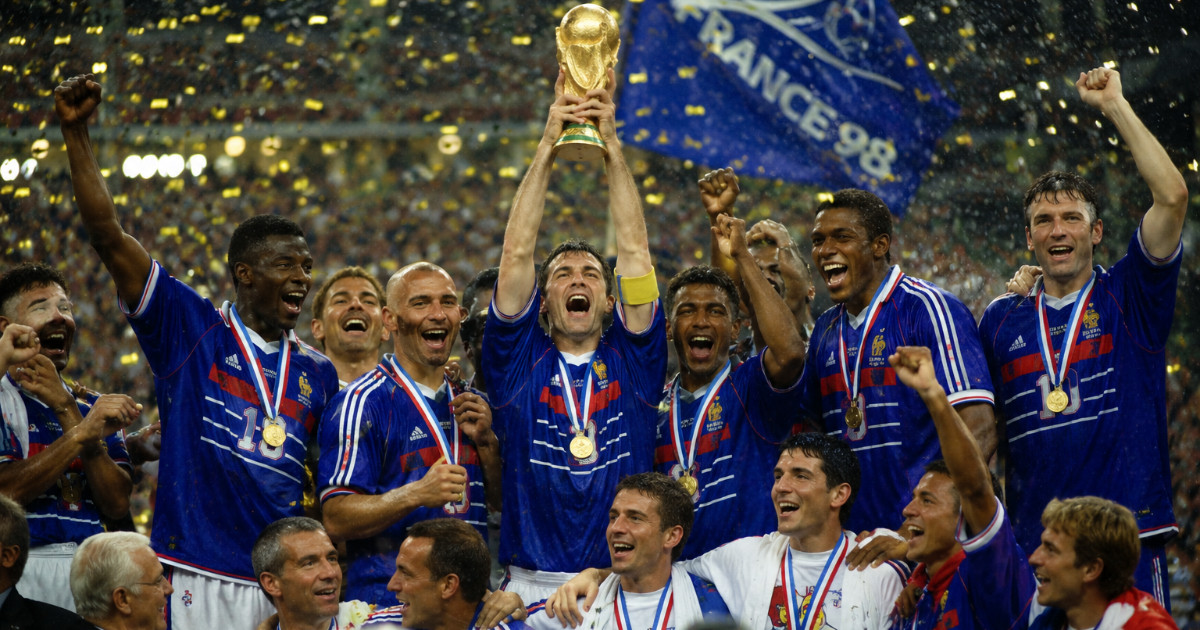
To understand what England has become, and what it has had to learn, it is instructive to look across the water at the nation that solved the very problem the English wrestled with, and solved it through a route the English never quite trusted. France is the great modern counter-example, a footballing power assembled not despite its mixed and migrant population but precisely because of it, and the story of the French is, at its heart, the story of the sons of elsewhere wearing the blue of somewhere new. When France won the World Cup for the first time, on home soil in 1998, the side that thrashed Brazil three goals to nil in the final at the Stade de France was a portrait of the country's full and complicated inheritance.
Zinedine Zidane, who scored twice in that final with two headers that have entered the permanent memory of the game, was the son of Algerian immigrants from a working-class quarter of Marseille, a second-generation child of the Kabyle mountains made good upon the grandest stage France could offer. Around him stood a team drawn from the whole arc of French history and its colonial reach: Lilian Thuram, born in Guadeloupe in the French West Indies, who would score the two goals that carried France past Croatia in the semi-final and who remains the nation's most-capped player; Christian Karembeu, from New Caledonia in the distant Pacific; Marcel Desailly, born in Ghana; Patrick Vieira, born in Senegal; players of Armenian and Portuguese and the West Indian descent intertwined into a single national purpose. The press christened them Black, Blanc, Beur, black, white and Arab, and the country, for one intoxicating summer, believed it had found in its football team a mirror of the better, more generous France it hoped to be.
Nine members of that 1998 squad were either immigrants themselves or the children of immigrants. When France won the World Cup again twenty years later, in Russia in 2018, the proportion had grown rather than diminished: seventeen of the twenty-three players called up were immigrants or the sons of immigrants, the great majority of them of African descent, so that some observers, only half in jest, called France the last African team standing in a tournament from which the African nations themselves had been eliminated. Kylian Mbappe, the teenage marvel who lit that tournament like a struck match, is the son of a Cameroonian father and an Algerian mother, raised in Bondy on the unloved northern edge of Paris. Paul Pogba, the midfield engine of the side, is the son of Guinean parents. The banlieues, the marginalised suburbs that ring the great French cities and that the French establishment has so often failed and feared, turned out to be the richest seam of footballing talent in Europe, and France had the wit, or the good fortune, to mine it.
This is the deeper lesson the French story holds for the English one. A national team is not a museum of the nation's past but a portrait of its living present, and a country that opens its arms to the talent washed up on its shores by the surges of empire and migration will, in time, be rewarded by that talent on the field. The defender Lilian Thuram has argued, in the years since his playing days, that the French triumphs of 1998 and 2018 genuinely shifted the nation's attitude towards its immigrants, that the sight of the sons of elsewhere winning glory for France complicated, however briefly, the easy bigotries of the age. He is careful, too, to note that the work is far from finished, that a football victory does not undo a structural prejudice, that the same players cheered on a Sunday are too often suspected on a Monday. The French team has been, by turns, a symbol of harmony and a lightning rod for the nation's anxieties, adored when it wins and racially abused when it loses, asked to carry a weight of meaning that no group of young men kicking a ball should reasonably be made to bear.
The Dark Passages: When Unity Fractured
The French route was not without its dark passages, and honesty requires their naming. The team that had been a symbol of unity in 1998 became, at the World Cup of 2010 in South Africa, a symbol of mutinous collapse, when a quarrel between the striker Nicolas Anelka and the coach Raymond Domenech metastasised into a players' strike, a refusal to train, and a group-stage exit conducted in open rebellion before a watching and appalled nation. The same diversity that the French had celebrated when it won was weaponised against the players when it lost, and the suburbs that had supplied the talent were blamed for the indiscipline, as though the geography of a man's childhood were the cause of a dressing-room schism. A year later came the revelation that officials within the French federation had discussed a covert quota to limit the number of dual-nationality youngsters in the national academies, a scheme that exposed how shallow the celebrated harmony could run when the results turned sour. The lesson, for England as much as for France, is that a multicultural national side is admired in victory and interrogated in defeat, and that the work of genuine inclusion is never completed by a single golden summer, however intoxicating.
England, watching this across the Channel, has undergone a quieter version of the same transformation, and it is one of the most important and least celebrated facts about the modern English game. The yeoman gallery of old, almost uniformly white, has given way across the past three decades to a national side that draws upon the full breadth of a multicultural country: the children of Caribbean and West African and South Asian migration, the grandchildren of the Windrush generation, the sons of families who arrived on these islands within living memory and whose boys now wear the three lions upon their chests. The current side carries the descendants of this long settlement in its spine, and it is no coincidence that the England team has grown stronger, more varied, and more technically gifted in exact proportion as it has grown to resemble the actual country it represents. The founders, having taught the world the game, are at last learning from the world how to play it.
The Knack: Breaking the Penalty Curse
There is a word the English use for the thing they could never quite acquire: the knack. It is the ability to win the matches that must be won, to keep the head when the head most wishes to be lost, to convert the penalty in the eighty-thousandth minute of a nation's accumulated dread. For decades, the English had every gift but this one, and the absence of it became a self-fulfilling thing, a curse that operated chiefly through the expectation of itself. A young Englishman walking to the penalty spot at a World Cup carried not just a ball and a goalkeeper to beat but the entire ghostly congregation of those who had missed before him, all the way back to Turin and beyond. The miss was inherited before it was made.
The breaking of this spell has been the great project of English football in the present century, and it has been pursued not through romance but through method. The Football Association built a national training centre, St George's Park, and set about manufacturing, as the Germans and the French had manufactured before them, a pipeline of technically schooled young players raised on possession and composure rather than the old religion of blood and thunder. They studied the penalty shootout as a discipline rather than a lottery, rehearsing the long walk and the cold moment until the moment lost some of its terror. And in 2018, in Russia, under a manager in a waistcoat who spoke of his players' mental wellbeing in a way no English manager had dared, England finally won a World Cup penalty shootout, against Colombia, and the breaking of that single hex felt, to a watching nation, like the lifting of a weight that had pressed upon the chest for twenty-eight years.
There is a temperamental dimension to all this that the English have only lately learned to name. For most of the long apprenticeship, English sides played as though afraid of their own quality, tightening in the great moments rather than loosening, contracting when they ought to have expanded. The fear was not of the opponent but of the disappointment of the watchers, of joining the long line of those who had fallen short, and fear of that particular kind is a contagion that passes from a crowd to a team and back again until the whole nation is locked in a single held breath. The slow work of the present century has been, as much as anything, a work upon the English mind: the deliberate construction of a culture in which young players are taught to treat the great occasion as an opportunity rather than a trial, to walk towards the penalty spot rather than away from the memory of those who missed. It is unglamorous work, conducted by sports psychologists and data analysts rather than by poets, but it has done what poetry could not, which is to give the English, at long last, a fighting chance of the knack.
That 2018 side reached the semi-finals, the country's best World Cup showing since the golden afternoon, before falling to a Croatia inspired by the ageless Luka Modric. Four years later, in Qatar in 2022, England reached the quarter-finals once more and went out, fittingly and agonisingly, to a missed penalty, Harry Kane lashing the equaliser against France high over the bar in a moment that contained the whole tragic history of English spot-kicks compressed into a single arc of leather against the Doha night. The knack, it seemed, had been half-learned and half-lost again. But something had changed beneath the surface, something structural and durable, and it is this change that explains why England arrives at the present moment carrying a weight of expectation heavier and, for once, more justified than at any time since 1966.
The Case for England at World Cup 2026
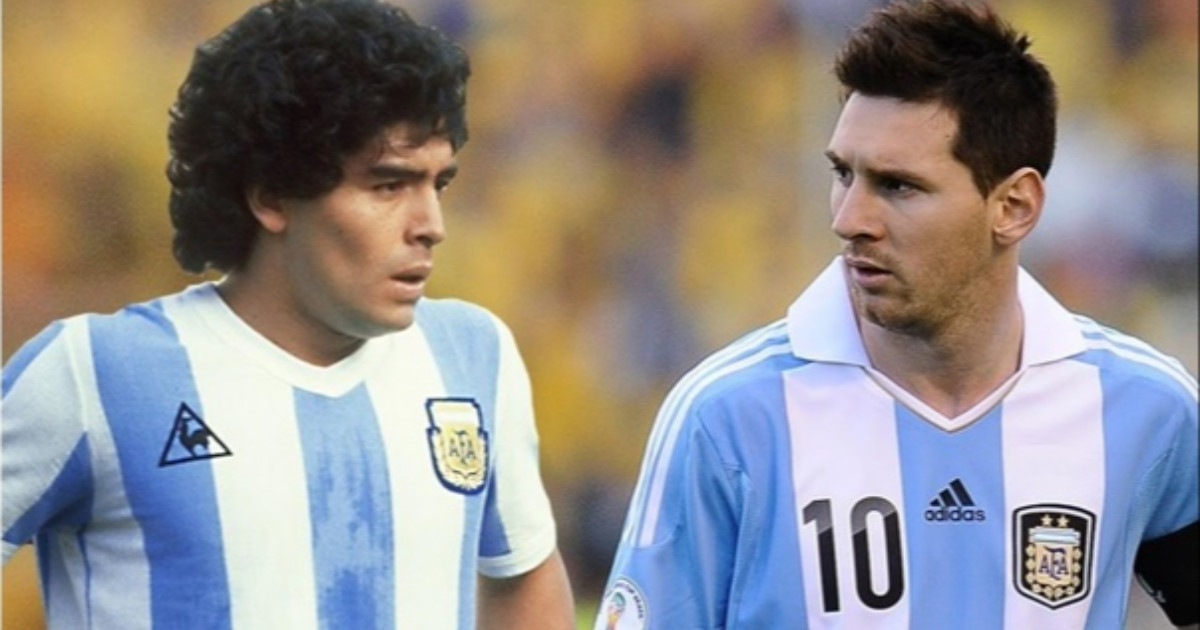
It must be said plainly, and with the caution the subject demands, that to call any side the strongest team of the contemporary age is to make an argument, not to state a settled fact, and the argument must reckon honestly with a record that holds a single world title and a long history of near misses. France has won the modern era's trophies; Argentina holds the present crown, carried to glory in Qatar upon the shoulders of the incomparable Lionel Messi; Spain, Germany, and Brazil all command deeper cabinets. The honest case for England is not that it has won more, but that it has assembled, at this particular hour, a combination of depth, youth, method, and temperament that no rival can presently match, and that the long apprenticeship of failure has finally produced a side equipped to convert promise into the only currency that counts.
Consider the evidence as it stands in the summer of 2026. England arrived at the expanded World Cup in the United States, Canada, and Mexico ranked among the foremost sides on the planet, having swept through their qualifying campaign with a flawless record, winning all of their matches and conceding, across the whole campaign, almost nothing. They became the first European nation to secure their place at the finals, achieving it with matches to spare, a quiet statement of efficiency from a team that has learned, at last, to do the ordinary things with ruthless reliability. The chaos and the heartbreak of the old English campaigns have given way to something colder and more formidable: a side that wins because it expects to, rather than one that loses because it fears it might.
Thomas Tuchel and the Continental Blueprint
The architect of this transformation is a German, and there is a fine historical irony in that. Thomas Tuchel, a Champions League winner and a tactician of European pedigree who has commanded Chelsea, Paris Saint-Germain and Bayern Munich, took charge of England at the start of 2025 and brought to the role the one quality the English game has most lacked: a continental clarity untroubled by the weight of English sentiment. Tuchel does not carry the ghosts of Turin or Doha within him. He sees the players for what they are rather than for what the national mythology insists they ought to be. Under his hand, the side has acquired a tactical coherence that observers have called the most complete an English team has carried to a World Cup since the golden afternoon itself, a settled shape with two midfielders shielding the back four and a mobile creator behind a world-class striker.
And the players. Here is the true foundation of the case, for England commands at present a generation of talent of a quality the nation has rarely, if ever, possessed all at once. Jude Bellingham, a midfielder of such precocious authority that he commands the centre of the pitch like a man twice his years, anchors the side alongside Declan Rice, whose growth into a leader has given the team a spine of iron. Bukayo Saka supplies the width and the wit. Harry Kane supplies the goals, as he has supplied them for a decade, a finisher of cold genius hunting the one honour that has eluded him. Behind them stands a depth of reserve so abundant that players who would walk into almost any other national side, the gifted Phil Foden, the elegant Cole Palmer, found themselves left at home, omissions that would once have been a crisis and are now merely the luxury of a nation rich beyond its own historical experience.
This combination, the continental method laid over the homegrown abundance, the cold reliability bolted to the technical gift, is what the argument rests upon. England no longer relies upon a single talisman, as Argentina relied upon Messi, nor upon a single irreplaceable system. It carries goals through the side and not only in the striker; it carries leadership in the midfield and not only in the captain; it carries, for the first time in living memory, players capable of producing the difficult thing under the heaviest pressure, because they have been schooled to do precisely that. The midfield platform that Bellingham and Rice provide is one that previous English generations, for all their heroes, simply lacked. The case for England is the case for a side that has, after the longest apprenticeship in the modern game, finally become the sum of all the lessons its failures taught it.
The Global Impact of English Football
Whatever happens upon the fields of North America in the summer of 2026, the impact of English football upon the world is already secured, and it is an impact that operates on a scale no single tournament can measure. The English gave the game its laws, its language, and its flows. The Premier League, born of English clubs and played in English stadiums, is the wealthiest and most-watched domestic competition on earth, a global theatre in which the talent of every nation gathers to perform, drawing into England the very migration that has, in turn, enriched the national side. The world watches English football on a scale it watches almost nothing else, so that a boy in Lahore or Lagos or Lima knows the chant of a Liverpool crowd before he knows the anthem of his own league. This is a soft power of extraordinary reach, a cultural empire that long outlasted the political one, and football is its lingua franca.
And there is the matter of the national mood, which football alone among English institutions has the power to move. No politician commands the streets the way a deep England run commands them; no royal occasion empties the pubs and fills them the way a World Cup semi-final does. The English are, by temperament, a reticent and undemonstrative people, and football is the one licensed arena in which they permit themselves to feel, openly and collectively, the full range of hope and grief and joy. The tears of Gascoigne in 1990, the agony of the missed penalties, the brief delirium of the 2018 summer when an entire country sang an old song about football coming home and half-believed it: these are not trivial things. They are the emotional weather of a nation, and football is the front that brings them in.
A Country Remade by the Game It Gave the World
The deepest impact of all may be the quiet one traced in these pages: the slow remaking of the English idea of itself, conducted not in the chamber of any parliament but on the training fields and in the dressing rooms of a national team that has come, over three generations, to look like the country it represents. The founders who once stayed home in haughty isolation now field a side drawn from every quarter of a settled, plural, multicultural island, and they are stronger for it, immeasurably and demonstrably stronger, exactly as the French were strengthened by the sons of their own elsewhere. The game that England gave the world has been given back to England, transformed and enriched by every hand that touched it on its long journey out and home again. That is the unending impact, and it is the truest one: a country taught by its own invention to become a fuller version of itself.
The weight of the lions has always been the weight of expectation, of a history too glorious to forget and too distant to repeat. For sixty years, that weight bent the English back and broke the English heart at the latest hour and the smallest margin. But weight, borne long enough and learned from honestly enough, becomes strength, and a side that has carried so much for so long may yet discover that it has been training all the while for the moment it must lift the heaviest thing of all. Whether that moment comes this summer or the next, the apprenticeship is over. The founders have learned the game they made. The only question that remains is the oldest one in English football, asked every four years and answered, so far, only once: not whether they are worthy of the prize, but whether, at the final hour, with the whole weight of history upon them, they will at last possess the knack to take it.
ABOUT THE WRITER: Dr. Nauman Niaz, a Post Doctorate (Oxford), PhD (UWA), FRCP (London), FRCP (Edinburgh), FRCP (Ireland), FRCP (Glasgow), CST (Endo, UK), MSc Biomechanics and Kinesiology (UWA), MRCP (UK), MBBS (Pb), is a civil award winner (Tamgha-i-Imtiaz) in Sports Broadcasting and Journalism, a regular cricket correspondent having covered 54 tours and three ICC World Cups, having written over 3,700 articles. He has authored 19 books and is the official historian of Pakistan Cricket (Fluctuating Fortunes, four volumes, 2005). His signature show Game On Hai has been the highest rated in both ratings and acclaim.
Key Points
- England codified modern football in the Victorian era but did not immediately dominate international competition.
- The Football Association withdrew from FIFA in 1928 over disputes about payments to amateurs.
- England missed the first three World Cups (1930-38) and arrived late to global tournaments.
- The 1950 defeat to the United States became a symbol of public humiliation and shock.
- These episodes shaped a long, public struggle to reclaim England's international footballing stature by 2026.
Key Questions & Answers
Why did England miss the early World Cups?
The Football Association withdrew from FIFA in 1928 over disputes about payments to amateurs and a belief that some international competitions were beneath its notice, contributing to England's absence from the first tournaments.
What made the 1950 World Cup defeat to the United States notable?
England's loss to a part-time United States side was a highly improbable and public humiliation that highlighted a gap between the country's status as football's founder and its on-field performance.
How did these early episodes affect England's reputation?
The combination of absences, governance disputes and shocking defeats created a national temperament marked by pride and long, public lessons that ownership of the sport did not guarantee mastery.
What does 'reclaim the Beautiful Game' mean in the context of 2026?
It refers to a symbolic and competitive effort by England to restore international credibility and success after decades of ups and downs, rather than a guaranteed outcome.
Ask AI: Understand this story your way
AI EnabledDig deeper, ask anything — get instant context, background, and clarity.
Disclaimer: This feature is powered by AI and is intended to help readers explore and understand news stories more easily. While we strive for accuracy, AI-generated responses may occasionally be incomplete or reflect limitations in the underlying model. This feature does not represent the editorial views of JournalismPakistan. For our full, verified reporting, please refer to the original article.