
The JournalismPakistan Global Media Brief | Edition 15 | April 10, 2026
JournalismPakistan.com | Published: 10 April 2026 | JP News Desk
Join our WhatsApp channel
This brief outlines mounting legal pressure on reporters, shifting business models, rising digital threats, and risks to press freedom; it cites Thai defamation suits, Pakistan's visa access for visiting press, and journalist releases in Baghdad and Iran.Summary
Editor's note:
Welcome to the 15th edition of the JournalismPakistan Global Media Brief. This edition brings together key developments shaping global journalism, including escalating legal pressure on reporters, shifting media business models, growing digital security threats, and continuing risks to press freedom across multiple regions.
Global media power shifts
No verified updates available for this edition.
Asia media watch
Thai minister files defamation suits — A senior cabinet minister has filed criminal defamation lawsuits against two journalists over reporting on bribery, underscoring ongoing legal pressure on investigative journalism in Thailand, where such laws carry potential jail terms (Human Rights Watch, April 9, 2026).
Pakistan opens visa-on-arrival for journalists— Pakistan has announced visa-on-arrival access for foreign journalists and delegates attending the Islamabad Talks 2026, aiming to facilitate international media participation and coverage of the high-level negotiations, according to a statement by the foreign minister shared on X (Ishaq Dar statement, April 2026).
Middle East media
American journalist freed in Baghdad — Freelance reporter Shelly Kittleson has been released a week after her kidnapping in Baghdad, reportedly linked to militia-led negotiations. The case highlights continuing risks for journalists working in high-security environments and ongoing operational challenges for media in Iraq (Washington Post, April 7, 2026).
Iran releases NHK journalist on bail — Iranian authorities have released a Japanese journalist, reportedly an NHK bureau chief, on bail after detaining him on security-related charges. He remains barred from leaving the country and is expected to face trial, underscoring continued risks for foreign correspondents in Iran (NHK, Reuters, April 2026).
Israeli forces escalate attacks on Palestinian journalists — Israeli military and security forces carried out 53 violations against Palestinian journalists in March 2026, including two confirmed killings, multiple detentions, assaults, and equipment confiscations, highlighting ongoing operational risks for media workers in the occupied territories (Middle East Monitor, April 8, 2026).
Arab journalists targeted in phishing attacks — Egyptian and Lebanese journalists are facing coordinated phishing campaigns aimed at compromising Apple, Microsoft, and Google accounts, raising concerns over digital surveillance and cybersecurity risks for media professionals in the Middle East (CPJ, April 8, 2026).
Africa media update
No verified updates available for this edition.
Media business and sustainability
Urdu News lays off journalists — Saudi-owned Urdu News has laid off multiple employees across Pakistan due to financial pressures, including National Press Club Vice President Bashir Chaudhry and senior journalist Waheed Murad, adding to a wave of newsroom job cuts and raising concerns over media labor stability (JournalismPakistan, April 3, 2026).
Kamran Khan TV return amid Nukta deal — Senior journalist Kamran Khan returns to television with “On My Radar” as ARY’s majority acquisition of digital platform Nukta signals deeper integration of broadcast and digital news operations in Pakistan, reflecting shifting audience consumption trends (JournalismPakistan, April 4, 2026).
Dawn columnist Abbas Nasir signs off amid financial strain — Veteran journalist Abbas Nasir has ended his 15-year column at Dawn, citing financial constraints and reduced advertising linked to the paper’s editorial stance, underscoring sustainability challenges for independent media in Pakistan (Dawn, April 2026).
AP cuts dozens of U.S. jobs in strategy shift — The Associated Press plans to cut dozens of U.S. staff positions as it pivots away from local print coverage toward video, digital formats, and national reporting, reflecting wider newsroom restructuring trends amid revenue and audience shifts (Axios, April 5, 2026).
Media law and regulation
Supreme Court halts ATC charges against journalist — Pakistan’s Supreme Court has restrained the Anti-Terrorism Court from framing charges against veteran journalist Matiullah Jan and directed the Islamabad High Court to urgently review the case challenging terrorism charges, underscoring judicial oversight in high-profile media-related cases (Dawn, April 2, 2026).
Pakistan journalist health scheme limited use — Only 187 of 4,537 journalists enrolled in Pakistan’s Prime Minister Health Insurance Program have accessed benefits, despite plans to expand coverage to 10,000 verified media workers. The scheme covers renal transplants, cancer care, and other critical conditions, with enrollment managed by the Press Information Department (JournalismPakistan, April 6, 2026).
Pakistan PECA Section 26A cases rise — Pakistan has registered 187 cases under PECA Section 26A targeting online misinformation, with 180 male, 21 female, and one minor suspect identified. The law carries up to three years’ imprisonment and fines of up to Rs2 million, raising concerns over enforcement and journalistic risk (National Assembly, April 6, 2026).
Pakistan government ad spending questions unanswered — Lawmakers in Pakistan’s National Assembly sought detailed disclosures on government advertising allocations across print, electronic, and social media, including payments to outlets and influencers, but the Ministry of Information and Broadcasting did not respond, highlighting transparency gaps in state media funding (JournalismPakistan, April 7, 2026).
Platforms and technology
X link posts show lower engagement — A Nieman Lab analysis finds that posts containing external links on X receive reduced visibility and engagement compared to native content, highlighting platform incentives that may limit traffic to news publishers’ websites (Nieman Lab, April 2026).
Press freedom and journalist safety
Karachi Press Club sealed amid protest fears — Authorities blocked roads leading to Karachi Press Club to prevent a reported PTI demonstration, drawing condemnation from KPC leadership over restrictions affecting journalists’ access and press activity (KPC statement, April 5, 2026).
Trump threatens journalist over source leak — U.S. President Donald Trump publicly warned an unnamed journalist they could face jail unless they disclosed the source behind reporting on a missing U.S. airman in Iran. Press freedom advocates said the comments could undermine source protection and investigative reporting (Reuters, April 6, 2026).
Russia Novaya Gazeta raid and journalist detention — Russian security forces raided the newsroom of Novaya Gazeta on April 9. They detained investigative journalist Oleg Roldugin amid allegations of personal data misuse, with restricted lawyer access reported and growing concern over pressure on independent investigative reporting (Reuters, April 9, 2026).
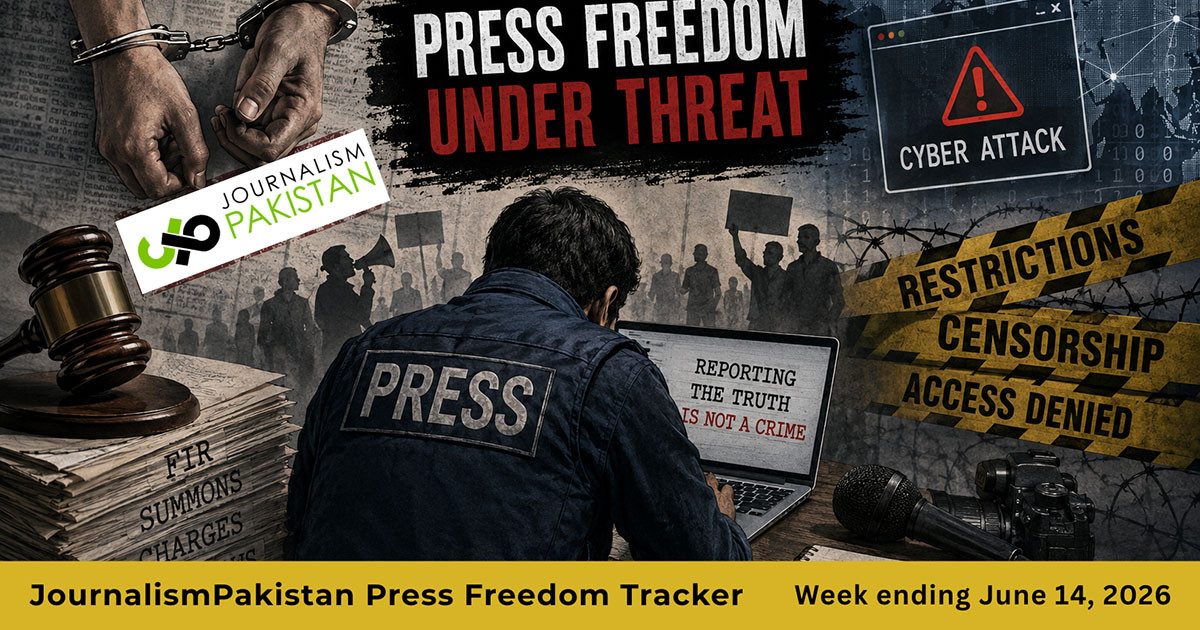
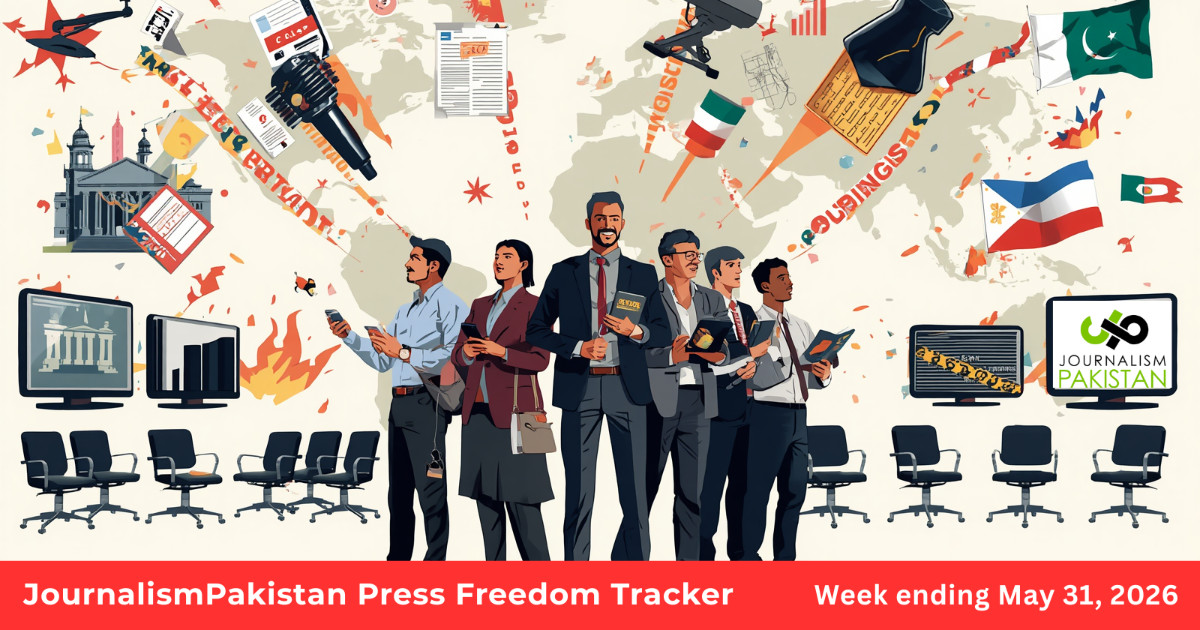
Press freedom incidents are reported in detail in the JP Press Freedom Tracker, published every Sunday. See the latest edition.
WHY THIS MATTERS: This edition highlights the accelerating strain on press freedom and media sustainability across regions, where legal pressure, digital surveillance, newsroom layoffs, and regulatory opacity are converging into a more restrictive operating environment for journalists. At the same time, shifting platform algorithms and consolidation in media ownership continue to reshape how news is produced, distributed, and monetized globally, with direct implications for editorial independence and public access to information.
PHOTO: AI-generated; for illustrative purposes
Key Points
- Escalating legal pressure on reporters, including criminal defamation suits in Thailand against investigative journalists.
- Pakistan announces visa-on-arrival to facilitate foreign journalists attending the Islamabad Talks 2026.
- Freelance American reporter Shelly Kittleson reportedly freed in Baghdad after a week-long abduction.
- Japan's NHK correspondent reportedly released on bail by Iranian authorities.
- Broader trends highlighted: shifting media business models and growing digital security threats to newsrooms.
Key Questions & Answers
What is the focus of this edition?
It reviews key developments affecting global journalism, including legal threats to reporters, changes in media economics, digital-security risks, and recent incidents involving detained or released journalists.
Why are the Thai defamation suits significant?
They illustrate ongoing legal pressure on investigative reporters; criminal defamation can carry jail terms and deter reporting.
What does Pakistan's visa change mean for media?
Pakistan's visa-on-arrival for visiting press aims to ease access for foreign journalists and delegates covering the Islamabad Talks 2026.
What recent journalist safety incidents are covered?
The brief notes the reported release of an American freelance reporter in Baghdad and an NHK journalist freed on bail in Iran, underscoring regional risks to reporters.
Ask AI: Understand this story your way
AI EnabledDig deeper, ask anything — get instant context, background, and clarity.
Disclaimer: This feature is powered by AI and is intended to help readers explore and understand news stories more easily. While we strive for accuracy, AI-generated responses may occasionally be incomplete or reflect limitations in the underlying model. This feature does not represent the editorial views of JournalismPakistan. For our full, verified reporting, please refer to the original article.