.png)
Press freedom review: Arrests, raids, and layoffs escalate
JournalismPakistan.com | Published: 3 May 2026 | JP News Desk
Join our WhatsApp channel
Press freedom faces mounting pressure as legal action, economic strain and direct attacks converge, with verified arrests, raids, killings and newsroom layoffs. In Pakistan, use of the amended PECA has led to more legal cases and increased self-censorship.Summary
Editor's note
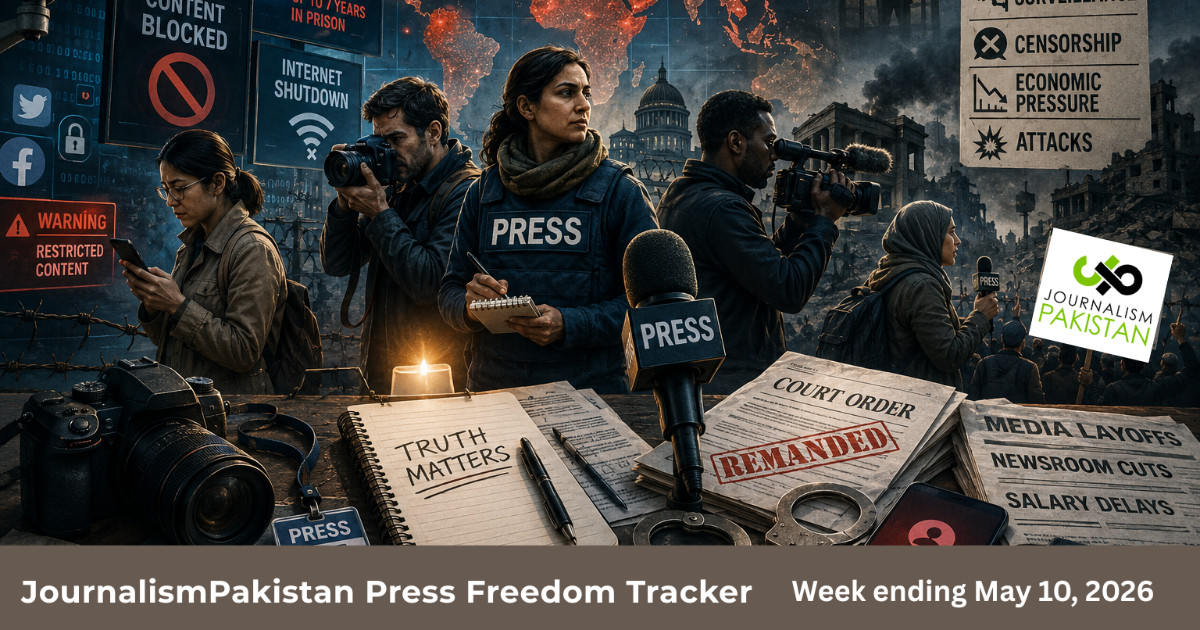
This week’s Press Freedom Tracker reflects a widening convergence of pressures on journalism worldwide, where legal action, economic strain, and direct violence are increasingly intersecting. From detentions and killings to newsroom raids and financial constraints, the developments underscore how both overt and subtle mechanisms are being used to shape, restrict, or challenge independent reporting. The entries below document verified incidents and trends affecting journalists, media organizations, and press freedom across multiple regions, offering a snapshot of the current global media climate.
Arrests and detentions
KUWAIT — Journalist Ahmed Shihab-Eldin has been released after nearly two months in detention over social media posts related to coverage of the regional conflict. (Reuters, April 25, 2026)
TUNISIA — Journalist Zied el-Heni has been placed in pretrial detention under telecommunications law following a social media post criticizing a judicial decision; his trial was scheduled for April 30. (Committee to Protect Journalists, April 28, 2026)
BELARUS — Journalist Andrzej Poczobut has been released in a U.S.-brokered prisoner swap involving seven countries, ending his detention since 2021 on charges widely condemned by rights groups as politically motivated. (International media reports, April 28, 2026)
Legal and regulatory pressure
PAKISTAN — A report by Freedom Network says expanded use of the amended PECA law has increased legal cases against journalists, intensified self-censorship, and contributed to a broader contraction of press freedom amid regulatory and economic pressures. (Freedom Network report, April 29, 2026)
PAKISTAN — The Counter-Terrorism Department has arrested YouTuber Muhammad Saad bin Riaz under anti-terror laws; his family disputes the circumstances of the arrest and alleges inconsistencies in official claims. (BBC Urdu, May 2026)
Attacks, threats, harassment, and killings
PHILIPPINES — Community journalist RJ Nichole Ledesma was killed during a Philippine Army anti-insurgency operation in Negros Occidental, with press groups calling for an independent investigation and accountability. (Committee to Protect Journalists, April 30, 2026)
Censorship and digital restrictions
ZAMBIA — The government has canceled RightsCon 2026 days before its opening, halting a major international forum on digital rights and limiting space for discussion on freedom of expression and online governance. (Tech Policy Press; Index on Censorship, April 2026)
Policy and court developments
PAKISTAN — Journalist Fakhar ur Rehman has been granted post-arrest bail after being detained by the NCCIA in a PECA case over the alleged dissemination of “false and misleading information” on social media. (Dawn, April 27, 2026)
Media labor and union activity
PAKISTAN — Journalist Matiullah Jan has exited Neo News following controversy over remarks on media freedom made to foreign journalists, raising concerns about potential professional repercussions amid heightened scrutiny. (JournalismPakistan, April 28, 2026)
UNITED STATES — Journalists at McClatchy have withheld bylines in protest against AI tools repurposing their reporting, citing concerns over attribution, accuracy, and labor rights. (Columbia Journalism Review, April 2026)
Media operations and industry pressures
MALDIVES — Police have raided the newsroom of independent outlet Adhadhu in Malé, seizing electronic equipment and imposing travel bans on its CEO and managing editor following reporting linked to allegations against President Mohamed Muizzu. (Committee to Protect Journalists, April 28, 2026)
PAKISTAN — Hameed Haroon, CEO of Dawn Media, says the country’s media is facing growing indirect economic and institutional pressure, including advertising restrictions and financial strain on independent outlets. (Dawn, April 30, 2026)
PAKISTAN — Media unions have warned that the suspension of government advertisements to Dawn is causing financial hardship for employees and threatening newsroom stability, urging immediate restoration. (APNEC statement, April 30, 2026)
INDIA — NDTV has reported its tenth consecutive quarterly loss, as rising costs and sustained financial pressure continue to challenge operations amid broader industry headwinds. (NDTV earnings statement, April 2026)
UNITED STATES — The Associated Press Guild says 40 union-covered newsroom employees who accepted buyouts have departed, while management has indicated additional layoffs may follow, though timing remains unclear. (Associated Press Guild, X post, May 1, 2026)
UNITED KINGDOM — BBC plans up to 2,000 job cuts, with the news division facing deeper reductions than other departments as part of a £600 million savings strategy. (Reuters, May 2, 2026)
Press freedom and journalist safety
GLOBAL — Reporters Without Borders’ 2026 World Press Freedom Index finds global press conditions at a 25-year low, with more than half of countries ranked in “difficult” or “very serious” categories amid worsening legal, political, and security pressures. (RSF, April 30, 2026)
ASIA-PACIFIC — More than half of the countries in the region are rated “difficult” or “very serious” for press freedom, with governments increasingly using cybersecurity, national security, and defamation laws to restrict journalism and shape media narratives. (RSF, April 30, 2026)
Global context
The latest developments align with broader global findings, particularly those highlighted in the 2026 World Press Freedom Index, which points to a sustained decline in media freedom driven by a combination of legal pressure, economic vulnerability, and security risks. Notably, economic constraints, such as advertising restrictions, layoffs, and financial losses, are emerging as a powerful indirect tool influencing editorial independence, alongside more visible actions like arrests, raids, and censorship. The convergence of these pressures suggests a shifting landscape in which both state and market forces are redefining the operating space for journalism worldwide.
For additional context, readers can review last week’s Tracker.
(The Press Freedom Tracker is produced by JournalismPakistan, which monitors, verifies, and synthesizes developments from credible international media outlets, press freedom organizations, and official sources. Where applicable, JournalismPakistan's original reporting is incorporated alongside external sources. The Tracker serves as a clear, accurate, and accountable record of developments affecting journalists and media freedom worldwide.)
Key Points
- Global trend of converging pressures: legal, economic and violent actions against media.
- Verified incidents include arrests, detentions, raids and killings across regions.
- Newsroom raids and widespread layoffs reflect increasing economic strain on journalism.
- In Pakistan, expanded use of the amended PECA has increased legal actions and self-censorship.
- These developments constrain independent reporting and heighten risks for journalists.
Key Questions & Answers
What does the Press Freedom Tracker show?
It records verified incidents and trends harming media worldwide, including arrests, raids, killings, legal cases and layoffs that together pressure independent journalism.
Which types of pressures are converging on journalists?
Legal and regulatory actions, economic constraints such as layoffs, and direct violence or raids are increasingly intersecting to limit reporting.
What is the situation in Pakistan?
Reports indicate expanded use of the amended PECA law has led to more legal cases against journalists and heightened self-censorship.
How do these trends affect newsrooms?
They reduce editorial independence, prompt self-censorship, weaken financial viability, and increase safety risks for reporters and editors.
Relevant Topics
Ask AI: Understand this story your way
AI EnabledDig deeper, ask anything — get instant context, background, and clarity.
Disclaimer: This feature is powered by AI and is intended to help readers explore and understand news stories more easily. While we strive for accuracy, AI-generated responses may occasionally be incomplete or reflect limitations in the underlying model. This feature does not represent the editorial views of JournalismPakistan. For our full, verified reporting, please refer to the original article.