.jpg)
Messi's farewell, Yamal's rise: Spain conquer Argentina in World Cup final
JournalismPakistan.com | Published: 20 July 2026 | Dr. Nauman Niaz (TI)
Join our WhatsApp channel
Spain beat Argentina in a dramatic World Cup final as Ferran Torres' extra-time volley secured victory, ending a contest defined by Emiliano Martinez's saves and Lionel Messi's farewell. Young Yamal emerged as a notable presence in the match.Summary
There are goals that arrive like storms, announced from a distance, gathering as they come; and there are goals that arrive like revelation, out of still air, unheralded and entire. Ferran Torres scored the second kind, and in scoring it he closed a final, a tournament, and an argument that had run for the better part of two decades.
Thirty-seven seconds into the second period of extra time at the vast grey bowl in East Rutherford, in the one hundred and sixth minute of a final that had begun to feel as though it might outlast the American summer, a ball dropped once inside the Argentine penalty area and sat up, briefly, insolently, as dropping balls sometimes do. It had no right to become anything.
A hundred and five minutes of this match had instructed the eighty thousand present that chances perished here, that they were caught and clawed and smothered by Emiliano Martinez, who had converted his six-yard box into a chancel where hope went to be heard, absolved, and dismissed.
Torres declined to let the ball bounce again. What followed occupied perhaps four-tenths of a second and contained within it everything the biomechanist could wish to teach. The eyes never left the drop of the ball, for the volley punishes the glance towards goal more cruelly than any stroke in the game. The plant foot arrived beside the ball rather than behind it, the knee flexing to absorb the load and hold the trunk steady over the strike. The kicking leg drew back short, since the great volleyers know that a long backlift is vanity, that force is made not in the sweep but in the snap. The ankle locked rigid at the instant of contact, plantar-flexed into a single unyielding surface, so that nothing would be squandered in the shudder of a loose joint; the hips opened and closed like a gate in a gale; the trunk rotated over the standing leg; and the entire kinetic chain, from the studs biting the turf to the follow-through of the instep, delivered its verdict through the centre of the ball, a fraction beneath its midline, enough to lift it and not an inch more. The shot rose under the crossbar, past the late, despairing hand of a goalkeeper who had spent the afternoon redrawing what a goalkeeper in a World Cup final might be, and into the net, and into the permanent past tense.
Torres had entered in the sixty-second minute carrying the oldest of a substitute's burdens, the obligation to alter what those who started could not. Afterwards, still trembling with the size of the thing, he offered the sentence that Spain will keep for as long as the game is played there. It was, he said, a goal scored by forty-seven million people. For once a footballer's hyperbole was nothing more than an honest census of the heart.
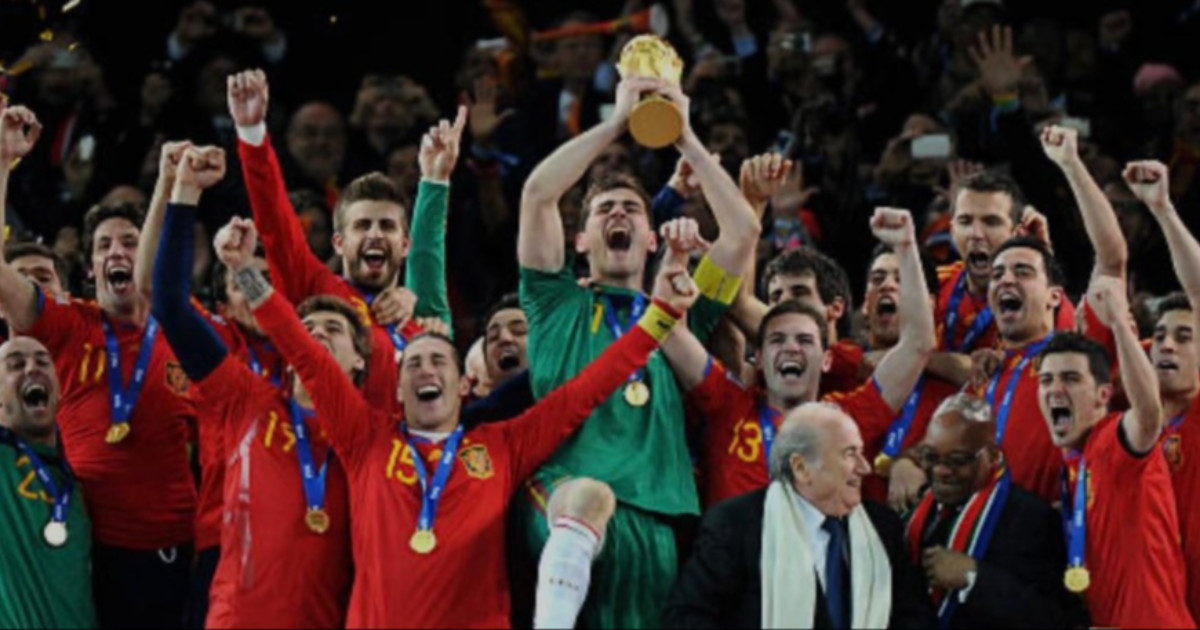
Spain 1, Argentina 0, after extra time, on the nineteenth of July in East Rutherford, New Jersey. A second star above the crest, sixteen years after the first; and stretched around that solitary goal, like skin around a heartbeat, a whole tournament's worth of conviction.
From early doubts to tournament favorites
Every triumph worth the telling begins somewhere unglamorous, and Spain's began in embarrassment. Atlanta, the fifteenth of June, the opening fixture of their campaign, and across the halfway line stood Cape Verde, islands of half a million souls, debutants at a World Cup, cast by the world as the soft opening chord of a Spanish symphony. They became instead its first dissonance. Spain attempted twenty-seven shots that afternoon and scored from none of them. Seven found the target, and all seven were repelled by Vozinha, a goalkeeper of forty years playing the match of several lifetimes: denying Oyarzabal, denying Laporte, denying Torres, whose best effort returned off the crossbar as though the day itself had ruled against him. Nil-nil. The islands celebrated the finest result in their history. In Madrid the inquests had convened before the players reached the dressing room. How, the country demanded, does the champion of Europe fail to score against a newcomer?
It is among football's older ironies that the question asked in anger so often proves, months later, to have been the wrong question altogether. The right question, unasked that evening in Georgia, was this: how does a team attempt twenty-seven shots, monopolise the ball, concede almost nothing at the other end, and remain wholly unshaken in what it believes? For that, and not the missing goal, was the true text of the Cape Verde match. Spain did not panic. Spain tore nothing up. Luis de la Fuente studied a goalless draw and perceived a machine wanting nothing but the smallest turn of a screw. The tournament would prove him right in the most emphatic language the sport possesses.
De la Fuente's evolution of Spanish football
To understand what Spain accomplished across these five weeks in North America, one must first understand what they declined to do. They declined nostalgia. It would have been easy, and forgivable, to spend this World Cup as a tribute act to 2010, to the sainted generation of Xavi and Iniesta, passing for passing's sake, keeping the ball as an act of remembrance. De la Fuente's Spain descend from that side the way a son descends from a father: recognisably, and with corrections. The possession endures, oceanic and patient. What has altered is its temper. This Spain keeps the ball not as ornament but as territory; and not only as territory but as anaesthetic, a means of putting an opponent's ambition quietly to sleep, and then, when the sleep is deepest, striking with a directness the old team sometimes disdained.
A midfield built on control and precision
The structure rewards close reading. On the team sheet it was a 4-3-3; in possession it was something far stranger and far cleverer. Cucurella tucked inward from the left to stand almost as a third central defender, insurance against the counter, while Porro climbed the right touchline like a winger on loan, and the shape dissolved into a 3-2-5 whose front five occupied every corridor of the pitch at once, pinning the opposing back four on the horns of an insoluble dilemma: step out and open the half-space, or stay and surrender the edge of the box to Olmo and Merino, who drifted between the lines like men who had been given keys to rooms the opposition did not know existed.
At the base of it all stood Rodri, and to watch him closely was to receive a tutorial in the unglamorous mechanics of control. In the seconds before every reception the head turned over each shoulder, six times, eight times, a scanning habit as grooved as a batsman's backlift, so that the picture was taken before the ball arrived and the decision made before the picture faded. He received on the back foot, body opened at an angle that let him see both penalty areas at once, the first touch cushioned away from pressure with the sole or the inside of the boot depending on where the nearest shirt was closing from. No player in the competition passed the ball more often; his eight hundred and three passes were less a statistic than a pulse, the steady beat to which everything in red moved. Around him Zubimendi and Fabian Ruiz took turns as the second heartbeat, and wide of them all flashed the two blades: Lamine Yamal on the right, eighteen years old and carrying a nation's imagination as lightly as a schoolbag, and Nico Williams on the left, all fast-twitch menace and mischief.
Yamal's game, examined coldly, is a small treatise on the physics of deception. The centre of mass rides low; the strides shorten as he approaches his man, ground contacts becoming brief and frequent, which is what allows the sudden brake and the sudden burst; the hips sway one way with such conviction that the defender's weight is committed before the ball has moved at all, and by the time the man has recovered his balance the ball has gone the other way, wrapped in the left instep, bending towards the far post or laid inside to the arriving runner. Defenders came at him in pairs and departed in confusion, for the mathematics of marking him never balanced: commit two and Porro overlapped into the vacancy; commit one and the one was lost.
The passing, though, is the thing to dwell upon, because in this Spain the pass is not a technique but a temperament. Watch them for ten minutes and you see it: the ball moved with affection, received with gratitude, given again without regret. Four thousand passes and more across the tournament, each one a small renewal of a promise between countrymen, each one saying the same thing: we do this together or we do not do it at all. Other teams pass to progress. Spain pass to persuade, to wear an opponent's certainty down to sand, and the whole five weeks became one long demonstration that patience, properly armed, is the most aggressive quality in football.
Luis de la Fuente never played a minute of senior international football and never managed a superclub; his life's work was done in the nurseries, the under-19s and under-21s of the federation, where he coached almost every member of this squad before they were famous, where he learned their games the way a schoolmaster learns handwriting. When he was handed the senior side, the appointment was greeted with a shrug. The shrug has not aged well. A European Championship in 2024, a national unbeaten run stretching past thirty matches, a qualifying campaign of twenty-one goals scored and two allowed, and now this. He built the house room by room, over years, in places nobody was watching, and in New Jersey he finally opened the front door.
The defense that conquered the world
And yet. Speak to any of them, from the manager down, and they will tell you that this World Cup was won at the other end, in the quieter country of their own penalty area. The number will be recited in Spanish schoolrooms for a generation: one. One goal conceded across the entire tournament, eight matches, seven clean sheets, from the opening afternoon in Atlanta to the last embrace in New Jersey. Entire footballing civilisations, France with Mbappe and Dembele and Olise and Doue among them, came at this defence and left with nothing, the French restricted in the semi-final to a third of an expected goal from ten attempts, which is the statistician's way of saying they were never truly there at all.
The architecture fascinated precisely because it did not look like an architecture of denial. Pau Cubarsi, nineteen and serene, defended the way librarians keep order, chiefly by anticipation, rarely by force: the body forever half-turned, shoulders open to ball and man alike, the position taken up two seconds early so that the interception replaced the tackle and the tackle was seldom required. Beside him Aymeric Laporte supplied the old wisdom, the reading of danger two passes before it declared itself. Marc Cucurella on the left played each match like a personal grievance, and Pedro Porro on the right contrived to attack like a winger while missing nothing behind him. Behind them all stood Unai Simon, whose craft repaid the slow-motion camera: the feet settling into their set position a heartbeat before every strike, weight forward on the balls of the feet, the small pre-dive hop timed so that the calves loaded and released their stored spring sideways at the very instant the ball left the boot. By the end of the group stage he had gone five hundred and nineteen World Cup minutes without conceding, past the record Walter Zenga had held since the Italian summer of 1990, and he wore the achievement the way he wears everything, as though it were somebody else's business.
But the deepest truth of Spain's defending is that it began sixty yards from Simon's goal. The press was the first wall, and it was a wall built of angles: the forwards approached on curved runs that closed the passing lane before they closed the man, each pursuer keeping an opponent locked in his cover shadow, so that the ball's escape routes were shut one by one like doors along a corridor, and when possession was lost the counter-press fell within five seconds, the nearest three shirts collapsing on the ball before the opponent could lift his head. The ball itself was the second wall. You cannot score against Spain while Spain have the ball, and Spain almost always had the ball. Belgium alone found the single breach, one goal in a quarter-final, and even that felt less like a crack in the structure than a courtesy extended once and never repeated. Great defences are usually described in the vocabulary of iron and stone. This one deserves gentler words. It was a defence made of understanding.
The road through the knockout stage
After Atlanta came the correction. Saudi Arabia were beaten four-nil, and the match gave the tournament its first true glimpse of the future: Yamal, on his first World Cup start, scoring within ten minutes, at eighteen years and three hundred and forty-three days the second-youngest scorer Spain have ever had at a finals. Oyarzabal helped himself to two before the half-hour, an own goal completed the account, and the inquests of the previous week were quietly withdrawn. Uruguay were then dispatched one-nil in Guadalajara, Alex Baena's strike just before the interval settling a scuffling, unlovely contest, and Spain topped their group without having conceded and without, it must be said, having yet fully persuaded.
A word here about the boy, because no honest account of this summer can move past him quickly. Yamal played the World Cup at eighteen the way most men play their garden at eight, with delight, with cheek, with the sense that nothing bad could possibly come of any of it. And wherever he went a smaller shadow followed: his three-year-old brother Keyne, whose antics beside the pitch travelled around the world faster than most of the tournament's goals, so that by July an entire country was being represented, in effect, by two children. There was something apt in that. This Spain is a young nation's team, and its youngest citizen played all summer as though the World Cup were the most natural place on earth for him to be. Perhaps, for the next decade, it will be.
The knockouts changed the register. Austria, in the round of thirty-two, were taken apart with a fluency that announced Spain's first World Cup knockout victory since the day they lifted the trophy in 2010. Twice Cucurella whipped the outswinger with the inside of the left boot, struck across the ball so that it bent away from the goalkeeper and died in the corridor of uncertainty, and twice Oyarzabal attacked it, the leap taken off the far foot, the hang at the top of the jump, the neck snapping through the header at the moment gravity paused; Porro rose for his first international goal, and the whole performance carried the ease of a side that had located its highest gear. Then Portugal, the neighbour, the rival, the tie the whole continent circled, and a match as tight as family. It took until injury time for the difference to arrive, and it arrived through Mikel Merino, one-nil, the kind of victory from which titles are secretly built.
Belgium in the quarter-final gave Spain their one genuine evening of jeopardy, scoring the tournament's only goal against them and asking, for an hour, the question every champion must eventually answer: what are you when the plan wobbles? The answer, again, was Merino, off the bench this time, striking the winner in a two-one victory and confirming himself the tournament's most reliable dealer in decisive moments. And then Dallas, the fourteenth of July, and France, the bookmakers' darlings, the most gifted attacking roster in the competition. Spain made them look ordinary. Lucas Digne's foul on Yamal brought the penalty that Oyarzabal despatched without ceremony; Porro exchanged passes with Olmo and finished the second just before the hour; and at the other end the French forwards, all that speed and all that fame, were reduced to ten harmless attempts. Two-nil, and it flattered France.
The final against Argentina
So to July 19th, and East Rutherford, and Argentina. The holders, seeking to become the first back-to-back champions in more than sixty years, with Lionel Messi, thirty-nine now, playing what carried the unmistakable air of his last World Cup match, chasing one more impossibility in a career assembled from them. Before kick-off Coldplay performed the first halftime show ever staged at a World Cup final, Chris Martin's note fluttering on eighty thousand flags, and the whole occasion wore that particular American bigness, the sense of sport as festival. Then the football began, and the festival narrowed to a single consuming question: could anybody, ever, get the ball past Emiliano Martinez?
Spain monopolised the match from its first minute to its last, twenty shots to Argentina's three, an expected-goals reading of nearly two against a fifth of one, and for most of the afternoon none of it mattered, because Martinez was staging one of the great goalkeeping performances in the history of the fixture. Oyarzabal's thirty-eighth-minute drive drew the first roar; Cucurella turned and shot from distance and missed the far post by a coat of paint; and save followed save followed save, the Argentine reading trajectories off the shape of the striking foot, launching himself from a set position so deep in his heels-to-toes rhythm that each dive seemed to begin before the shot did, until he had made twelve of them, more than any goalkeeper in any World Cup final before him. He was, on the day, both his team's entire resistance and very nearly its salvation.
The texture of that first hour deserves recording, because finals are so rarely what their scorelines suggest. This was not siege from the opening whistle; it was a slow tightening. For half an hour the two sides knocked the ball back and forth in that wary, sniffing manner of teams who know exactly how much the other can hurt them, Argentina compact and coiled, waiting for the one transition that would bring Messi to life, Spain probing at the edges of the block like water seeking the low ground. Then, gradually, the water rose. By the hour mark, Argentina had ceased attacking in any recognisable sense; their possession became a form of rest, their clearances a form of prayer. The crowd, which had come for a duel between Yamal and Messi, between the game's dawn and its dusk, found itself watching something else entirely: a study in whether one man's hands could hold back a nation's tide.
The hinge came in second-half stoppage time. Enzo Fernandez, already booked, went through Cubarsi with a recklessness that sent the young defender cartwheeling, and the second yellow was out of the referee's pocket before Cubarsi had landed. Ten men, and Argentina, who had not managed a shot in ninety minutes, withdrew into pure endurance, defending the road to penalties as though it were the last road on earth. Extra time brought Spain's cruellest moment, Nico Williams lashing the ball into the net only for the goal to be erased for Merino's foul on Otamendi in the build-up, and the stadium began to believe in the shootout. Then came the restart of the second period, and the bounce, and Torres, and the release of five weeks of held breath. Even afterwards Martinez would not surrender, flinging himself full stretch to turn away Yamal's curling free kick from twenty-two yards, rising to punch the air and demand more noise from his people. But the whistle came, and with it the ending that the balance of the game, and of the month, had long since written.
The symmetries are almost too kind. In Johannesburg in 2010, Spain won their first World Cup one-nil, in extra time, the goal scored deep in the additional period by a player the nation adored. In New Jersey in 2026 they won their second by the same score, in the same added hour, and the champions of Europe became champions of the world again, sixteen summers on, having scored eleven and conceded once. De la Fuente, a man who spent decades in the unphotographed rooms of Spanish football raising other people's sons into internationals, spoke afterwards of his pride in a generation that had grown up inside an idea and stayed loyal to it. That word, loyal, is the one to keep. Tactics won Spain matches; loyalty won them the tournament. Loyalty to the pass when the hurried ball was easier, to the press when tired legs argued otherwise, to the belief, tested in Atlanta and vindicated in East Rutherford, that if you defend with understanding and attack with patience the game will eventually, inevitably, open its hand to you.
Messi's farewell, Yamal's arrival
And what of Messi? He walked the pitch afterwards in the manner of a man taking a final look around a house he has lived in all his life, touching nothing, missing nothing. There was no second consecutive crown, and no overtaking of Kylian Mbappe at the head of the scoring lists; those small mercies the tournament withheld. But there was, from every corner of the ground, including the Spanish corners, the long warm applause the game reserves for those who have given it more than it can ever repay.
It was then that the tournament produced the image by which it will be remembered longer than the goal itself. Through the confetti and the delirium, Lamine Yamal detached himself from the celebrating reds and crossed the pitch alone. He was three years old when Messi was already the finest player alive; he has said, often, that he learned the game by watching him the way other children watch cartoons. Now, at nineteen, newly a champion of the world, he came to the thirty-nine-year-old standing quietly amid the wreckage of his last great chase, and the two of them, the game's dawn and the game's dusk, held each other for a long moment while eighty thousand people forgot which side they had come to support. Messi cupped the back of the boy's head and said something no microphone caught and no lip-reader has honestly claimed; Yamal, who had played all month with the cheek of a child in his own garden, bowed his head like a pupil. It was not a torch being taken. It was a torch being handed, gently, by a man who knew exactly what it weighs, to a boy who does not yet, and who will learn, and who looked in that moment entirely willing to carry it.
Then Messi turned and walked towards the tunnel, growing smaller with every step, fading from the World Cup as light fades from a summer evening, gradually, gracefully, and then all at once; and Yamal turned back towards the noise, towards the medals, towards the decade that now belongs to him.
The future embraces the past
The game opened its hand in the one hundred and sixth minute, to a substitute's left foot, under a crossbar in New Jersey. Forty-seven million people scored. The rest of us were lucky enough to watch, and luckier still to see the future embrace the past before either of them let go.
ABOUT THE WRITER: Dr. Nauman Niaz, a Post Doctorate (Oxford), PhD (UWA), FRCP (London), FRCP (Edinburgh), FRCP (Ireland), FRCP (Glasgow), CST (Endo, UK), MSc Biomechanics & Kinesiology (UWA), MRCP (UK), MBBS (Pb) is a civil award winner (Tamagha-i-Imtiaz) in Sports Broadcasting & Journalism, a regular cricket correspondent having covered 54 tours and three ICC World Cups, having written over 3700 articles. He has authored 19 books and is the official historian of Pakistan Cricket (Fluctuating Fortunes IV Volumes - 2005). His signature show Game On Hai has been the highest in ratings and acclaim. He is also the sports editor at JournalismPakistan.
Key Points
- Ferran Torres scored the decisive extra-time volley to give Spain the win.
- Emiliano Martínez produced multiple key saves that kept Argentina in the game.
- The final carried significance as Lionel Messi's emotional farewell on the world stage.
- Young player Yamal emerged as a notable talent during the match.
- The game was played in East Rutherford before a large, passionate crowd.
Key Questions & Answers
Who scored the winning goal?
Ferran Torres scored the extra-time volley that sealed Spain's victory.
What role did Emiliano Martínez play?
Martínez made several important saves that kept Argentina competitive throughout the match.
Was this match significant for Lionel Messi?
Yes, the final was framed as an emotional farewell for Messi on the world stage.
Which young player stood out in the final?
Yamal emerged as a notable young talent during the match.
Ask AI: Understand this story your way
AI EnabledDig deeper, ask anything — get instant context, background, and clarity.
Disclaimer: This feature is powered by AI and is intended to help readers explore and understand news stories more easily. While we strive for accuracy, AI-generated responses may occasionally be incomplete or reflect limitations in the underlying model. This feature does not represent the editorial views of JournalismPakistan. For our full, verified reporting, please refer to the original article.