
Spain at the FIFA World Cup: The complete history of La Roja's rise to glory
JournalismPakistan.com | Published: 1 July 2026 | Dr. Nauman Niaz (TI)
Join our WhatsApp channel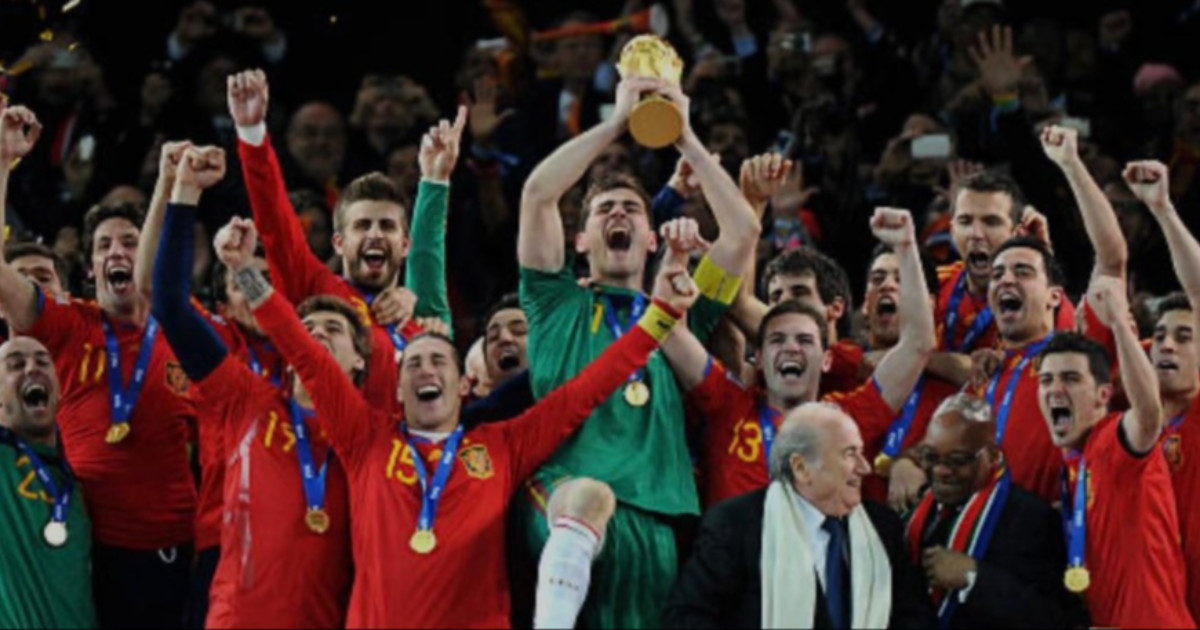
This article traces Spain's World Cup journey from early appearances marked by disappointment to the tactical shifts that culminated in their 2010 victory in Johannesburg. It examines key eras, playing philosophies and the players who defined La Roja.Summary
Some nations arrive at the World Cup, and there are nations that, for the longest while, only attended it. Spain, for the better part of three-quarters of a century, belonged maddeningly to the latter category, a footballing aristocracy in everything but the one accounting that mattered. To follow the Spanish at the great tournament was to follow a beautiful argument that kept losing on points, an orchestra forever tuning and never quite playing the symphony.
And then, on a Johannesburg night in July of 2010, the argument was settled, and the orchestra played, and a country that had waited since its first appearance in 1934 understood at last what it had always suspected: that it was, and had been, among the finest exponents the game has known.
This is the history of that long romance. It is a story of furia and finesse, of the red shirt that gave the side its enduring sobriquet, of generations of gifted men who carried the burden of expectation across continents, and of the singular philosophy that finally transmuted possession into prize.
To understand Spain at the World Cup, one must understand a paradox: that a nation never short of genius spent decades convincing the world, and itself, that genius alone is insufficient.
The birth of Spanish football
Football came to Spain through the harbours and the mines, carried by British engineers and sailors who set down the game along the Andalusian coast and in the industrial north before the close of the nineteenth century. Recreativo de Huelva, founded in 1889, lays claim to seniority among Spanish clubs, and from such seeds grew an institution that would become one of the most luxuriant in the European game.
The Royal Spanish Football Federation was constituted in 1913, and the national side took the field for the first time at the Antwerp Olympics of 1920, where it claimed silver and, more lastingly, acquired its nickname. A Belgian journalist, struck by the ferocity of the Spanish play, described it as La Furia Roja — the Red Fury — and the phrase stuck to the shirt like a brand.
World Cup debut and early heartbreak
When FIFA inaugurated its world championship in 1930, Spain stayed at home, as did most of Europe, deterred by the long passage to Uruguay. The Spanish debut came instead in 1934, in Mussolini's Italy, and it announced both the talent and the heartbreak that would characterize the country's relationship with the tournament for generations.
In Florence, Spain met the hosts in a quarterfinal of brutal attrition. The first match ended level at one apiece after extra time, a contest so violent that the legendary goalkeeper Ricardo Zamora, the elegant custodian whose name still adorns the trophy for Spain's best goalkeeper, was battered out of the replay.
Spain lost the second meeting by a single goal and went home, undone less by superior football than by the bruising arithmetic of a tournament that did not yet protect its artists.
Ricardo Zamora and Spain's first footballing icon
The figure of Zamora deserves a moment of its own, for he was the first of the Spanish immortals and set a template the nation would honour ever after. El Divino — the Divine One — he was called, a goalkeeper of such elegance and authority that he became the first genuine celebrity of Spanish football, his name later lent to the trophy awarded each season to the league's finest custodian.
That Spain's earliest icon should be a goalkeeper, a man defined by composure under siege, is itself suggestive of a footballing temperament that prized poise and intelligence over mere force. The thread runs unbroken from Zamora through Casillas and onward, a lineage of Spanish goalkeeping artistry as distinctive as the midfield tradition that would later eclipse it in fame.
Years of frustration after a promise
Then came the Civil War, and the long Franco years, and Spanish football turned inward upon its clubs while the national side wandered in a wilderness of underachievement.
The 1950 World Cup in Brazil offered the brightest of these early flickers: Spain reached the final pool, the four-team group that then decided the championship, and finished fourth, defeating England along the way. It would remain, astonishingly, the high-water mark of Spanish endeavour for sixty years.
What followed was one of sport's great riddles. Here was a country whose clubs bestrode Europe, whose league drew the finest talent of the age, whose Real Madrid won five consecutive European Cups in the 1950s with Di Stéfano, Puskás and Gento.
Yet the national side, drawing upon this same abundance, could not translate domestic magnificence into international consequence. They arrived at tournament after tournament garlanded as contenders and departed, with grim regularity, having flattered to deceive.
Quarterfinal curse and tournament disappointments
There were quarterfinals, four of them across the decades, each a polished door that would not open. There was the humiliation of 1982, when Spain hosted the World Cup and exited meekly in the second group phase, the home crowd's expectation curdling into disenchantment.
There was the cruelty of 1986 in Mexico, when Emilio Butragueño, the Vulture, scored four against Denmark in a glorious round-of-16 evening, only for Spain to fall to Belgium on penalties in the next round.
There was 1994 in the United States, perhaps the bitterest of all, when Mauro Tassotti's unpunished elbow bloodied Luis Enrique's face in the dying minutes against Italy, and Spain went out clutching a grievance rather than a result.
And there was 2002, the year of the wound that would not heal, when a Spanish side of genuine quality was eliminated by co-hosts South Korea in a quarterfinal remembered chiefly for the officiating, two Spanish goals disallowed in contentious circumstances before the inevitable penalty defeat.
The Spanish carried this catalogue of misfortune like an inherited illness. They were the eternal bridesmaid, the perennial dark horse, a phrase that became almost a taunt. The talent was never in question. What was missing was something less tangible: a conviction, a method, a way of being that would convert their evident gifts into the only currency the World Cup recognizes.
Rivalries that divided a nation
Part of the riddle lay in the very surfeit of riches that Spanish football enjoyed. The two great clubs, Real Madrid and Barcelona, divided the country's loyalties and, often, its dressing room, and the rivalry that lent the domestic game its electric charge sometimes carried into the national side a fault line of suspicion and competing allegiance.
A player schooled in the Madrid way and one reared in the Catalan idiom did not always speak the same footballing language, and the side could appear, in its lesser moments, less a unified team than an uneasy confederation of brilliant individuals.
The genius of the golden generation was partly that it dissolved this old division, drawing so heavily upon a single Barcelona core, and an understanding between its principal figures so complete, that the historic fissure was, for a time, simply rendered irrelevant by the weight of shared method.
The philosophy that transformed Spain
The transformation, when it came, was not a matter of acquiring better players, for Spain had rarely lacked them. It was a matter of acquiring a creed. Its roots lay at Barcelona, in the legacy of Johan Cruyff and the Dutch idea of Total Football, refined and Hispanicized through the club's academy at La Masia and brought to its apotheosis under Pep Guardiola.
The Spanish national side, drawing heavily upon Barcelona's spine, made this philosophy its own. The world would come to call it tiki-taka, a phrase coined in commentary to describe the hypnotic, staccato rhythm of short passing, though the men who played it often disdained the term as a caricature of something deeper.
What it amounted to was a radical proposition: that possession of the ball is itself a form of defense, that a team which never surrenders the ball can never be hurt by it. Spain would pass, and pass, and pass again, drawing opponents out of shape, probing for the half-yard of space that a Xavi or an Iniesta required to thread the decisive needle. It was football as patience, as attrition by caress rather than by force, a deliberate inversion of the old furia. Where Spain had once been admired for its passion, it would now be feared for its serenity.
The ball moved in triangles and rondos, the players rotating in fluid interchange, and the opposition, deprived of the ball for long stretches, was reduced to chasing shadows until concentration cracked and the single goal that Spain so often needed arrived.
It was not, to every taste, beautiful. Critics found it soporific, a slow strangulation rather than a flourish, and there were matches Spain won by a solitary goal having barely troubled the net. But it was devastatingly effective, and it was unmistakably theirs.
No side had ever imposed such a comprehensive monopoly of the ball upon the international game. Between 2008 and 2012 Spain achieved what no nation had managed before or has managed since: it won a European Championship, a World Cup, and a second European Championship in unbroken succession, a triple crown of such completeness that it redefined the limits of international dominance.
The road to South Africa
The 2010 World Cup in South Africa was the trial. Vicente del Bosque, a manager of monastic calm whose unflappability mirrored his team's philosophy, led a side at the height of its powers. Yet even this began in the manner of old Spain, with defeat: the opening match was lost, improbably, to Switzerland, and the familiar dread stirred.
What distinguished this Spain from all its predecessors was the response.
It did not panic. It did not abandon its method. It simply continued to play, and the method, given faith, delivered.
Spain won every subsequent match by a single goal: 1-0 against Honduras, Chile, Portugal, Paraguay, and then Germany in a semifinal of supreme control settled by a Carles Puyol header.
It was a tournament won not by avalanche but by precision, the same scoreline repeated like a signature.
The night Spain conquered the world
And then the final, in Soccer City before a global audience, against a Netherlands side that chose to meet Spanish artistry with cynicism and the boot. The match was ill-tempered and tense, goalless through 90 minutes and deep into extra time, until, with four minutes remaining before the lottery of penalties, Cesc Fàbregas found Andrés Iniesta arriving in the Dutch box, and Iniesta, with the composure that defined his generation, swept the ball home.
It was the goal that ended 76 years of waiting, the goal that turned the eternal bridesmaid into the bride.
Iniesta wheeled away and revealed a vest bearing a tribute to Dani Jarque, a friend and fellow professional who had died young, and in that gesture the moment acquired a tenderness beyond triumph.
Spain were the champions of the world.
The argument, at long last, was settled.
The architects of greatness
No account of Spain's World Cup story is complete without its men, the artists who gave the philosophy its flesh.
In goal there was Iker Casillas, San Iker, the captain who lifted the trophy in 2010 and whose reflexes in the final, a sprawling save from Arjen Robben, preserved the dream long enough for Iniesta to fulfil it. Casillas remains, with Sergio Ramos, among the most capped Spaniards at the World Cup, a presence across four tournaments and the very image of Spanish goalkeeping nobility in the line of Zamora.
In midfield reigned the twin geniuses of the age, Xavi Hernández and Andrés Iniesta, two men of modest stature who between them reimagined how the game might be played. Xavi was the metronome, the conductor who saw the angles before they opened and who once seemed to have completed more passes than the rest of the field combined. Iniesta was the illusionist, gliding through congestion as though the laws of physics had granted him a private exemption, the scorer of the only goal that has ever truly mattered to Spanish football.
Behind them, anchoring the whole edifice, stood Sergio Busquets, the most underappreciated of great players, whose positional intelligence was so complete that he seemed to be in two places at once and was sometimes accused of being in neither.
In attack, there was David Villa, El Guaje, who remains Spain's leading scorer in World Cup history with nine goals, a finisher of cold precision who supplied the cutting edge that a possession side perpetually risks lacking.
There was Fernando Torres, El Niño, whose pace and poise in his pomp made him among the most feared forwards in Europe. And marshalling the defense was Sergio Ramos, ferocious and theatrical, the embodiment of the old furia harnessed at last to the new method, a man who would feature across four World Cups and accumulate a record number of international caps.
Around them orbited a constellation of others—Carles Puyol, Gerard Piqué, Xabi Alonso, Cesc Fàbregas, David Silva—each a master in his own right, a depth of quality that made the side less a team than a movement.
The fall from the summit
Empires of the spirit do not last, and Spain's did not. The defense of the crown in Brazil in 2014 was a calamity, an aging side dismantled 5-1 by the Netherlands in a match of almost vengeful symbolism, and was eliminated at the group stage.
The philosophy that had conquered the world had, in the way of all orthodoxies, been studied, decoded and answered. The world had learned to sit deep and to strike on the break, and Spain, slower now and shorn of its peak practitioners, found that possession without penetration is merely a handsome way of going nowhere.
Searching for a second golden generation
The years that followed were a search for a second act. There was a round-of-16 exit in 2018, undone by a resilient host Russia on penalties amid the chaos of a managerial dismissal on the eve of the tournament.
There was Qatar in 2022, where a young and rebuilt Spain under Luis Enrique announced itself with a seven-goal demolition of Costa Rica, the country's largest World Cup victory, before stumbling once more in the round of 16, beaten on penalties by Morocco after a performance that recalled all the old vices: sterile domination of the ball without the killing thrust.
The method endured; the magic had departed, and the question hung over Spanish football of whether the golden generation had been the beginning of a tradition or merely a glorious and irreproducible exception.
Spain's Renaissance under Luis de la Fuente
The answer is being written even as these words are set down.
Under Luis de la Fuente, Spain has undergone a renewal of remarkable vigor. The triumph at the 2024 European Championship, won with a verve and directness that married the old possession game to a new appetite for attacking width, restored Spain to the summit of the European game and to the front rank of contenders for the world title.
The team that arrived at the 2026 World Cup, staged for the first time across three nations in Canada, Mexico and the United States, did so as reigning European champions and as one of the tournament's foremost favorites, the second-ranked nation on earth.
Rodri, Lamine Yamal, and the new era
At its heart stand new gods for a new age. Rodri, the Ballon d'Or-winning midfield anchor, has inherited the organizing role once held by Busquets, the still point around which the Spanish carousel turns.
And in Lamine Yamal, the prodigy of Barcelona who arrived at his first World Cup having already conquered Europe as a teenager, Spain possesses a talent of such precocious brilliance that comparisons to the immortals are made without embarrassment.
Beside him, Nico Williams supplies the pace and the menace on the flank that the patient Spanish game had so often wanted.
It is a squad that blends the tournament-hardened with the gloriously young, and it carries the weight of favoritism with a confidence the side has not known since the days of Xavi and Iniesta.
A cautious beginning to the 2026 World Cup
The 2026 campaign opened, in the way of Spanish history, with a reminder that nothing is given. A goalless draw against Cabo Verde, the tiny island nation appearing at only its second World Cup, was among the early shocks of the tournament, a defensive masterclass by the underdog that left the Red Fury frustrated and the favorites checked.
It was, in its way, a fitting echo: Spain has always been a side that must labor for what its talent seems to promise, and that has, more than once, recovered from a stuttering start to reach the heights, as the champions of 2010 famously did after losing their opener.
The tournament unfolds still, and what verdict it will deliver upon this generation remains, gloriously, unwritten.
Furia and finesse: The two souls of Spanish football
It is tempting to imagine that Spanish football underwent a single, clean conversion, that the furia of the early decades was simply discarded and the finesse of the golden generation adopted in its place.
The truth is subtler and more interesting.
Spain has always contained two souls, and its greatest sides were those that found the proper marriage between them.
The furia roja of Antwerp was never just brutality; it was intensity, conviction, the refusal to yield, and these qualities did not vanish when Spain learned to caress the ball. They were sublimated, channeled, given discipline.
Consider that the supreme possession side of 2010 was captained from defense by Carles Puyol and Sergio Ramos, two men in whom the old fury burned undimmed, and that it was a Puyol header, all aggression and timing, that dispatched Germany in the semifinal.
The finesse needed the furia as much as the furia, in its raw form, had needed the finesse.
The Spanish genius, at its height, lay precisely in holding these opposites in equilibrium: the patience to keep the ball and the ferocity to win it back, the artist's touch and the warrior's appetite.
When the balance was lost, as in the sterile possession of later years, Spain became a parody of itself, all caress and no cut. When it was held, Spain was very nearly unbeatable.
This tension explains much of the long underachievement, too. In the decades before 2010, Spanish sides often possessed an excess of one quality without the disciplining presence of the other: flair without resolve, or effort without coherence.
The clubs, with their cosmopolitan blends of foreign talent, frequently supplied the finishing intelligence that the national side, drawing only upon native players, sometimes lacked.
It was only when an entire generation emerged, schooled in a single philosophy from boyhood and bound by the shared grammar of La Masia and its imitators, that the two souls were at last reconciled in a single coherent body of players.
That reconciliation was the precondition of everything that followed.
Spain's footballing foundations
One must situate the men's national side within the larger ecology that produced it, for no team springs from nothing. Spain's success was the visible peak of a vast and patient labour conducted at every level of the game. The Spanish league, La Liga, became across the late twentieth and early twenty-first centuries among the most technically refined competitions in the world, a stage upon which the arts of close control and intelligent movement were prized above the cruder virtues. Barcelona and Real Madrid, eternal antagonists, drove standards relentlessly upward, while clubs such as Valencia, Sevilla, and the Basque sides supplied their own distinctive contributions to the national character.
Beneath the senior side lay an academy system of extraordinary productivity.
The Spanish youth teams accumulated continental titles at every age group, a conveyor of talent that ensured the senior side was never long without successors. This was not an accident but a design, a deliberate national commitment to a particular conception of how football ought to be taught and played, instilled from the earliest years. The triumph of 2010, in this light, was less the achievement of a single fortunate generation than the harvest of decades of cultivation, the moment when a footballing civilisation that had long been forming finally bore its ripest fruit. That the well has not run dry, that a Yamal and a Rodri should emerge to carry the standard forward, is the surest evidence that what Spain built was structural rather than serendipitous.
Spain's lasting impact on the World Cup
Whatever the final reckoning of 2026, Spain's place in the history of the World Cup is secure and singular. Its single championship may seem a modest tally beside the multiple stars of Brazil, Germany, Italy and Argentina, but the manner of that triumph, and the dynasty that surrounded it, has left an imprint upon the game out of all proportion to the bare count of trophies. Spain did not just win the World Cup; it changed the way the world thought about how the game ought to be played.
The tiki-taka revolution reshaped coaching philosophy across the planet. A generation of managers and academies absorbed the Spanish gospel of possession, of pressing to win the ball back within seconds of losing it, of building patiently from the goalkeeper outward.
The emphasis on technical mastery over physical dominance, on the small and gifted player over the powerful athlete, owed an immense debt to the Spanish example. Even those who reacted against tiki-taka, who built their counter-attacking edifices precisely to defeat it, were defining themselves in relation to what Spain had established as the prevailing orthodoxy of the age.
The enduring strengths of La Roja
Spain's strengths, the deep wellspring of technical talent nurtured in its academies, the cultural commitment to the ball as the team's most precious possession, and the continuity of philosophy that runs from the youth sides through to the seniors, remain its enduring inheritance. So too does its resilience, the capacity, evident across nearly a century, to absorb heartbreak and return.
From the silver of Antwerp to the gold of Johannesburg, from the eternal quarter-finals to the European renaissance of the present, the red shirt has carried a constant: the conviction that football is, at its finest, an art of intelligence and grace, and that the ball is to be cherished rather than merely chased.
The legacy of La Roja
That is the legacy of La Roja. Not simply a world title, though it possesses one, but a demonstration, complete and definitive, that beauty and victory need not be strangers, that the most aesthetic conception of the game can also be the most successful. Spain spent the longer part of a century as the great unfulfilled promise of international football. It spent four golden years proving that the promise had been true all along.
And it spends the present initiating a new phase, with new gods in the old red, in pursuit of the second star that would confirm the first was no accident but the announcement of a footballing civilisation come, at last, into its inheritance.
A victory that vindicated generations
There is, finally, a poignancy in the Spanish story that lends it a dimension beyond the merely sporting.
For so long, the nation seemed condemned to be admired without being crowned, to be loved for its football and pitied for its luck, a side that the neutral always wished well and never expected to prevail. The breaking of that curse in 2010 was therefore not only a victory but a kind of vindication, the redemption of every Butragueño who had scored four and gone home, every side that had passed the ball with the angels and lost to the mortals.
When Iniesta struck in Soccer City, he scored for them all, for the ghosts of every Spanish team that had played beautifully and finished second. That is why the tears in Spain that night ran deeper than ordinary joy.
A people had been waiting the better part of a century to be told that they had been right all along about the game they loved and the way they chose to play it.
ABOUT THE WRITER: Dr. Nauman Niaz is a Post Doctorate (Oxford), PhD (UWA), FRCP (London), FRCP (Edinburgh), FRCP (Ireland), FRCP (Glasgow), CST (Endo, UK), MSc Biomechanics & Kinesiology (UWA), MRCP (UK), MBBS (Pb), is a civil award winner (Tamagha-i-Imtiaz) in Sports Broadcasting & Journalism, a regular cricket correspondent having covered 54 tours and three ICC World Cups, having written over 3,700 articles. He has authored 19 books and is the official historian of Pakistan Cricket (Fluctuating Fortunes IV Volumes – 2005). His signature show, Game On Hai, has been the highest on ratings and acclaim.
Key Points
- Origins of Spanish football and early British influence.
- Long periods of World Cup underachievement despite talent.
- Evolution of Spain's tactical identity, including tiki-taka.
- The 2010 World Cup win in Johannesburg that changed Spain's standing.
- Legacy and lasting influence on international football.
Key Questions & Answers
When did Spain first appear at the FIFA World Cup?
Spain made its first World Cup appearance in 1934.
When did Spain win the World Cup?
Spain won the FIFA World Cup in 2010, securing victory with Andrés Iniesta's extra-time goal in the final.
What is tiki-taka and why is it associated with Spain?
Tiki-taka is a possession-based style emphasising short passes and movement; it became closely associated with Spain and Barcelona and underpinned Spain's success in the late 2000s.
Why is the 2010 victory seen as a turning point?
The 2010 triumph validated Spain's tactical approach, converted sustained talent into a major prize and cemented La Roja's status among football's elite.
Ask AI: Understand this story your way
AI EnabledDig deeper, ask anything — get instant context, background, and clarity.
Disclaimer: This feature is powered by AI and is intended to help readers explore and understand news stories more easily. While we strive for accuracy, AI-generated responses may occasionally be incomplete or reflect limitations in the underlying model. This feature does not represent the editorial views of JournalismPakistan. For our full, verified reporting, please refer to the original article.