.png)
JP Monthly Review | June 2026: Journalism under pressure, AI on the rise
JournalismPakistan.com | Published: 30 June 2026 | JP Special Report
Join our WhatsApp channel
June 2026 showed journalism facing structural shifts: AI integration and digital audience changes, tightening government control, shrinking public broadcaster budgets, and financial pressures prompting newsroom reorganizations and job cuts.Summary
Editor's note
June 2026 demonstrated that journalism is undergoing simultaneous transformation on multiple fronts. Artificial intelligence is reshaping newsrooms, governments are redefining access to information, digital platforms continue altering audience behavior, and financial pressures are forcing difficult decisions across the media industry. Yet the month also reaffirmed journalism's enduring role in documenting events, holding power to account, and adapting to profound technological change. As these trends continue to evolve, JournalismPakistan remains committed to tracking the developments that matter most to journalists, media organizations, and everyone invested in the future of independent news.
Introduction
If May reflected growing uncertainty across the global media industry, June demonstrated that those pressures were becoming structural rather than temporary. Throughout the month, JournalismPakistan tracked developments spanning more than two dozen countries, revealing a profession confronting increasingly complex challenges, from conflict zones and political restrictions to artificial intelligence, financial restructuring, and rapidly evolving audience behavior.
The stories published during June showed that journalism is now operating within a transformed environment. Governments continued tightening control over information, media organizations accelerated digital and AI strategies, public broadcasters struggled with shrinking resources, and journalists in several regions faced imprisonment, deportation, intimidation, or death.
Yet June also demonstrated journalism's resilience. News organizations continued investing in innovation, international institutions released new evidence highlighting journalism's economic value, and industry leaders gathered to debate how independent reporting can survive an era defined by technological disruption and declining public trust.
Collectively, these developments offer a snapshot of an industry navigating one of the most consequential periods in its modern history.
At a glance
Coverage highlights
• More than 40 international media stories published
• Coverage spanning over 25 countries
• Five continents represented
Dominant themes
• Press freedom
• Artificial intelligence
• Media sustainability
• Digital transformation
• Broadcasting
• Journalist safety
1. The month in perspective
No single event defined journalism during June. Instead, the month was characterized by several interconnected developments reshaping how news is produced, distributed, funded, and consumed.
Conflict remained one of the most dangerous environments for journalists. Coverage from Gaza, Israel, Lebanon, and Yemen underscored the continuing risks facing reporters operating amid military operations. The killing of media workers, expanding censorship measures, and restrictions on battlefield reporting highlighted the increasingly difficult conditions under which journalists seek to document armed conflicts.
Elsewhere, governments continued relying on legislation, administrative measures, and accreditation systems to limit journalistic access. Restrictions affecting foreign correspondents in China, Ethiopia, and Israel, alongside new limitations on Pentagon access and NATO accreditation disputes, illustrated how governments across vastly different political systems are increasingly controlling who may report, and under what conditions.
At the same time, artificial intelligence became impossible to separate from conversations about journalism's future. Whether discussed at the World News Media Congress, highlighted in Reuters Institute research, or debated in copyright lawsuits involving major AI companies, generative AI shifted from an experimental technology to a central strategic issue for news organizations worldwide.
Economic pressures also intensified. Large-scale BBC restructuring, Fox Corporation's proposed acquisition of Roku, the BMG-Concord merger, Australia's News Bargaining Incentive debate, and FIFA broadcasting deals all reflected an industry searching for sustainable business models in an increasingly digital marketplace.
June ultimately revealed an industry balancing two realities: unprecedented technological opportunity and growing political, financial, and security challenges.
2. Press freedom watch
Press freedom remained under sustained pressure throughout June.
Journalists were arrested in Bangladesh and Mali, imprisoned in Cambodia, deported from Ethiopia and Israel, denied accreditation in Turkey, forced off the air in Afghanistan, and targeted through legal proceedings in Indonesia and India.
Conflict zones remained particularly dangerous. The deaths of journalists in Gaza and Yemen once again demonstrated the extraordinary risks faced by reporters covering war.
International organizations, including CPJ, RSF, and UNESCO, repeatedly intervened during the month, issuing calls for governments to release detained journalists, protect reporters in conflict areas, and uphold international commitments to press freedom.
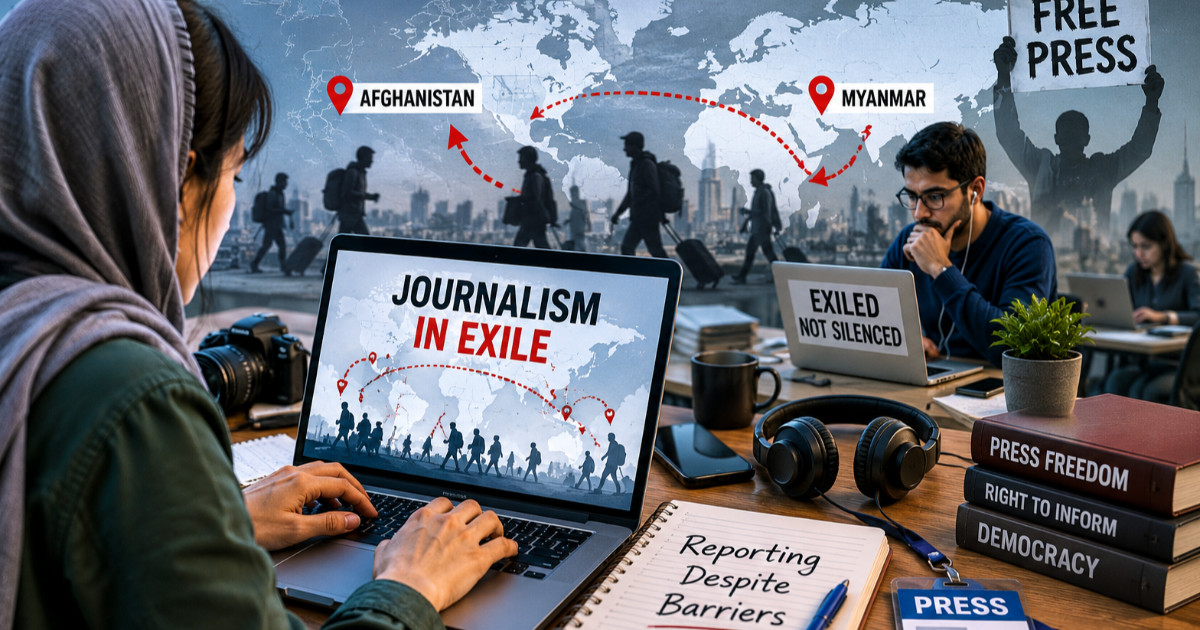
Perhaps the month's most sobering assessment came from Reporters Without Borders, whose latest findings showed that the number of countries from which journalists have been forced into exile has doubled over the past five years.
3. Governments versus journalism
Government intervention emerged as one of the defining themes of June.
The Pentagon introduced new restrictions limiting reporter access to parts of the U.S. Defense Department.
Israeli authorities expanded military censorship relating to missile strikes while also deporting a foreign journalist attempting to report from the occupied West Bank.
China and the United States exchanged accusations regarding the treatment of each other's journalists, while Taiwan criticized Beijing over the expulsion of a New York Times correspondent.
Turkey denied accreditation to dozens of journalists covering the upcoming NATO summit, while the UAE introduced the Arab world's first minimum social-media age requirement.
Although these developments occurred under different political systems, together they reflected a common trend: governments are increasingly seeking greater influence over information flows.
4. Media business & broadcasting
Business transformation accelerated throughout June.
Fox Corporation's proposed $22 billion acquisition of Roku represented one of the year's largest media transactions and reinforced the strategic importance of owning digital distribution platforms.
India's Zee secured broadcasting rights for the 2026 and 2030 FIFA World Cups, highlighting the continuing value of premium sports rights.
Broadcasters also explored new revenue opportunities, with analysts predicting that FIFA-mandated hydration breaks could create valuable advertising inventory during World Cup matches.
Meanwhile, regulators approved the merger between BMG and Concord, creating what will become the world's fourth-largest music company.
At the same time, financial pressures continued to reshape legacy media organizations. The BBC announced extensive restructuring and hundreds of job reductions, while Australian publishers urged lawmakers to move forward with digital platform compensation reforms.
5. AI & digital transformation
Artificial intelligence became one of journalism's defining topics.
The WAN-IFRA World News Media Congress identified AI as a strategic priority for publishers, while the Reuters Institute Digital News Report revealed audiences increasingly consume news through social and video platforms rather than publisher websites.
Legal disputes over AI training data intensified after hundreds of U.S. newspapers joined copyright litigation involving OpenAI and Microsoft.
Meanwhile, the Global Fact-Checking Awards highlighted innovation in combating misinformation, including tools designed to identify AI-generated content.
Collectively, these stories demonstrated that AI is no longer a future issue. It is already reshaping editorial workflows, copyright law, audience engagement, and newsroom strategy.
6. Public service media
Public broadcasters faced mounting pressure.
The BBC announced one of its most significant restructuring programs in years.
Journalists at Czech Television and Czech Radio protested proposed funding reforms they believe could weaken editorial independence.
In Britain, policymakers launched consultations on increasing the prominence of trusted public-service news across digital platforms.
The future of public-interest broadcasting emerged as one of the month's recurring themes.
7. Reports that mattered
Several influential reports shaped debate across the media industry.
The Reuters Institute Digital News Report documented changing audience habits, declining trust, and growing reliance on social media.
UNESCO's evidence review reinforced the economic and democratic value of independent journalism.
RSF's findings on journalist exile highlighted worsening global safety conditions.
Together, these reports provided empirical evidence supporting many of the trends observed throughout June.
8. Five trends JP identified
1. AI has become a newsroom necessity rather than an experiment.
2. Governments are exercising greater control over journalistic access.
3. Public-service media face increasing financial and political pressure.
4. Independent journalism remains under sustained threat in many parts of the world.
5. News organizations continue searching for sustainable digital business models.
9. Looking ahead
Several issues are expected to dominate media coverage in July.
The implementation of AI strategies in newsrooms will continue attracting attention as publishers negotiate licensing agreements and copyright disputes.
Questions surrounding media sustainability, particularly public broadcasting funding and platform compensation, are likely to remain central.
Meanwhile, journalists covering conflicts in the Middle East and other volatile regions will continue operating under exceptionally challenging conditions, making press freedom and journalist safety persistent international concerns.
ATTRIBUTION: JP Monthly Review is JournalismPakistan's monthly editorial analysis of the most significant developments in global journalism, press freedom, media business, broadcasting, and digital transformation.
PHOTO: AI-generated; for illustrative purposes
Key Points
- Artificial intelligence is increasingly integrated into newsroom workflows and editorial tools.
- Governments in several countries tightened control over information and access to data.
- Audience behavior continued shifting toward digital platforms and on-demand formats.
- Financial pressures led to restructurings, budget cuts, and job losses at media organizations.
- Journalists faced legal, physical, and regulatory threats while public broadcasters struggled with shrinking resources.
Key Questions & Answers
What were the main trends affecting journalism in June 2026?
AI adoption, tighter government controls on information, digital shifts in audience behavior, and intensified financial strain on media organizations were the main trends.
How is artificial intelligence changing newsrooms?
Newsrooms are using AI for content creation, research, personalization, and workflow automation, raising questions about accuracy, ethics, and editorial oversight.
Are governments limiting access to information?
Yes. Several governments introduced or enforced measures that restrict information flows, impact press freedom, and complicate journalists' access to public data.
How are financial pressures affecting media organizations?
Financial strain has led to budget cuts, restructurings, layoffs, reduced resources for public broadcasters, and greater emphasis on digital monetization strategies.
Relevant Topics
Ask AI: Understand this story your way
AI EnabledDig deeper, ask anything — get instant context, background, and clarity.
Disclaimer: This feature is powered by AI and is intended to help readers explore and understand news stories more easily. While we strive for accuracy, AI-generated responses may occasionally be incomplete or reflect limitations in the underlying model. This feature does not represent the editorial views of JournalismPakistan. For our full, verified reporting, please refer to the original article.