.png)
How Italy won four World Cups and then vanished from the biggest stage
JournalismPakistan.com | Published: 18 June 2026 | Dr. Nauman Niaz (TI)
Join our WhatsApp channel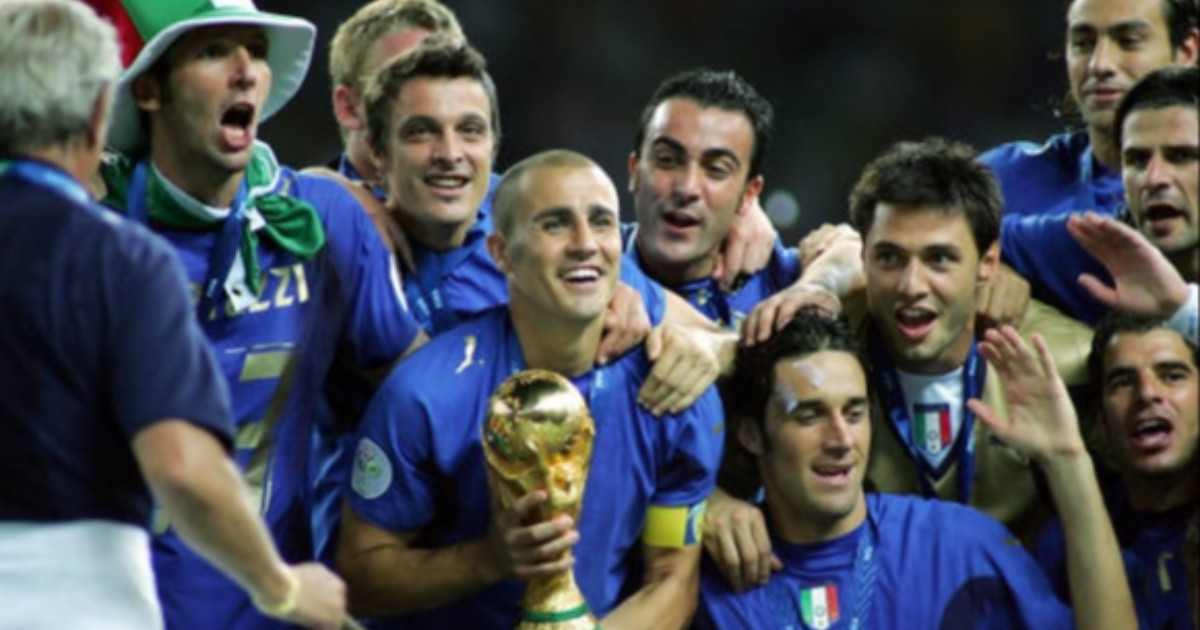
Italy's national team built an identity of disciplined defence and tactical organization, winning four World Cups through structure rather than flair. Shifts in coaching, player generations, and evolving global tactics have reduced the Azzurri's consistency at major tournaments.Summary
ISLAMABAD — There is a particular kind of football that does not invite you in. It stands at the entrance and regards you with the cold, unhurried assessment of a man who has witnessed every human tendency toward excess and found it, on the whole, unpersuasive. It does not dazzle in the manner of the South American traditions, where the individual flourish is the very argument the game is making, and the scoreline follows as a kind of afterthought, almost irrelevant to the central performance. It does not persuade through beauty. It persuades through structure, through organisation so deeply considered and so precisely maintained that beauty, when it occasionally appears, does so as an unexpected visitor rather than a resident, surprising even the host.
This is Italian football. It is the football of the locked door, the sprung trap, the defence assembled with an architectural patience that would have satisfied the engineers of the Colosseum, men who understood that what endures must be built upon principles rather than impulses and that the wall which stands for centuries is the wall which was never given cause to doubt itself. It has produced four World Cup titles, more than any other European nation and equalled only by Brazil in the total accounting of world football's greatest honour. It has produced, in those years of achievement and in the years between them, players of such individual distinction that the game has occasionally been required to revise its understanding of what a position means, what a role may contain, what intelligence and will and physical excellence, combined in the right proportions and organised within the right system, may accomplish. And since 2018, it has produced nothing at all at the World Cup, because it has not been there, absent from the stage upon which it built its entire reputation with a completeness that suggests not misfortune but something more troubling, something structural, something that the four stars above the crest cannot quite disguise.
That absence is the riddle at the end of this long and honourable story, and it is a conundrum worth contemplating at some length before the answer is attempted, because the answer, when it comes, reveals something important not only about Italian football in its present difficulties but about the fate of any aesthetic philosophy, however refined and however proudly maintained, that loses living contact with the game that produced it and discovers, too late, that it has been speaking a language the world has ceased to understand.
Mussolini, Pozzo, and the Birth of a Tradition: 1934 and 1938
Italy's story at the World Cup begins beneath the long shadow of Mussolini, and that shadow, cast as it was across the architecture of a nation's life with the thoroughness that only totalitarianism achieves, does not lift quickly from any account of Italian football in its foundational period. The 1930 tournament in Uruguay was conducted without them: Italy declined to make the crossing, a decision that speaks with unmistakable eloquence of the same pride and self-containment that has always characterised Italian football's relationship with the wider world. They did not need to travel to Uruguay. Uruguay existed at an inconvenient distance. When the world was prepared to take Italy seriously on the question of football, as on so many other questions, the world could arrange itself accordingly and come.
In 1934, the world came, or rather Italy, with the thoroughness of a nation that arranges its own occasions, caused the world to come by hosting the tournament and then winning it with a completeness that satisfied both the sporting requirement and the political one, since under Mussolini, the two had been declared inseparable. Vittorio Pozzo managed the Azzurri through these years with a quality of tactical intelligence and human authority that made the two qualities indistinguishable from each other, each reinforcing the other in the way that all genuine authority does. He was not a dictator of the training pitch in any simple sense. He was something more interesting and more durable: a man who understood what it meant to take players from the fractured regional loyalties of a country not yet certain of its own unity, from Turin and Milan and Rome and Genoa and Naples, each carrying its own history and its own pride, and form from them something that felt, at least for the duration of a tournament, like a nation with a single purpose.
The system he employed was the metodo, a 2-3-2-3 formation of elegant internal balance that gave Italy both the defensive structure that the Italian temperament required and an attacking fluency that the Italian talent made possible, a system in which roles were precisely defined but the freedom within those roles was genuine and creative. Giuseppe Meazza stood at the centre of this arrangement, a Milanese of extraordinary gifts who played inside forward with the kind of intelligent, anticipatory movement that makes defenders look not merely beaten but philosophically outmanoeuvred, as though they have been deceived not by pace or strength but by the superior organisation of the other man's mind. Meazza did not run past people in the Brazilian manner, with the ball at his feet and the joy of movement as its own justification. He arrived in the spaces before the defenders had conceived that the spaces existed, before the geometry of the moment had declared itself, and he was there already, composed and ready, waiting for the situation to confirm what he had already understood. He scored twice in the semi-final against Austria with the composure of a man conducting a transaction he considers somewhat beneath his capabilities, the goals arriving with the inevitability of conclusions to arguments that were never really in dispute.
Italy won the final against Czechoslovakia three to two, requiring extra time to do so, and the crowd at the PNF Stadium in Rome provided what Mussolini required of it. But football, whatever the political arrangements of the society surrounding it, is not obliged to be convenient for its context, and what Pozzo had built was genuinely fine, genuinely Italian in its organisation and its individual quality, and genuine things possess the essential quality of outliving the circumstances of their making.
France in 1938 presented a different challenge entirely, because Italy was now defending champions on foreign soil, stripped of the particular and substantial advantage that home support confers. What replaced it was what Italian football has always had available when every other resource has been withdrawn: the organisation, the tactical coherence, the stubborn individual quality, and the stubbornness itself, that particular Italian capacity for maintaining a position under pressure that derives not from arrogance but from something older and deeper, from the accumulated experience of a civilisation that has been defending positions, literal and otherwise, for rather longer than football has existed.
Silvio Piola scored four goals through the tournament with the directness and physical conviction of a centre forward who understood that his primary obligation was not to be admired but to score. Meazza, his right knee bound after a groin muscle had torn in the semi-final against Brazil, ran up to take a penalty in that match with his shorts held up by one hand, because the other was needed for balance, and he scored, because great players convert penalties even when their physical circumstances are absurd, and this small, almost comical detail contains within it a perfectly compressed image of what Italian football has always required of those who represent it. Function before comfort. The result before the impression. The deed before the gesture.
They beat Hungary four to two in the final, and Pozzo became the only manager in the history of the competition to win two World Cups, a record that will in all probability never be equalled because the circumstances that produced it, the conjunction of a single visionary with a national team across an entire decade of undivided authority and continuity of purpose, belong irrevocably to an era that has passed and will not return. What he bequeathed to Italian football was not just two trophies but a way of thinking about the game: a tradition of organisation, of the individual excellence deployed within collective structure, that would become, over the following decades, the most recognisable and most distinctively Italian contribution to the world's understanding of what football can be.
Tragedy, Humiliation, and the Catenaccio Years: 1950 to 1970
The years between 1938 and 1982 contain within them enough material for tragedy, for comedy, and for that particular form of Italian experience which is both simultaneously. The Superga air disaster of the fourth of May 1949 took the lives of the Grande Torino, the finest club side in Italy and the essential spine of the national team, and left Italian football hollowed in ways that years of rebuilding and patience were required to repair. It was a wound that the game absorbed, as football always absorbs its wounds, but it left a mark upon the Italian soul that those who study the psychology of Italian football's defensive instincts would do well to consider.
Brazil in 1950, a group stage exit. Switzerland in 1954, elimination by the hosts. Sweden in 1958, the most complete humiliation of the lot: failure to qualify at all, a fact received in Italy as though the universe had temporarily suspended its obligations to reason. Chile in 1962, another group stage departure. England in 1966 brought what seemed at the time the most crushing indignity available, though Italian football would subsequently discover that it had underestimated its own capacity for self-invention in the production of indignity. A defeat to North Korea in Middlesbrough, Pak Doo-ik's solitary goal standing unchallenged in the grey English rain, and Italian players returning home to airports where crowds had gathered with rotten fruit in the expectation of their arrival. It was the sporting equivalent of a public shaming, and it was earned.
That afternoon in Middlesbrough, the nineteenth of July 1966, is worth dwelling upon not as an aberration but as a symptom, as a diagnostic episode in the long clinical history of Italian football's periodic retreats into itself. The catenaccio system, the door chain, the defensive arrangement in which a libero or sweeper positioned behind the line of man-markers offered insurance against the attacker who escaped the first line of attention, had by this period been refined to a condition of such elaborate sophistication that it had ceased to function as a strategy and had become instead an ideology, pursued for its own intrinsic satisfactions rather than for any external objective. Italy could keep clean sheets with an efficiency that would have satisfied a Swiss engineer. Against opponents who had studied their methods and were prepared to sit deep and contain them, they could not score, and the locked door that kept opponents out kept them in also, moving in diminishing circles within a system that had forgotten what it was originally designed to serve.
Mexico in 1970 carried Italy to the final, which sounds like success and by any ordinary reckoning was precisely that. But the journey contained the semi-final against West Germany, four to three after extra time, which the FIFA Technical Committee named the Match of the Century, a designation that flatters both sides while accurately capturing the peculiar splendour of what occurred, a game in which defensive organisation was abandoned somewhere in the second half by both sets of players and pure attacking instinct took over, as though the sheer accumulated pressure of the occasion had dissolved the tactical frameworks that contained it.
The result, and the manner of it, suited Germany somewhat better than it suited Italy. They lost the final to Brazil four to one, and the margin was not unkind. The 1970 Brazilians were the finest assembly of footballers the game had yet produced, and Italy, having spent the energy required to reach the final, did not have reserves sufficient to contest it on equal terms.
Argentina in 1978, a third-place finish, and in the squad the presence of Paolo Rossi, young and already carrying within him the peculiar gifts of the penalty area predator, the man who understands instinctively that his obligation to the game is not to be present throughout it but to be present at the precise and unrepeatable moment when presence produces a goal.
Spain 1982: Rossi, Bearzot, and Italy's Greatest World Cup Story
Spain in 1982 is where Italy makes its most complex and finally most revelatory appearance at the World Cup, the tournament in which every element of the Italian football story, the organisation, the individual quality, the stubbornness, the capacity for self-reinvention, the suspicion of excess, and the understanding that form is temporary while structure is permanent, came together in the form of a single astonishing human story.
Rossi had been suspended for two years for his alleged complicity in a match-fixing scandal. He had returned to club football with Juventus a matter of weeks before the tournament began, short of match practice, short of confidence, and to the Italian press short of any obvious justification for his place in the squad. The group stage produced no Italian victories, three draws against Poland, Peru, and Cameroon, a performance so lacking in distinction that even the Italian press, not customarily given to understatement in matters of national sporting failure, expressed itself with unusual directness. Bearzot, who had already imposed a press embargo on his players in response to the sustained criticism, maintained his selections with the quiet immovability of a man who trusts his own judgement above the accumulated opinion of those who write about games rather than play them.
What happened next belongs to the rare category of things that football provides and ordinary life rarely does: the complete and instantaneous restoration of a man's confidence and capability within the most pressured environment that his profession can provide. Against Brazil in the second group stage, needing a victory to remain in the tournament, facing a side of such evident and celebrated attacking beauty, Zico and Socrates and Falcao and Cerezo, that the football world had more or less settled the question of who would win the World Cup in their favour, Italy played, and Rossi scored three goals.
The first arrived with the fatalistic precision of the born poacher, the body already in the space before the situation had fully declared itself. After Brazil equalised, then took the lead, then were equalised again, Rossi scored the third with the same quality of absolute presence in the penalty area that cannot be manufactured through coaching because it is not a skill but a form of temperamental knowledge, a reading of the ball's trajectory and intention that certain players possess at a level which separates them permanently and mysteriously from those of similar physical and technical equipment who simply do not have it.
Against Poland in the semi-final, two more goals. Against West Germany in the final in Madrid, the opener, and then Tardelli's second, and then Altobelli's third, and the three to one victory brought Italy a third World Cup title forty-four years after the second, a gap so long that its crossing felt not only like sporting success but like the resolution of something much older, much more personal, much more bound up with the Italian sense of who they are and what the game owes them.
Enzo Bearzot, the manager who had administered this extraordinary campaign, possessed the particular stubbornness of the man who is right about something unprovable until the moment when proof arrives and is then simply confirmed. His loyalty to Rossi through the weeks of wretched form, his press embargo maintained against the sustained disapproval of an entire football press corps, his willingness to trust a system flexible enough to contain both the Italian defensive virtues and an attacking ambition that the national stereotype sometimes discouraged: these were the contributions of a mind that understood Italian football completely enough to know when to apply its principles and when, for the brief creative interval that a World Cup requires, to set the most rigid of them aside.
Dino Zoff was forty years old and kept goal with the specific composure of a man who has long since made his peace with the game's capacity for cruelty and has concluded, on reflection, that the peace serves him better than the anxiety. His goalkeeping was not athletic in the showy sense, not given to the spectacular save that other men might not have needed to make, because his positioning and his reading of play reduced the requirement for athleticism by the simple expedient of not being in situations that required it. He was forty, and in the final against Germany, he was the best goalkeeper on the field.
Marco Tardelli, who scored Italy's second in that final and then ran in the manner of a man temporarily beyond the control of every social inhibition his culture had invested him with, arms spread, face contorted in something between ecstasy and anguish, head shaking as though in disbelief at his own feeling, gave the football world one of its enduring images. It is the image of a system briefly transcended by the human being within it, the disciplined midfielder released into pure and unguarded emotion by the single most important goal of his life, and the fact that the image has survived forty years without losing any of its power is because what it shows is not a footballer's reaction to a goal but a man's response to the moment when everything he has worked toward is suddenly and irrevocably achieved.
Bruno Conti on the right wing brought to the tournament a directness and a quality of individual expression that the Italian defensive tradition sometimes discouraged in attackers, as though an excess of flair in the attacking third might represent a challenge to the metaphysical priority of the defensive. Antonio Cabrini missed a penalty in the final, the first missed spot kick in a World Cup final, and then played the remaining forty minutes with the particular concentrated excellence of a man who knows that the only response to an error of such public significance is to be irreproachably good at everything that follows it. He was.
Italy in 1982 was Italy at its theoretical best, the point at which the defensive intelligence and the attacking capability achieve the precise equilibrium that the Italian philosophy intends and rarely, in practice, fully realises. The structure as the precondition of the individual's freedom. The individual freedom is the ultimate justification of the structure. The door that locks also opens, and in Madrid in July of 1982, it opened.
Baggio, Schillaci, and the Theatre of Italia 90
Mexico in 1986 produced a quarter-final exit against France on penalties, and the tournament's essential narrative belonged to Diego Maradona rather than to anyone in blue. Italia Novanta, the 1990 World Cup on home soil, belongs to Italian football's self-understanding as a kind of extended theatrical production in which the sporting result is almost secondary to the symbolic resonances available for contemplation. Italy reached the semi-final. The venue was Naples. And Napoli's God, Diego Maradona, was the opposing captain. The Neapolitan public, divided between its constitutional obligation to the Azzurri and its specific devotion to the Argentine, found in that division an articulation of something that political theorists have been unable to express as economically: that identity is not simple, that loyalty is not singular, and that a city's attachment to a man who has spent years expressing its deepest aspirations on a football field may outweigh its attachment to a national flag it has not always had cause to cherish.
Italy lost that semi-final on penalties. Salvatore Schillaci, the Palermitano who had played his way into the tournament's consciousness from relative national obscurity, who had scored six goals while appearing to conduct himself in a permanent state of mild astonishment at his own presence in the company he was keeping, could not sustain the tournament alone. Roberto Baggio was in that squad, demonstrably extraordinary even at twenty-three, and the four years that followed were the years that belong to him in the way that certain historical periods belong to particular individuals: not because no one else was present but because the presence of the individual defined the terms on which everything else in that period is subsequently understood.
Pasadena 1994: The Penalty That Defined a Generation
The 1994 World Cup final against Brazil in Pasadena, goalless through ninety minutes and through thirty minutes of extra time, was decided by penalty kicks. Roberto Baggio had scored the penalty that eliminated Spain in the quarter-final. He had scored the penalty that eliminated Bulgaria in the semi-final. He had carried Italy through the knockout rounds on a series of moments of individual quality that operated at a frequency different from the football surrounding them, as though he and the tournament were conducting a private conversation that the other players were not quite equipped to follow.
He walked up to take the fifth and final Italian penalty with the tournament in the balance, needing to score to keep Italy in it. He struck the ball and it rose above the crossbar and came down somewhere behind the Pasadena sky, and he stood for a moment with his head bowed and his hands upon his knees, and the image of that stance became one of the defining photographs in the history of not only Italian football but of football's unique capacity to produce suffering of such concentrated and specific and public intensity that it takes on the quality of something that transcends sport entirely and belongs to the wider human conversation about failure and grace and the way in which even those most gifted in their generation are not exempt from the moment's refusal to oblige.
France in 1998, a semi-final loss to the hosts on penalties. South Korea and Japan in 2002 produced elimination in circumstances that Italy still discusses, sixteen years on, with the particular quality of indignation that has not been softened by time. A Totti disallowance, an Ahn Jung-hwan golden goal, a standard of refereeing from the Ecuadorian official that the Italian press addressed with the restraint one might expect from a press corps that had reached a settled verdict before the match was replayed in print. The golden goal was real. The feelings about it were also real. Both were Italian.
Germany 2006: Cannavaro, Calciopoli, and a Fourth World Cup
Germany in 2006 is where Italy won the World Cup for the fourth time, and it is where Marcello Lippi assembled one of the most complete Italian defensive structures in the tournament's history, and where Fabio Cannavaro lifted the trophy as captain and subsequently collected the Ballon d'Or, the award given only twice in its half-century of existence to a defender, because what Cannavaro performed in Germany during those weeks was not the prevention of goals in any simple physical sense but the embodiment of a philosophy: the argument, made through positioning and timing and the organisation of space rather than through any pronouncement, that the denial of the other side's ambitions is itself a form of artistry, that the perfectly calibrated tackle, the interception completed half a second before the moment has declared itself to require one, the positioning that makes the attacker's options contract gradually and invisibly until they have ceased to exist, require a quality of intelligence and anticipatory imagination equal to anything that happens at the other end of the pitch. Cannavaro was not tall for a central defender. He held no particular advantage in the air. He won because he knew earlier than anyone else where the ball was destined and had arranged himself there in advance, calm and ready, like a man who has read the last part of a book and is simply observing the narrative arrive at its conclusion.
The tournament opened beneath the shadow of Calciopoli, which had broken across Italian football in the weeks preceding it and had implicated Juventus, AC Milan, Fiorentina, and Lazio in the manipulation of referee appointments for competitive advantage, a scandal of sufficient magnitude that Juventus were subsequently relegated and stripped of titles. Several members of the Italian World Cup squad played for these clubs. They went to Germany carrying not just the ordinary expectations of the defending nation, not only the weight of a tournament's demands upon the body and the mind, but the additional and quite specific weight of their employers' public disgrace. They won the World Cup anyway. What this says about the capacity of Italian footballers to maintain professional compartmentalisation under conditions that might overwhelm less organised temperaments is something that the student of Italian psychology is best equipped to address.
The semi-final against Germany in Dortmund, which at ninety minutes and at the hundred-and-nineteenth minute of extra time had produced no goals, ended with two Italian goals scored in the final sixty seconds of additional time. Fabio Grosso's curling left-foot drive, struck with the specific conviction of a man operating beyond his own conscious understanding of what he is doing, and Alessandro Del Piero's composed finish, struck with the equally specific and contrasting conviction of a man who knows precisely what he is doing because he has done it so many times in smaller theatres than this, produced in the Italian management and coaching staff the kind of expression that does not typically belong to the stoical profession of football management: pure, unguarded, disbelieving joy, the feeling of a group of people released from a sustained and terrible tension into a confirmation that what they believed was possible was actually, against the evidence of a hundred and nineteen minutes, true.
The final against France was decided by an incident from a different order of event entirely. Zinedine Zidane, the greatest European player of his generation, in the last competitive appearance of his professional life, headbutted Marco Materazzi in the chest in extra time, was shown the red card, and walked past the World Cup trophy on his way from the field. He subsequently explained his action. He did so with the air of a man who has considered the matter and found it, on reflection, to contain a justification that he is not entirely unhappy with. Italy won on penalties. Fabio Grosso, who had earlier curled the shot that ended Germany's tournament, converted the final kick. Lippi embraced his players on the field of the Olympiastadion in Berlin with the specific tenderness of a manager who had maintained professional composure through weeks of pressure and was now given permission to cease doing so.
The Long Decline: South Africa 2010 to the Sweden Disaster of 2018
South Africa in 2010. Italy, the defending champions, did not emerge from the group stage. They drew with Paraguay, drew with New Zealand in a result whose implications would not be apparent for some years, and lost to Slovakia. The football was laboured and technically unremarkable, tactically predictable in ways that teams with adequate preparation time are not typically required to be predictable. The age of the squad, the conservative tactical approach, the visible absence of players of the individual quality that the previous generation had made available to successive managers: these were the symptoms of a structural condition that the 1982 and 2006 titles had disguised, much as the well-maintained exterior of a building may conceal the progressive deterioration of its foundations.
Brazil in 2014 brought a quarter-final exit against Uruguay, marked by Luis Suarez biting Giorgio Chiellini's shoulder in an act of such specific and bewildering irrationality that it immediately displaced the actual result as the primary subject of subsequent discussion. The bite was real. The result was also real. Both deserved the attention of those minded to reflect upon Italian football, but the world chose the bite, because the football, for once and with some justice, had not distinguished itself sufficiently to demand its own independent narrative.
And then 2018. The qualification campaign for Russia. The play-off against Sweden, a nation of similar footballing tradition and comparable resources. A goalless draw in Stockholm in the first leg. A goalless draw in Milan in the second leg, in front of a crowd at the San Siro that had come expecting to watch Italy qualify and instead watched Italy fail to score across one hundred and eighty minutes of football against an opposition of honest rather than exceptional quality. Italy's absence from the Russian World Cup was not a misfortune of the kind that tournaments periodically administer to nations of quality through the capricious arithmetic of the draw or the particular form of an opponent on a given day. It was a declaration of structural crisis, an announcement that the foundations upon which four World Cup titles had been built had been allowed, across the years since 2006, to deteriorate beyond a level that individual talent or collective organisation could any longer conceal.
What Went Wrong: The Structural Crisis in Italian Football
What had gone wrong? Several things at once, which is the characteristic manner in which structural crises assemble themselves, each constituent failure reinforcing and amplifying the others until the combined effect is not just the sum of individual deficiencies but something qualitatively different, a comprehensive and systemic inability to produce at the level the tradition requires.
The academies continued to produce players of technical competence, but they produced them within a system that had made tactical sophistication a substitute for individual creativity rather than its complement. The Serie A of the 1990s and the first years of the new century had been, by the combined assessment of those who watched it and those who played in it, the finest domestic football competition in the world, generating an environment in which Italian players were formed daily in the company of the finest foreign players, subjected to a standard of opposition and a quality of technical challenge that accelerated their development beyond what any purely domestic environment could have provided. By the second decade of the new century, the Premier League had assumed that role, and those players, and Serie A, financially weakened, less able to attract and retain the best foreign talent, had become a competition of considerable tactical intelligence operating at a reduced level of athletic intensity, a place where the mind was sharpened while the body was perhaps insufficiently stretched.
The catenaccio tradition, in its historical purest form, a framework for creating defensive security as the precondition for controlled attacking, had in its long decline become something aesthetically and practically opposite: a purely defensive philosophy shorn of the attacking component that gave it purpose and strategic sense. Italy produced, through the 2010s, central defenders of genuine quality and forwards of very limited quality, and the proposition that a side which defends magnificently and attacks inadequately can sustain itself at the highest level of international competition belongs among the propositions that the game has repeatedly and unkindly disproved.
There was, additionally, a cultural displacement that is less comfortable to express but no less consequential for the discomfort. Italian football had sustained itself for generations upon a particular type of player: technically educated, tactically sophisticated, physically hard in the Italian manner, capable of executing within a system with a precision and a consistency that players formed in more individualistic traditions frequently could not match. The culture that produced those players, the provincial clubs, the patient youth development, the formation of footballers within a specific Italian tradition of collective responsibility and individual technical discipline, had been eroded by the same forces that had eroded Italian football at its senior levels: the movement of money, the influence of foreign models, the globalisation of the game's structures and ideas, and the consequent weakening of the specific local conditions from which specific local virtues had historically been generated.
Euro 2020 Glory and the Qatar Humiliation: A False Dawn
Roberto Mancini's team, winning the European Championship in the summer of 2021 after a tournament delayed by a pandemic, suggested that the crisis was reparable, that the system retained beneath its difficulties the capacity to produce footballers of intelligence and organisation and, when asked by a manager of sufficient vision and human skill, to combine them into a collective of genuine quality.
The football they played was not the Italy of 1982 or the Italy of 2006. It was more fluid, more disposed to press, more willing to play from the back through situations that the older Italian tradition would have resolved defensively rather than constructively. But it was recognisably Italian in its coherence, in the way the collective exceeded the individual, and in the final against England at Wembley it produced, when the penalty shootout arrived, the composure under maximum pressure that has always been the most essential and the most specifically Italian quality in sport.
That the same side then failed to qualify for the Qatar World Cup, losing a play-off to North Macedonia, a country of two million people playing their first major qualification campaign of any significance, was not a simple refutation of the European title but a confirmation that the title had been achieved in conditions of unusual specificity: a prolonged period of preparation, the peculiar collective focus that a delayed tournament and a period of national confinement had generated, a draw of unusual generosity. Beneath the gold of the European Championship, the structural problems had not been resolved. They had been papered over with exceptional organisation and exceptional management, and the paper, when tested a few months later by a Macedonian side of determined ordinariness, had given way.
The Greats: Zoff, Cannavaro, Maldini, Baggio, and the Gallery of Distinction
To speak of Italy's great players is to traverse a gallery of such remarkable breadth and such genuine individual distinction that the temptation toward simple ranking must be resisted in favour of something more honest: the recognition that different Italian eras have produced excellence of different kinds, each form of excellence shaped by and in turn shaping the Italian tradition of the moment.
Dino Zoff was the finest goalkeeper the game has produced. This is not a sentimental claim but a considered assessment from those who watched him across a career from 1961 to 1983, keeping goal for Juventus and for Italy with a quality of positional intelligence and concentrated attention that made the spectacular save unnecessary by the simple method of not being in situations that required spectacular saves. He read the game from behind it with the specific understanding of a student of human tendency under pressure, and his positioning removed problems before they presented themselves as problems requiring resolution. He was forty years old at the 1982 World Cup, and in the final in Madrid he was the best goalkeeper on the pitch.
Fabio Cannavaro was the embodiment of what Italian defending at its finest actually means: not physical domination of opponents but intellectual pre-emption of their intentions, the understanding of space and trajectory and human tendency that places the defender in the correct position before the attacker has perceived that the position is the correct one. He was not tall. He did not dominate the air. He won because his mind was faster and more accurate than those of the men he faced, and the Ballon d'Or he received in 2006 was the rarest of sporting recognitions: excellence in an unfashionable discipline acknowledged with the award created for fashionable ones.
Paolo Maldini spent twenty-five years at AC Milan, playing left back with a grace of movement and a quality of reading that made the position seem permanently and completely different from what others were doing in it. He was not a defender who occasionally attacked or an attacker who occasionally defended. He was a complete footballer deployed on the left side of a defensive structure, and his 926 appearances for a single club represent an unmatched testimony to sustained excellence across a span that no contemporary professional structure permits and very few in any era have achieved.
Roberto Baggio was the player through whom Italian football discovered, in the early 1990s, that the national tradition contained within it the possibility of something the tradition had not always encouraged: the individual who transcends the system rather than fulfilling it, who plays the game at a frequency removed from the collective, who is most fully himself precisely in the moments when the system around him has failed and he must resolve alone what the organisation could not resolve together. His dribbling and his vision and his goals under the pressure of elimination, and the missed penalty in Pasadena, and the ponytail and the Buddhism and the decade of knee injuries absorbed without complaint: these details constitute one of football's richest biographical narratives, the story of a prodigious gift deployed, partially and imperfectly but memorably, within a tradition that was not quite constructed to receive it.
Giuseppe Meazza, who gave his name to the stadium that houses both Milan clubs and remains one of the game's great civic monuments, played in the 1930s with a technical quality that the era rarely demanded and he provided regardless, anticipating a style of play that the game would not fully develop for another generation. Sandro Mazzola and Gianni Rivera, the great midfield presences of the 1960s whose individual excellence was so similar in character and in positional demand that they could not play together, and whose rivalry for a single place in the national team became itself a story about how Italy failed to fully release what it possessed, about the structural inability to accommodate two genuine artists in the same creative space. Franco Baresi, who organised the AC Milan defensive block of the late 1980s and early 1990s with a precision that made the libero role look like a different position from what anyone else had been playing in it, the free defender's freedom exercised as permanent attentiveness to the game's evolving geometries. Alessandro Del Piero, who scored in two World Cup finals from the bench or from the margins of tournaments that did not always use him as his quality warranted, and who converted those brief appearances into goals of such specific and irreversible quality that the limitations of his deployment became part of the story rather than a simple reduction of it.
And Tardelli. Not the most gifted, not the most technically distinguished, but the player who gave the world the image that most completely and most economically contains what Italian football means to Italians: the suppressed feeling released in an instant of such overwhelming completeness that the system which formed him could not contain the response, the controlled professional briefly beyond the reach of every discipline his culture had invested in him, running with his mouth open and his arms spread and his head shaking across the Bernabeu towards the Italian supporters, carrying in his face everything that football, at its most honest, is actually about.
Balotelli: Lightning, Waste, and the Illuminating Parenthesis
Mario Balotelli, who belongs to this story as its most illuminating parenthesis, arrived in professional football as lightning arrives: without adequate warning and with a force that made everything adjacent to it briefly irrelevant. At his best, which came in concentrated intervals of such concentrated brilliance that observers struggled to locate adequate expression, he was among the most complete centre forwards in Europe. The body was constructed for the purpose with what seemed in retrospect a degree of unfairness, broad-shouldered and powerful yet quick across the first ten yards with the specific acceleration that no training ground can manufacture because it derives not from conditioning but from the particular conjunction of muscle fibre and instinct that certain players are simply born possessing.
His technique was immaculate in the Italian tradition, the first touch that controlled and set the next action, the finishing precise without being mechanical, the ability to score with either foot and with his head and from distances that conventional forwards did not present to themselves as viable options. At the European Championship of 2012, he scored twice against Germany in the semi-final with such authority and such contemptuous ease that the commentary failed to find adequate expression, and he lifted his shirt to reveal an undershirt asking "Why Always Me," with the self-awareness of a man who has decided that his own paradox is so total and so persistent that the only honest response is to acknowledge it directly, while twenty-two thousand people and several million television viewers watched him do so.
The chaos that surrounded and ultimately undermined Balotelli was not due to performance. It was the actual and persistent condition of a life that he had never found adequate instruments to manage. Born to Ghanaian parents and adopted in infancy by a white Italian family in Brescia, he grew up in a country that has not resolved, and in the years of his development was very far from resolving, its institutional relationship with race. The abuse directed at him from Italian grounds throughout his career was of a sustained ugliness that any honest account of his professional difficulties is obliged to address as a central rather than a peripheral fact.
At Manchester City under Roberto Mancini, the fireworks set off within the house, the dart thrown at a youth player, the absences, the arguments, and the generalised atmosphere of a talent for which no stable containing structure had been found. At Liverpool, the goal against Manchester United was the celebration of such specific and local delight that Anfield held him briefly as its own, and then the form departed within months. At Marseille and Brescia and the succession of smaller Italian clubs that offered him possibilities in his thirties, the occasional flash of what had once appeared limitless, now resembling a man sorting through old correspondence in search of something he remembers writing but cannot quite find. What Italian football lost in Balotelli cannot be measured precisely because what was lost was not what he was but what he might have been, which was, on those days when the gifts aligned with the composure and the fire operated in a controlled manner rather than a consuming one, something extraordinary in the fullest sense of that word.
The Philosophy Endures: Italy's Path Back to World Football's Summit
The blue shirt carries all of this: the four stars and the four decades between the first and the last of them, the Pozzo tradition and the Bearzot silence and the Lippi embrace in Berlin, the Tardelli run and the Baggio penalty and the Balotelli revelation and the Balotelli waste, and somewhere beneath the layers of philosophy and tactics and individual biography the simple and irreducible fact that Italian football at its finest has produced a way of playing the game that no other country has exactly replicated, because no other country has exactly the same relationship between the individual and the collective, the instinct and the discipline, the feeling and the organisation.
The locked door remains. The key has been mislaid, not destroyed. Somewhere in the academies of Turin and Milan and Rome and Naples, a boy of twelve or thirteen is learning to read the spaces before they open, learning to position himself in relation to the game's dynamics with the precision of a craftsman working in a tradition centuries older than the game itself, learning that football in the Italian sense is not a collection of moments of individual inspiration but a sustained collective act of organised intelligence, and that the organisation, maintained with sufficient intelligence and with the specific Italian stubbornness that has outlasted two thousand years of external pressure, eventually opens every door it needs to open.
That is the Italian philosophy. That is what four World Cups were built from. And that, whenever Italian football recovers sufficient contact with the tradition that made it, is what the four that follow will be built from too.
ABOUT THE WRITER: Dr. Nauman Niaz, a Post Doctorate (Oxford), PhD (UWA), FRCP (London), FRCP (Edinburgh), FRCP (Ireland), FRCP (Glasgow), CST (Endo, UK), MSc Biomechanics & Kinesiology (UWA), MRCP (UK), MBBS (Pb) is a civil award winner (Tamagha-i-Imtiaz) in Sports Broadcasting & Journalism, a regular cricket correspondent having covered 54 tours and three ICC World Cups, having written over 3700 articles. He has authored 19 books and is the official historian of Pakistan Cricket (Fluctuating Fortunes IV Volumes - 2005). His signature show Game On Hai has been the highest in ratings and acclaim.
Key Points
- Italy's success was built on defensive discipline and tactical organisation rather than individual flair.
- The national side has won four World Cups, a record among European teams.
- Catenaccio and similar systems shaped Italy's reputation for structural, patient defending.
- Recent declines reflect coaching turnover, generational shifts and the global tactical evolution.
- Rebuilding requires youth development, tactical adaptation and long-term stability.
Key Questions & Answers
How did Italy win four World Cups?
Italy's World Cup victories were driven by organised defence, tactical planning, strong coaching and generation-spanning defensive talent that made the team consistently hard to break down.
What is catenaccio?
Catenaccio is a defensive system associated with Italian football that emphasises tight marking, compact shape and quick counterattacks to neutralise opponents.
Why has Italy's presence on the biggest stages weakened?
Multiple factors - including frequent coaching changes, shifts in player generations, domestic issues and the rapid evolution of global tactics - have reduced Italy's consistency at major tournaments.
Can Italy return to sustained international success?
Yes, a return is possible but would likely depend on investment in youth development, tactical evolution, stable coaching and integrating new playing styles with defensive strengths.
Ask AI: Understand this story your way
AI EnabledDig deeper, ask anything — get instant context, background, and clarity.
Disclaimer: This feature is powered by AI and is intended to help readers explore and understand news stories more easily. While we strive for accuracy, AI-generated responses may occasionally be incomplete or reflect limitations in the underlying model. This feature does not represent the editorial views of JournalismPakistan. For our full, verified reporting, please refer to the original article.