.png)
Marked reduction in media killings in Pakistan: IFJ
JournalismPakistan.com | Published: 3 February 2017
Join our WhatsApp channel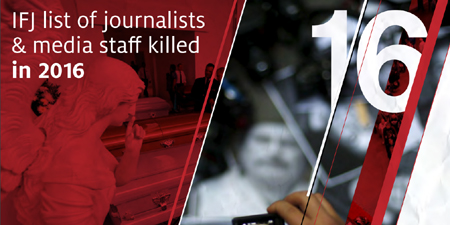
The IFJ has noted a decline in media killings in Pakistan while recognizing ongoing challenges in neighboring countries. Efforts to improve journalist safety have seen some success, but issues persist across the region.Summary
The International Federation of Journalists (IFJ) Thursday launched the IFJ list of journalists and media staff killed in 2016, documenting the deaths of colleagues killed in the line of duty.
In the Asia-Pacific region, 28 journalists were brutally murdered in 2016, an increase from 2015. The report, which is now in its 26th year, is a key tool in the IFJ’s continued efforts to tackle impunity for crimes against journalists and campaign for greater safety.
In the Asia Pacific region, there have been some wins, but with each comes a devastating blow to the efforts made to secure the safety of journalists worldwide. In the last two years, the IFJ Asia-Pacific cautiously noted a marked reduction in media killings in Pakistan. While actions in Pakistan to tackle journalist fatalities and shocking impunity levels finally seem to be making some difference, the situation in neighbouring Afghanistan and India is taking a worrying trajectory. Afghanistan is now our region’s frontline, with 13 journalists brutally murdered in 2016. The year started with the loss of seven media workers from Tolo TV in a suicide bomb attack on their transport van as they left work on January 20. The incident occurred after sustained threats by the Taliban on the news outlet for its media coverage of the Taliban takeover of Kunduz the year prior. Another 25 civilians were wounded in the same attack.
The situation in India has also deteriorated in the past 12-18 months, with five journalists killed in 2016, taking the total to 40 in the past five years. What is becoming clear in the case of India is that despite being the world’s biggest democracy, freedom of expression and critical reporting increasingly has a murderous price.
IFJ Director – Program & Development, Jane Worthington, said: “Across the Asia Pacific region, 28 journalists and media workers lost their lives on duty in 2016 – accounting for a quarter of all media deaths recorded by IFJ globally in the year. Most were gunned down in direct attacks. Many of them were reporting on the toughest issues: illegal mining and forestry, corruption, black market activities, political and criminal mafia operations.”
Hard-fought wins have been achieved in Sri Lanka, the Philippines and Pakistan in the past 12 months which give hope about the continued work across the globe. The reopening of investigations into the murder of Lasantha Wickremetunge in Sri Lanka; and convictions in the murders of Ayub Khattak in Pakistan and Desiderio Camangyan in the Philippines, illustrate what can be achieved through consistent campaigns, solidarity action and collaborative effort.
“But as long as these are the exception rather than the rule and we continue to lose a journalist to murder every 13 days, we still have the greatest challenges before us,” said the IFJ. - IFJ media release
Key Points
- IFJ reports a reduction in media killings in Pakistan.
- 28 journalists were murdered in the Asia-Pacific region in 2016.
- Afghanistan remains the most dangerous country for journalists.
- Serious safety issues persist in India despite democracy.
- Recent successes include reopening cases of murdered journalists.
Relevant Topics
Ask AI: Understand this story your way
AI EnabledDig deeper, ask anything — get instant context, background, and clarity.
Disclaimer: This feature is powered by AI and is intended to help readers explore and understand news stories more easily. While we strive for accuracy, AI-generated responses may occasionally be incomplete or reflect limitations in the underlying model. This feature does not represent the editorial views of JournalismPakistan. For our full, verified reporting, please refer to the original article.