
Every frame at a cost: The safety crisis facing Pakistan's camerapersons
JournalismPakistan.com | Published: 5 June 2026 | Wajid Ali
Join our WhatsApp channel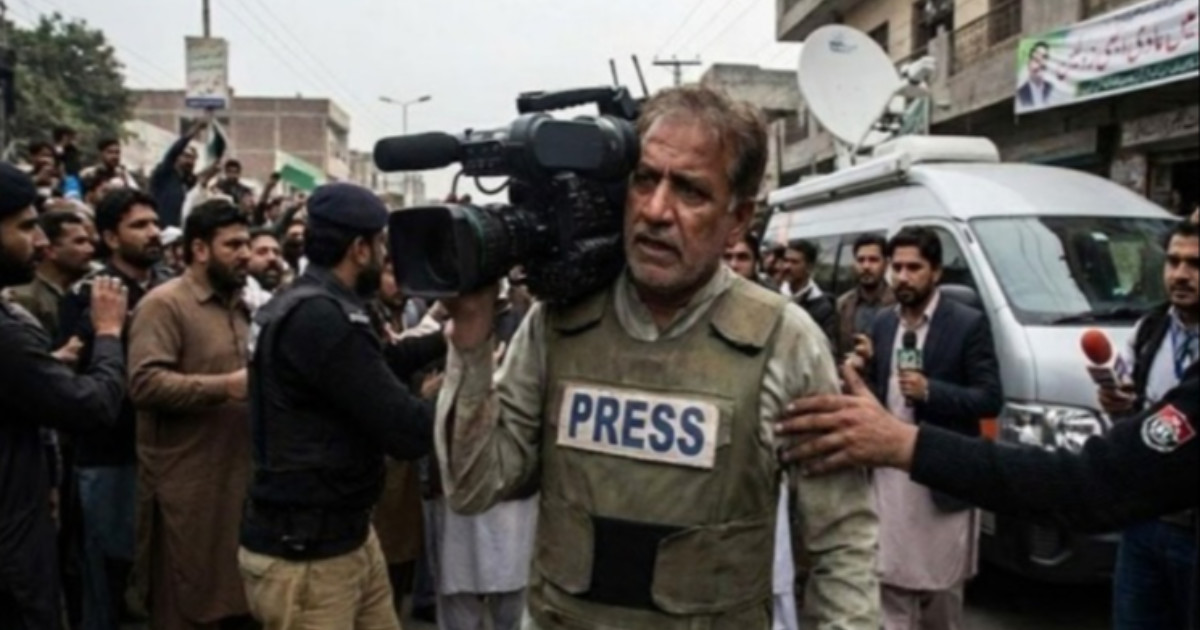
A camera operator was thrown into the Ravi while filming floods and received safety gear only after the accident; across Pakistan, camerapersons work in floods, protests and violence with minimal training, gear or employer safeguards.Summary
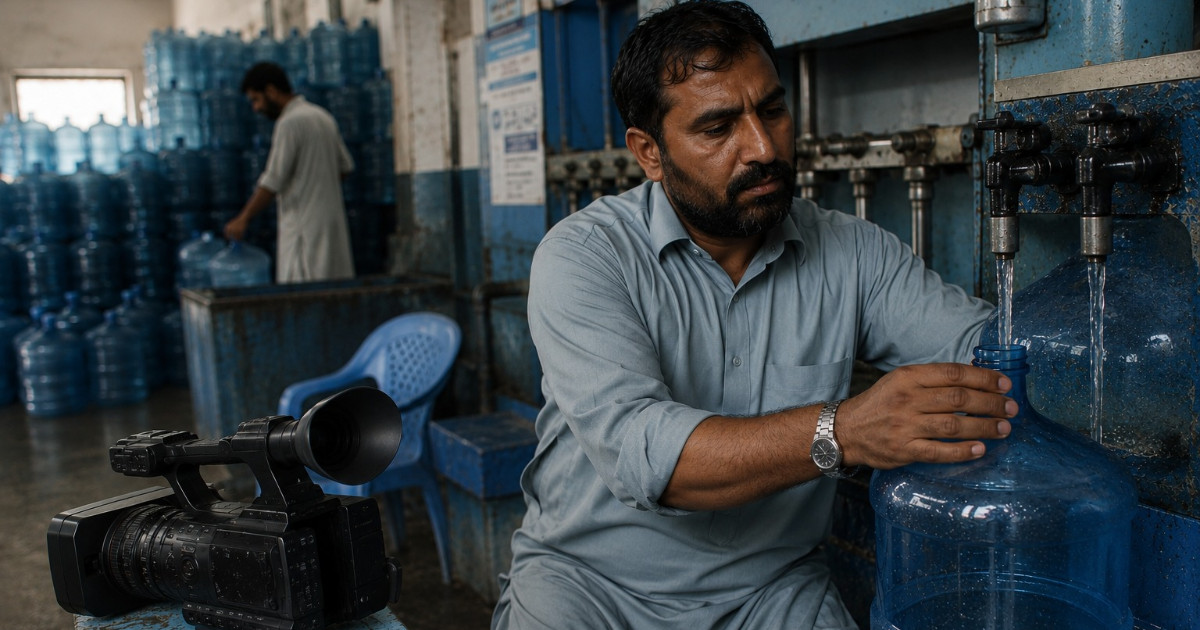
ISLAMABAD — On a flooded August evening in 2025, Haq Nawaz climbed into a small boat on the Ravi River to capture footage of rising waters for his television channel. There was no safety vest, no helmet, and no briefing on emergency procedures. There was only the assignment.
As the boat moved through swollen waters, it struck overgrown bushes along the riverbank. The impact threw Nawaz into the river. He was rescued and taken to hospital. His camera was destroyed.
After more than two decades in the profession, it was the first time he had come so close to losing his life on assignment. It was also the first time his employer provided him with safety equipment. His channel, Samaa News, equipped him only after the accident, and he returned to flood duty.
“I began this profession because I believed in the power of visuals to inform the public,” Nawaz said. “But today, we are treated like disposable labor, risking our lives without adequate safety measures or recognition.”
His experience is far from unique. Across Pakistan, camerapersons routinely work in floods, protests, riots, bomb blasts, political rallies, and other hazardous environments with little formal training, limited protective equipment, and few institutional safeguards. They often stand closest to danger because the job demands it. Yet despite their central role in gathering news, many say they remain among the least protected and least recognized members of the media workforce.
Frontline journalists without frontline protection
When major events unfold, it is often the cameraperson who moves closest to the scene. While reporters can sometimes observe from a safer distance, television crews must capture images from the heart of the action. That requirement carries consequences.
According to data compiled by the Pakistan Press Foundation (PPF), attacks, injuries, arrests, harassment, and other violations involving camerapersons and photographers have been recorded consistently for decades. PPF has documented at least 205 such cases since the mid-1990s — 22 in 2021, 23 in 2022, 19 in 2024, and at least 14 in the first months of 2025. The numbers are not improving.
For veteran photojournalist Mohsin Raza, a former chief photographer at Reuters, the issue extends beyond physical danger. “Camerapersons’ safety is always uncertain, no matter how hazardous the conditions,” he said.
Raza spent years documenting major events for international and local media. During one political protest in Lahore, he found himself trapped between advancing police lines and retreating demonstrators. Reporters had already moved back. He remained because the images were still unfolding. “We are trained to stay and capture,” he said. “Nobody trains us on when to leave.”
Because they must stay near the stage or the point of impact to get usable images, camerapersons consistently sustain more severe physical injuries than reporters, a pattern borne out across three decades of PPF’s records.
Many camerapersons argue that newsroom culture reinforces this pressure. They are expected to deliver footage regardless of conditions, while discussions about safety frequently take a back seat to operational demands.
Dr. Muhammad Asim Siddique, General Manager at Samaa Digital, acknowledged that safety training has historically received limited attention within many media organizations. “Honestly, these trainings were not a priority,” he said. “Many organizations have simply not thought to start them. The assumption has often been that camerapersons learn on the job.”
Kashif Abbasi, President of the Television Cameramen Journalists Association (TVCJA), believes the problem reflects a broader failure to recognize camerapersons as journalists in their own right. “Camerapersons are the eyes of every news channel,” he said. “But too often they are treated as invisible. No training, no gear, no recognition. The system has normalized their sacrifice.”
According to Abbasi, the TVCJA represents nearly 1,000 camerapersons nationwide. Many members report never receiving formal safety instruction despite years of field experience.
The cost of getting the shot
The dangers become even more pronounced outside major urban centers. Babar Ali, a cameraperson with nearly two decades of experience across multiple channels, including a stint at Reuters and now with Aaj News TV, says financial insecurity can make it virtually impossible to refuse dangerous assignments.
“At the district level especially, camerapersons might not even receive a regular salary. If we don’t go, there is no footage and no income. When the pocket is empty and responsibilities loom, danger becomes compulsion,” he said.
Economic pressure often intersects with physical risk. Low wages, delayed salaries, and the absence of hazard allowances mean many field crews cannot afford personal safety equipment or supplemental insurance. The result is a profession where danger becomes normalized.
In 2024, Geo News cameraperson Samiullah Khan suffered critical head injuries while covering a suicide blast. The same year, Time News cameraman Haider Mastoi was killed in a shooting in the Rohri area of Sukkur district, Sindh. Police have classified the killing as a robbery, a finding his family and colleagues dispute. No court proceedings have begun, which press freedom advocates link to the culture of impunity surrounding violence against media workers.
The deadliest entry in PPF’s records dates to August 2016, when a suicide bombing at Civil Hospital in Quetta killed Aaj News cameraperson Shahzad Khan at the scene. Mehmood Khan of DawnNews was critically wounded in the same blast and later died. Both were documenting the aftermath of a targeted killing when a second device detonated, killing more than 70 people, most of them lawyers. No one has been convicted.
PPF’s records include other recurring assaults: seven reporters and camerapersons injured at a PTI rally in Peshawar in April 2022, and five media workers, most of them camerapersons, wounded in November 2014 when attackers threw explosives at the DSNG vans of DawnNews, Dunya News, and Abb Takk News in Islamabad. The perpetrators were never identified.
Between November 2024 and September 2025, Freedom Network documented at least 142 cases of violations against journalists and media professionals, a nearly 60 percent rise from the previous year. PPF separately recorded 137 incidents between January and October 2025, including 35 physical assaults, five detentions, two abductions, and eight arrests, alongside 30 cases of legal harassment, 22 of them under the Pakistan Electronic Crimes Act (PECA).
Television journalists frequently bear the brunt of these incidents because of their proximity to unfolding events.
The image that cost a life
On October 18, 2007, former Prime Minister Benazir Bhutto returned to Pakistan after years in exile. Thousands lined the streets of Karachi to welcome her home. Among them was ARY News cameraperson Muhammad Arif Khan.
As Bhutto’s procession moved through the city’s Karsaz area, twin bomb blasts tore through the crowd. At least 141 people were killed, and hundreds were injured. Arif Khan was among the dead. He was survived by his wife and six children.
Colleagues later remembered him as a journalist who instinctively moved toward the center of events. If there was a crucial image to capture, he wanted to be there. That instinct ultimately placed him within range of one of the deadliest attacks in Pakistan’s political history.
The case was re-registered in 2008 and passed through several inquiry committees and, eventually, the Federal Investigation Agency. No one has ever been convicted. ARY News has commemorated him on every anniversary of his death and extended financial assistance of up to Rs500,000 to his family, a mark of institutional respect that, for six children who grew up without a father, leaves the harder question unanswered: why was he there without protection?
The cycle repeated itself in Quetta on January 10, 2013, when Samaa News TV cameraperson Imran Shaikh was killed in a double bomb blast while documenting the aftermath of an earlier explosion. He left behind a wife and two daughters. His widow later told PPF that she remembered him saying: “My job is to inform citizens of Pakistan about the situation of the country, and one day I will die for this cause.” Samaa News has honored him on every anniversary of his death and provided his family with financial assistance of up to Rs1 million.
These cases have become part of Pakistan’s broader press freedom narrative. Yet many industry observers argue that camerapersons receive less public recognition than reporters, anchors, and editors, despite facing comparable, and sometimes greater, levels of danger.
Laws on paper, weak in practice
In 2021, Pakistan enacted the Protection of Journalists and Media Professionals Act, a landmark law intended to strengthen safeguards for media workers. The legislation recognizes a broad category of media professionals, including camerapersons, and places specific obligations on media organizations. Pakistan also passed the Sindh Protection of Journalists and Other Media Practitioners Act the same year, which explicitly lists camerapersons and photographers among protected media practitioners.
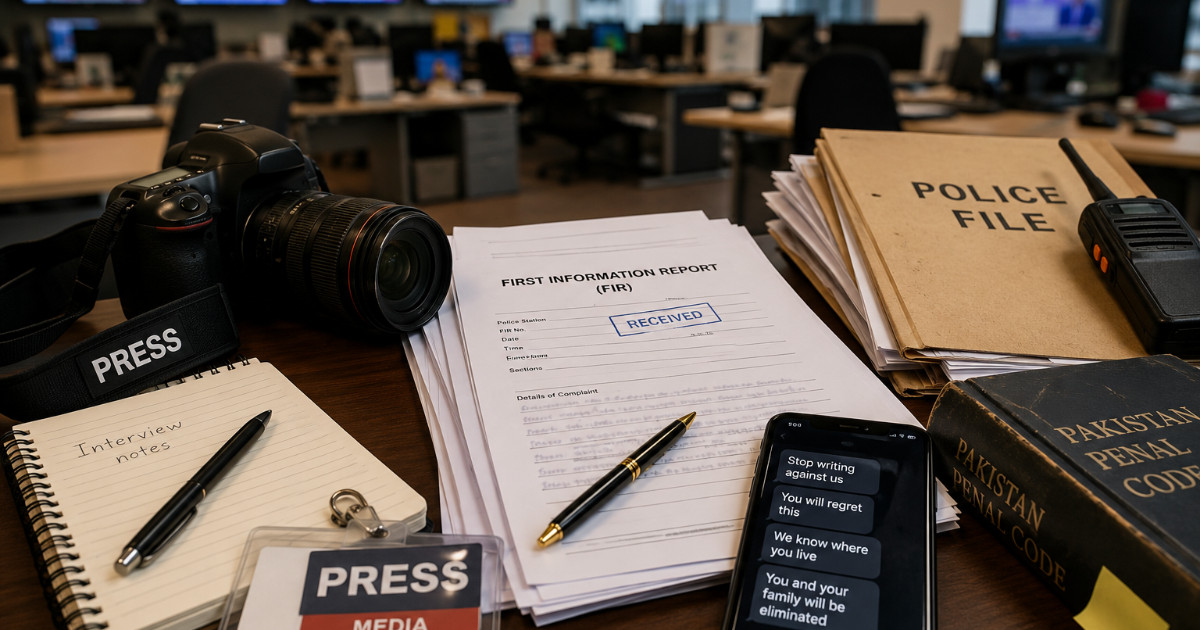
Among those obligations are the provision of safety equipment, training, insurance coverage, and mechanisms for addressing workplace safety concerns. The law also established the Commission for the Protection of Journalists and Media Professionals, which was designed to investigate complaints, resolve them within 14 days, and promote accountability.
The law has already been invoked in practice: when a hospital administration in Islamabad harassed a GTV crew, bureau chief Mateen Haider cited the 2021 Act in his FIR applications.
In practice, many journalists and media advocates argue that implementation has lagged behind legislative intent. Shakeel Ahmed, Secretary-General of the Pakistan Federal Union of Journalists (PFUJ), said one of the biggest challenges remains the lack of a fully functioning enforcement mechanism. “The law exists, but the institutional structure needed to make it effective is still not functioning as it should,” he said.
The situation is further complicated by a longstanding debate over professional classification. While camerapersons are recognized as media professionals under existing legislation, labor representatives have argued that they should also be explicitly recognized as journalists because of their direct role in news gathering.
That debate reached the Islamabad High Court in 2022, when PFUJ challenged the exclusion of photojournalists and camerapersons from parts of the legal definition of journalist. In late March 2022, IHC Chief Justice Athar Minallah validated the union’s position, observing on the record that photojournalists and camerapersons “absolutely fall under the definition of journalists,” and directing the federal government and the Ministry of Human Rights to explain and rectify the exclusion.
For many working camerapersons, however, the debate is less about legal terminology than practical outcomes. Their concerns are straightforward: training, equipment, insurance, and the ability to decline dangerous assignments without fear of professional consequences.
The absence of a newsroom safety culture
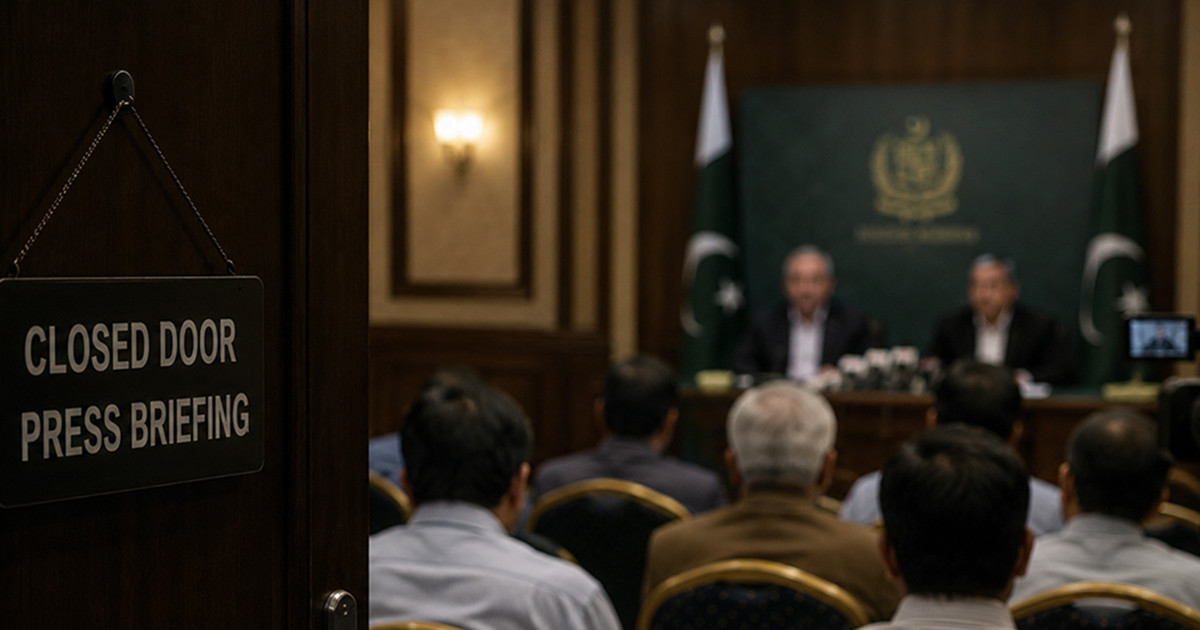
If legal protections remain uneven, many journalists argue that the problem is even more visible inside newsrooms. Interviews conducted for this article revealed a striking lack of formal safety policies governing field assignments.
When asked whether their organizations maintained written safety protocols specifically for camerapersons, senior managers acknowledged that such documentation often does not exist. Dr. Muhammad Asim Siddique of Samaa Digital and Tariq Mehmood of DN 365 News both confirmed their organizations have no written safety policies for field crews, though both said insurance is extended to all staff as part of the employment package.
Kashif Abbasi of the TVCJA believes this creates an accountability gap. “When there is no written policy, it becomes difficult to determine whether safety procedures were followed or whether responsibilities were ignored,” he said.
Noshad Abbas, a senior cameraperson at DawnNews and a TVCJA member, said the absence of an institutional safety culture is pervasive. “We are sent into dangerous situations without being told what to expect or how to protect ourselves,” he said. “Safety has to be built into the assignment, not left to chance.”
Muhammad Shahbaz, a senior cameraperson at Khyber News, echoed him. “In my years of fieldwork, I have never once received formal safety training from any channel,” he said. “We learn on the job, often the hard way.”
What international standards require
Globally, organizations focused on journalist safety have spent years developing guidelines for media workers operating in hazardous environments. The International News Safety Institute (INSI) recommends that journalists and field crews receive hostile-environment training before covering dangerous assignments, and emphasizes employer responsibility for providing protective equipment and insurance. The INSI code is also explicit that no journalist’s career should suffer for refusing a dangerous assignment.
Similar recommendations have been advanced by the International Federation of Journalists (IFJ), which advocates mandatory safety training, adequate insurance, and employer-funded protective gear. The United Nations Plan of Action on the Safety of Journalists, endorsed in 2012, has likewise called on governments and institutions worldwide to strengthen protections and combat impunity for attacks against media workers.
Measured against those standards, many Pakistani media organizations still have considerable ground to cover. The gap is not necessarily one of awareness. The challenge lies in turning awareness into consistent policy and practice.
The economic dimension
Safety concerns cannot be separated from economics. Compared with many reporters and presenters, field crews frequently occupy lower positions within newsroom hierarchies, and wages often fail to reflect the risks associated with the work.
“If people are worried about receiving their salaries, safety equipment can become a secondary concern,” said Nasir Hussain, a former President of the Khyber Union of Journalists. “You cannot ask someone to risk their life when you haven’t even paid them for the last assignment.”
In nearly two decades on the job, Babar Ali says he has received formal recognition just once, a 2021 certificate of appreciation from City News Group. The vulnerability extends even to public-health crises: in April 2020, police in Dera Ismail Khan arrested 24 News cameraperson Wajahat Zaidi alongside his reporter for covering a COVID-19 quarantine facility.
Many camerapersons report the absence of hazard allowances, limited access to insurance, and insufficient support following injuries sustained on assignment. “No media outlet provides proper safety gear for camerapersons,” said Dr. Muhammad Asim Siddique. “Every institution must adopt safety allowances, protective gear, and insurance plans.”
Without institutional investment, media professionals argue, risk is effectively transferred from employers to individual journalists.
Recognition behind the lens
For many camerapersons, another challenge is less tangible but equally significant: recognition. Visual journalism shapes how audiences understand the world, yet the individuals responsible for capturing those images frequently remain anonymous.
“Our hard work is ignored,” said Mohsin Raza. “People see the photograph or the footage, but they often don’t see the person who captured it.” “A reporter lights a cigarette, places the picture on six columns, yet no one asks who took it,” he added of newsroom attribution.
When workers are viewed primarily as technical support staff rather than journalists, investment in training, safety, and professional development can become easier to overlook. Freedom Network’s Impunity Report 2024 recorded six media casualties and 57 violations between November 2023 and October 2024.
For advocates of media reform, improving conditions for camerapersons requires more than distributing safety equipment. It requires changing how the profession itself is perceived.
What needs to change
Despite the challenges, there is broad agreement among journalists, union leaders, and media advocates about what reforms are needed: clear, written safety protocols for field assignments; hostile-environment and risk-awareness training as a standard part of professional development; adequate insurance and access to protective equipment; consistent implementation of existing law, supported by effective institutions; and greater professional recognition of camerapersons as journalists whose work is central to the public’s right to information.
Union leaders echo these points. Afzal Talib, secretary-general of the Lahore Press Club, says policies providing safety allowances or protective measures for camerapersons simply do not exist.
Asad Baig, founder of Media Matters for Democracy, calls them “the backbone of Pakistan’s news industry, yet the most neglected.”
Lala Asad of the PFUJ Sukkur wing argues that “a cameraperson who has never been trained cannot be blamed for misjudging danger,” while Fazil Jamili, president of the Karachi Press Club, says injured camerapersons must receive immediate compensation: “The state benefits from their coverage but bears none of the cost of their suffering.”
These reforms are neither radical nor unprecedented. Many are already reflected in international safety standards and existing legal frameworks. The challenge is ensuring they become routine rather than exceptional.
Beyond the frame
Muhammad Arif Khan moved toward the crowd at Karsaz because that was where the story was unfolding. Imran Shaikh remained at the scene of a bombing in Quetta because the public needed to know what had happened. Haq Nawaz stepped into a boat on the Ravi River because his newsroom needed images of a flood.
Their experiences span different years, different circumstances, and different forms of danger. Yet each reflects the reality that some of journalism’s most important work is carried out by people standing behind the lens.
For decades, Pakistani camerapersons have documented the country’s triumphs, tragedies, crises, and transformations. Yet many continue to perform that work without the protections routinely expected in other high-risk professions.
The question facing Pakistan’s media industry is no longer whether the risks exist. The evidence is abundant. The question is whether news organizations, policymakers, and industry leaders are prepared to act on what they already know.
Every frame carries a story. The people behind those frames deserve to return home safely after capturing it.
ABOUT THE WRITER: The author is a digital journalist covering climate change, artificial intelligence, and technology, with a focus on in-depth reporting, insightful storytelling, and evidence-based analysis. Contact: [email protected]
Key Points
- Camerapersons frequently operate closest to danger during floods, protests, riots and violent incidents.
- Many lack formal safety training, helmets, life vests and basic protective equipment.
- Employers often provide little institutional support or emergency protocols before incidents occur.
- Individual incidents, like Haq Nawaz's accident on the Ravi, highlight systemic neglect.
- Calls for standardized safety policies, training and employer accountability are growing within the industry.
Key Questions & Answers
What risks do camerapersons face on assignments?
Camera operators face floods, crowd violence, explosions, traffic hazards, and toxic environments, often with little protective equipment or safety training.
Why do many camerapersons lack proper safety gear?
Newsrooms and employers often prioritize coverage speed and cost over staff safety, and there are limited industry-wide regulations or budgets for protective gear.
Are there any regulations protecting media workers in Pakistan?
There are no comprehensive, enforced national standards specifically for media safety; protection often depends on individual employers and ad hoc measures during crises.
What measures are being suggested to improve safety?
Advocates call for mandatory training, provision of basic protective gear, clear emergency protocols, insurance, and stronger employer accountability for frontline staff safety.
Ask AI: Understand this story your way
AI EnabledDig deeper, ask anything — get instant context, background, and clarity.
Disclaimer: This feature is powered by AI and is intended to help readers explore and understand news stories more easily. While we strive for accuracy, AI-generated responses may occasionally be incomplete or reflect limitations in the underlying model. This feature does not represent the editorial views of JournalismPakistan. For our full, verified reporting, please refer to the original article.