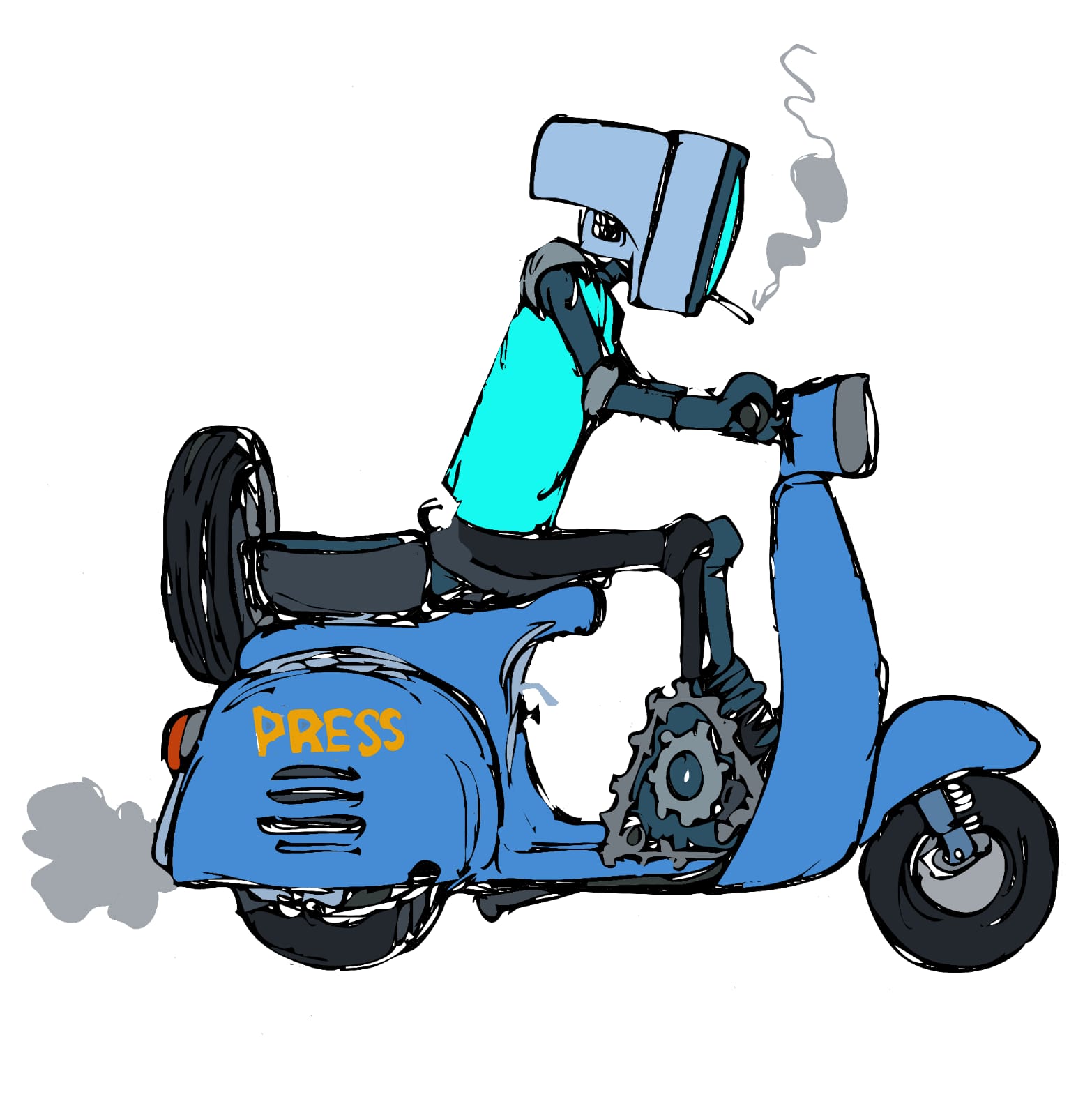

Can journalists trust AI for fact-checking?
JournalismPakistan.com | Published: 22 July 2026 | JP Special Report
Join our WhatsApp channel
AI can speed journalists' research by summarising reports and flagging inconsistencies, but its outputs may be convincingly wrong. Newsrooms maintain human editorial oversight and require independent verification before publication.Summary
Artificial intelligence has become part of many journalists' daily workflows. Reporters and editors increasingly use AI tools to summarize documents, identify potential sources, translate content, and even assist with fact-checking. As these systems become more capable, an important question has emerged: Can journalists trust AI to verify facts?
The answer is nuanced. AI can help speed up research and identify potential inaccuracies, but it cannot replace editorial judgment or established verification methods. Every major newsroom that permits AI use continues to require human oversight before publication because generative AI systems are capable of producing convincing but incorrect information.
Why is AI being used for fact-checking?
Fact-checking has always been a time-consuming part of journalism. Reporters must verify names, dates, quotations, statistics, locations, and claims before publication. AI tools can reduce that workload by quickly searching large volumes of text, comparing documents, highlighting inconsistencies, and suggesting sources for further review.
Modern large language models can also summarize lengthy reports, identify missing context, compare multiple versions of a document, and explain technical topics in accessible language. These capabilities make AI a useful research assistant rather than an independent fact-checker.
Several news organizations have adopted AI policies that allow limited newsroom use while requiring journalists to independently verify all factual claims before publication. Organizations such as the BBC, Reuters, The Associated Press, and others emphasize that editorial responsibility always remains with human journalists.
What can AI do well?
AI performs best when assisting with repetitive and structured verification tasks.
For example, it can:
Summarize lengthy reports
Compare different versions of documents
Identify potentially inconsistent statements
Suggest additional questions reporters should investigate
Help locate publicly available background information
Organize research notes
Translate material into multiple languages for initial understanding
These capabilities can save considerable reporting time, especially during breaking news or investigations involving thousands of pages of documents.
Some AI-powered tools can also help detect manipulated images or videos by analyzing metadata or identifying signs of digital alteration. However, such results should always be confirmed using specialist forensic tools and independent expertise.
What are AI hallucinations?
The biggest challenge is that generative AI systems sometimes produce false information that appears authoritative. These errors are commonly known as hallucinations.
A hallucination occurs when an AI system generates information that is inaccurate, fabricated, or unsupported by evidence while presenting it confidently. This may include invented quotations, fictional court cases, incorrect statistics, nonexistent academic studies, or fabricated citations.
Hallucinations happen because language models are designed to predict likely sequences of words rather than determine objective truth. Although modern models have become significantly more reliable, none can guarantee complete factual accuracy.
This is why AI-generated answers should never be treated as evidence.
Why can hallucinations be dangerous for journalists?
Journalism depends on accuracy, credibility, and public trust.
Publishing AI-generated misinformation can result in:
Incorrect reporting
Damage to a newsroom's credibility
Legal risks, including defamation claims
Public confusion
Amplification of false information
Several lawyers, academics, and professionals have faced criticism after submitting court filings or documents containing AI-generated citations that did not exist. These incidents have become widely cited examples of why AI output requires careful human verification.
The same principle applies in journalism.
Can AI verify online claims?
AI can assist in evaluating online claims, but it cannot independently determine whether a statement is true.
For example, if a social media post claims that a government agency announced a new policy, AI may identify similar reports or summarize available information. However, journalists should still verify the claim by consulting the official government website, published regulations, official statements, or direct communication with relevant authorities.
Likewise, AI should never be used as the sole authority for election results, court rulings, public health guidance, financial information, or breaking news.
What verification practices should journalists follow?
Professional verification standards remain unchanged regardless of AI.
Journalists should:
Confirm every important fact using primary or authoritative sources.
Check quotations against original recordings or transcripts.
Verify statistics from official publications.
Examine original documents whenever possible.
Cross-reference claims with multiple credible sources.
Independently confirm AI-generated citations.
Clearly distinguish verified facts from analysis or opinion.
If AI provides a useful lead, journalists should treat it as the beginning of the reporting process rather than the final answer.
How are newsrooms responding?
Many major news organizations have introduced formal AI guidelines.
Common newsroom principles include:
Human editors remain responsible for published content.
AI-generated material must be reviewed before publication.
Journalists should disclose AI use where appropriate.
Confidential information should not be entered into public AI systems without authorization.
Editorial standards apply equally to AI-assisted reporting.
Industry organizations have issued similar guidance. The European Broadcasting Union, the International Fact-Checking Network, and several press associations encourage responsible AI use while emphasizing transparency, accountability, and human oversight.
Are AI tools improving?
Yes. AI models continue to improve in reasoning, multilingual understanding, and the ability to cite reliable sources. Some systems now retrieve information from current online sources rather than relying solely on pre-trained knowledge, reducing, but not eliminating, the risk of outdated or incorrect responses.
Researchers are also developing methods such as retrieval-augmented generation (RAG), confidence scoring, and source-grounded responses to improve factual reliability. Even so, developers and independent researchers continue to caution that no AI system should be regarded as infallible.
What should journalism students learn?
AI literacy is becoming an essential newsroom skill.
Future journalists should understand both the strengths and limitations of AI. They should know how language models work, recognize common hallucination patterns, evaluate sources critically, and maintain traditional reporting standards.
Journalism education increasingly focuses on verification techniques, digital investigations, AI ethics, transparency, and responsible use of automation.
Rather than replacing reporting skills, AI makes rigorous verification even more important.
Will AI replace human fact-checkers?
Most experts do not believe AI will eliminate the need for professional fact-checkers.
Instead, AI is likely to automate routine research while allowing journalists to spend more time interviewing sources, analyzing evidence, investigating complex issues, and providing context that machines cannot reliably produce.
Ultimately, public trust depends on human editorial responsibility. AI can support verification, but accountability for accuracy remains with journalists and news organizations.
Why this matters
AI is becoming a permanent part of modern journalism, but trust in news still depends on accurate reporting and transparent verification. Understanding where AI helps, and where it can fail, allows journalists, students, and newsrooms to use these tools responsibly without weakening editorial standards or public confidence.
Key takeaways
AI is a valuable research assistant but should not be treated as an independent fact-checker.
Generative AI can hallucinate by producing false information that appears convincing.
Every significant factual claim should be verified using authoritative sources.
Human editorial oversight remains essential in AI-assisted journalism.
Responsible AI use combines technological efficiency with established verification practices.
ATTRIBUTION: Reporting by JournalismPakistan, based on publicly available laws, official documents, newsroom AI policies, academic research, and reporting from credible news organizations where applicable.
PHOTO: By Steve A Johnson on Unsplash
Key Points
- AI can rapidly summarise documents and surface potential inconsistencies.
- Large language models assist research but may produce plausible falsehoods.
- Major newsrooms require human editorial oversight for any AI-assisted work.
- AI is a research aid, not a substitute for established verification methods.
- Independent verification and editorial judgment remain essential before publishing.
Key Questions & Answers
Can journalists trust AI to verify facts?
AI can help find leads and flag inconsistencies, but it can also generate convincing errors; human verification and editorial oversight are required.
How do newsrooms use AI in fact-checking?
Newsrooms use AI to summarise documents, compare sources, translate text and suggest potential sources, while keeping final checks with human journalists.
What are the main risks of using AI for verification?
Risks include hallucinated facts, outdated or biased training data, and misplaced confidence in machine outputs without independent corroboration.
How should journalists verify AI-generated findings?
Journalists should corroborate AI findings with primary sources, official records, expert interviews and standard editorial review before publishing.
Relevant Topics
Ask AI: Understand this story your way
AI EnabledDig deeper, ask anything — get instant context, background, and clarity.
Disclaimer: This feature is powered by AI and is intended to help readers explore and understand news stories more easily. While we strive for accuracy, AI-generated responses may occasionally be incomplete or reflect limitations in the underlying model. This feature does not represent the editorial views of JournalismPakistan. For our full, verified reporting, please refer to the original article.