.png)
Protect media workers: IFJ writes to Sharif
JournalismPakistan.com | Published: 22 January 2014
Join our WhatsApp channel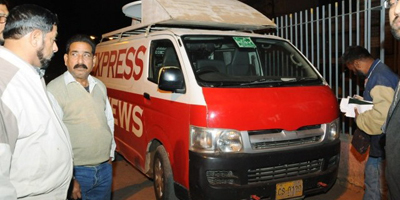
The International Federation of Journalists calls on the Pakistani government to protect journalists after the assassination of three media workers. Protests are ongoing demanding more safety measures.Summary
The International Federation of Journalists (IFJ) has issued a letter to Pakistani Prime Minister Nawaz Sharif, calling for “serious and overdue action” to protect Pakistani journalists and bring attackers to justice following the shooting assassination of three media workers from Express News Television.
The IFJ said in a press release that the Pakistan Federal Union of Journalists (PFUJ) is conducting nationwide action to protest government inaction and call for safer working conditions for media workers. The PFUJ has also declared 10 days of mourning in honor of the three men.
The latest attack brings the number of media workers killed in Pakistan to four in the year to date.
The IFJ said condemning the actions of attackers was “no longer enough” and Pakistan’s government needed to take swift and strong justice for media attacks if it wanted to tackle its rank as the third most dangerous country in the world for journalists.
“This is the third strike on media workers from Express Group and if concerted effort had been made to bring the culprits of these previous attacks to justice, these three men might still be alive,” the IFJ said in its letter to the prime minister.
“The IFJ has issued its report card on Pakistan as one of the most deadly places for journalists; it has condemned attacks that took 10 journalists’ lives in 2013 but these protests seem to fall on deaf ears.
The IFJ went on to say that “the government of Pakistan has failed in its duties to protect media workers when the realities for them are all too apparent. It has failed to bring killers to justice and yet these brave journalists continue to try to do their jobs knowing death is a real repercussion.”
Express News employees technician Waqas Aziz, driver Muhammad Khalid and security guard Muhammad Ashraf were fired upon as they sat in an Express TV van on Friday, January 17. A fourth staff member, a cameraman, was reportedly injured but in a stable condition.
Express News bureau chief Aslam Khan said the van was parked near the Matric Board Office in Nazimabad for a routine assignment when four gunmen on two motorbikes approached the stationary vehicle and opened fire through the window.
The three men were shot multiple times from close range and died soon after. Law enforcers found at least 17 shell casings from 9mm and 32-bore pistols at the crime scene. The Tehreek-e-Taliban Pakistan (TTP) claimed responsibility for the attack.
The brutal shooting has incensed a Pakistan media community weary of the specter of death. IFJ affiliate, PFUJ, continues its nationwide demonstrations, criticizing the government for failing to protect them and calling for industry solidarity in their battle against attacks to silence them in their duties.
“We condemn the brutal murder of three workers of Express News and demand urgent law and order enforcement all over the country”, said the PFUJ.
The PFUJ said Pakistani journalists stood united throughout the country and would not be ‘bogged down by such cowardly acts’.
The attack was not on a specific media group but on the whole journalistic community, it said.
The IFJ said this is not the first time Pakistani Taliban has targeted Express News. Four gunmen on motorcycles fired more than 30 rounds into its Karachi office building in August, injuring one female staffer and a security guard. In the second attack, on December 2, 2013, at least four armed assailants opened fire and tossed homemade bombs at the same office, injuring a guard in the process.
Despite visiting the Express Media office in Karachi twice and constituting investigation teams to probe the two incidents, law enforcement agencies have been unable to arrest even a single perpetrator, the IFJ said.
Pakistan is one of the most dangerous places in the world for journalists and associated staff. The country had the third most media fatalities in 2013, with ten people killed.
On January 1, investigative journalist Shan Dahar (Odhor) was shot and killed on his way home, also the result of an armed assault, taking place in the southern province of Sindh.
In October, the IFJ launched the End Impunity campaign to seek justice for journalist killings in Pakistan, Iran and Russia. The IFJ and PFUJ strongly urge the authorities to pursue those responsible for the latest murders.
“It is time that the Sharif government took its obligations seriously, to ensure justice is done and that the media is able to operate in Pakistan without fear of deadly reprisal,” the IFJ said. As long as impunity runs rife in Pakistan, journalists and media workers will continue to die.”
Key Points
- Three Express News workers were shot dead in Karachi.
- The Tehreek-e-Taliban Pakistan claimed responsibility for the attack.
- The IFJ demands stronger government action against media worker killings.
- Protests led by the Pakistan Federal Union of Journalists are ongoing nationwide.
- Pakistan ranks third in the world for journalist fatalities.
Relevant Topics
Ask AI: Understand this story your way
AI EnabledDig deeper, ask anything — get instant context, background, and clarity.
Disclaimer: This feature is powered by AI and is intended to help readers explore and understand news stories more easily. While we strive for accuracy, AI-generated responses may occasionally be incomplete or reflect limitations in the underlying model. This feature does not represent the editorial views of JournalismPakistan. For our full, verified reporting, please refer to the original article.