
Amar Guriro: Journalism's future is human-AI partnership The JournalismPakistan Global Media Brief | Edition 23 | June 5, 2026 As AI reshapes news, publishers seek a sustainable future Every frame at a cost: The safety crisis facing Pakistan's camerapersons Why journalists are increasingly targeted in conflict zones What the 60 Minutes controversy means for TV journalism Zee secures FIFA World Cup rights in India through 2030 How fact-checkers verify viral videos during breaking news Pentagon restrictions on reporters draw media backlash Israel-Lebanon talks proceed as conflict hinders reporting Why governments are tightening controls on foreign journalists China condemns US restrictions on Xinhua reporter Taiwan condemns China over New York Times reporter expulsion The biggest threats facing journalism in Asia today Press freedom review: The many faces of pressure on the press Amar Guriro: Journalism's future is human-AI partnership The JournalismPakistan Global Media Brief | Edition 23 | June 5, 2026 As AI reshapes news, publishers seek a sustainable future Every frame at a cost: The safety crisis facing Pakistan's camerapersons Why journalists are increasingly targeted in conflict zones What the 60 Minutes controversy means for TV journalism Zee secures FIFA World Cup rights in India through 2030 How fact-checkers verify viral videos during breaking news Pentagon restrictions on reporters draw media backlash Israel-Lebanon talks proceed as conflict hinders reporting Why governments are tightening controls on foreign journalists China condemns US restrictions on Xinhua reporter Taiwan condemns China over New York Times reporter expulsion The biggest threats facing journalism in Asia today Press freedom review: The many faces of pressure on the press
Logo
Janu
Women in Media

Pakistan journo deaths steady at 7: CPJ

 JournalismPakistan.com |  Published: 19 December 2012

Join our WhatsApp channel
Pakistan journo deaths steady at 7: CPJ
The Committee to Protect Journalists reported that seven journalists were killed in Pakistan in 2012, maintaining a grim pattern. Balochistan, the poorest region, recorded four of these fatalities amid ongoing conflicts.

NEW YORK: Pakistan, the deadliest place for journalists in 2010 and 2011, dropped two notches this year, but the number of fatalities held steady at seven, the Committee to Protect Journalists (CPJ) found in its yearly analysis.

Four of those killings took place in Balochistan, the country’s poorest region and a scene of protracted violence between separatists, anti-separatists, various tribes and ethnic groups, Pakistani security forces and intelligence agencies, and groups aligned with the Taliban.

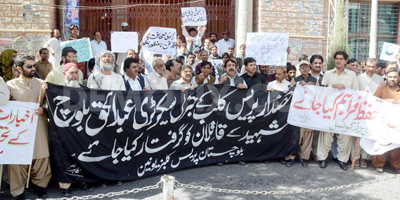
Among the victims was Abdul Haq Baloch, a correspondent for ARY Television, who was shot in September as he was leaving the Khuzdar Press Club, where he served as secretary-general. The authorities have held no one accountable in the killing, which is the near-universal result in media murders in both the region and across the nation.

“The fact that journalists are targeted so frequently in Balochistan has to do with the nationalist movement,” said Malik Siraj Akbar, founder and editor of The Baloch Hal and a native of Balochistan who now lives in the United States.

“There is a revolt across the entire province of Balochistan against the government. As one journalist gets killed in Khuzdar, and the government takes no action, it promotes a culture of impunity and emboldens the targeting of journalists elsewhere.”

The CPJ said the number of journalists killed in the line of duty increased sharply in 2012, as the war in Syria, a record number of shootings in Somalia, continued violence in Pakistan, and a worrying increase in Brazilian murders contributed to a 42 percent increase in deaths from the previous year.

Internet journalists were hit harder than ever, while the proportion of freelancers was again higher than the historical average.

With 67 journalists killed in direct relation to their work by mid-December, 2012 is on track to become one of the deadliest years since CPJ began keeping detailed records in 1992.

The worst year on record for journalist killings was 2009, when 74 individuals were confirmed dead because of their work—nearly half of them slain in a massacre in Maguindanao province, Philippines.

CPJ is investigating the deaths of 30 more journalists in 2012 to establish whether they were work-related.

More here

Key Points

  • Seven journalists killed in Pakistan in 2012.
  • Balochistan accounted for four journalist deaths.
  • Impunity for journalist killings remains prevalent.
  • Abdul Haq Baloch was among the victims.
  • CPJ reported rising violence against journalists globally.

Ask AI: Understand this story your way

AI Enabled

Dig deeper, ask anything — get instant context, background, and clarity.

Not sure what to choose? Try one of these.

The AI generates results based on your selected options
Your AI-generated results will appear here after you click the button.

Disclaimer: This feature is powered by AI and is intended to help readers explore and understand news stories more easily. While we strive for accuracy, AI-generated responses may occasionally be incomplete or reflect limitations in the underlying model. This feature does not represent the editorial views of JournalismPakistan. For our full, verified reporting, please refer to the original article.
Explore Further

Newsroom
Amar Guriro: Journalism's future is human-AI partnership

Amar Guriro: Journalism's future is human-AI partnership

 June 05, 2026 Amar Guriro, founder of Pakistan's first AI-powered news platform, says journalism's future rests on human-AI collaboration to improve reporting while preserving editorial oversight.


The JournalismPakistan Global Media Brief | Edition 23 | June 5, 2026

The JournalismPakistan Global Media Brief | Edition 23 | June 5, 2026

 June 05, 2026 Global Media Brief reviews pressures reshaping journalism, press freedom, AI and platform power, and reports BBC's Emmy, 60 Minutes turmoil and Taiwan's protest.


As AI reshapes news, publishers seek a sustainable future

As AI reshapes news, publishers seek a sustainable future

 June 05, 2026 At the World News Media Congress in Marseille, publishers discussed how generative AI is altering newsroom workflows, audience engagement and content licensing.


Why journalists are increasingly targeted in conflict zones

Why journalists are increasingly targeted in conflict zones

 June 04, 2026 Journalists in conflict zones face rising danger as combatants, states and militias increasingly target independent reporting to control narratives.


What the 60 Minutes controversy means for TV journalism

What the 60 Minutes controversy means for TV journalism

 June 03, 2026 The 60 Minutes controversy at CBS exposes tensions over leadership, editorial independence and pressures on legacy TV journalism amid political polarization.


Popular Stories