.png)
From Pele to Ronaldo: Ranking Brazil's greatest World Cup players ever
JournalismPakistan.com | Published: 16 June 2026 | Dr. Nauman Niaz (TI)
Join our WhatsApp channel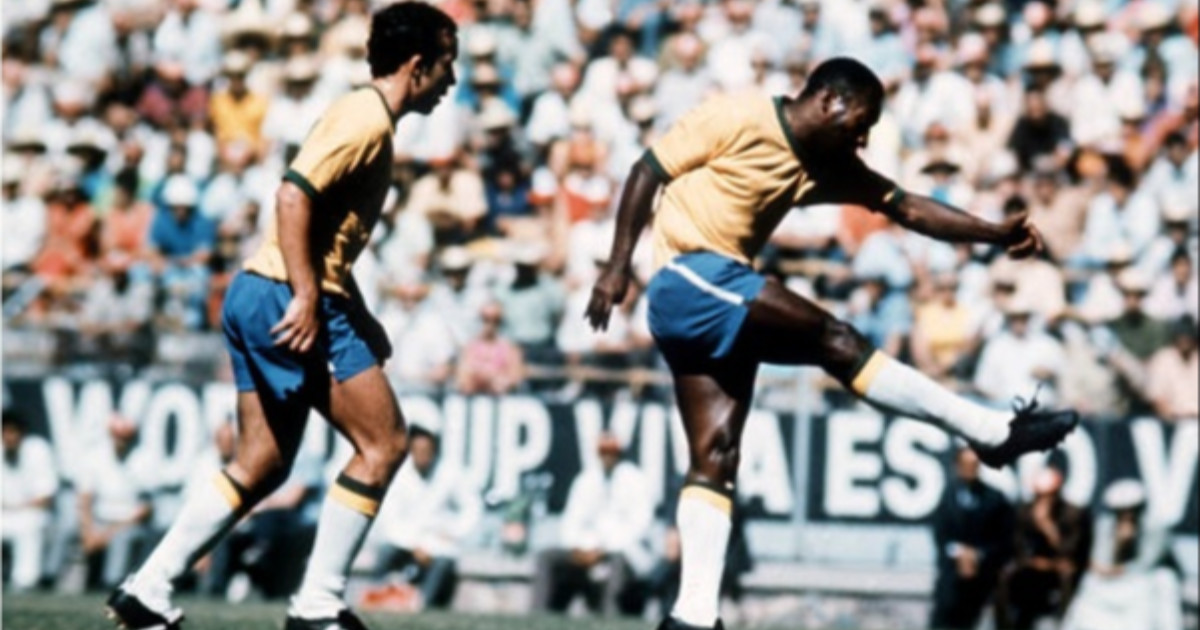
This article ranks Brazil's most influential World Cup players, examining careers from early squads to modern icons. It assesses each player's impact on tournament outcomes and on Brazil's stylistic identity, balancing achievements, skill, and cultural significance.Summary
ISLAMABAD — Some nations play football, and there is Brazil. The distinction is not one of degree. It is one of a kind. Where others pursue the game as contest, as effort, as the grinding accumulation of advantage, Brazil has always approached it as though the ball were a living thing that must be coaxed rather than struck, persuaded rather than driven, and the great figures who have worn the canary yellow have been less athletes than artists who happened to work in a medium of leather and grass and extraordinary human skill.
The color itself tells you something. Amarelo e verde. Yellow and green. Not the blue of authority, not the red of passion, simply stated, but something more abundant, more solar, more extravagant in its implications. When Brazil walks onto a field in those shirts, the world leans slightly forward. It has been doing so since 1930. It has never entirely stopped.
The Early Years: From Uruguay 1930 to the Maracanazo
Uruguay in 1930 was the first stage, and Brazil arrived at it carrying the particular confidence of a country that had invented its own relationship with the game. They had taken the sport, introduced by English merchants and Scottish railway engineers in the dying years of the nineteenth century, and had done with it what cultures do when they are genuinely creative: they had changed it into something unrecognizable to its originators. The English game was organized, functional, and rectangular in its ambitions. The Brazilian game, even in those early years, was something rounder, more conversational, more disposed toward the individual moment of beauty.
They departed the 1930 tournament after the group stages, beating Bolivia yet falling to Yugoslavia, and the result told less than the manner. There was already, in the best of their football, a looseness of the hip, a readiness to improvise, that the northern European game had never considered a virtue. Brazil considered it the whole point.
In 1934, Italy fared no better, eliminated by Spain in the first round, and the record shows nothing that the record can adequately hold. The game was there. The players were there. The stage was not yet ready, or perhaps Brazil was not yet ready for the stage in the way that it would one day be.
Leonidas and the Promise of 1938
1938 in France changed the terms of the discussion permanently. Leonidas da Silva stepped forward, and forward is the right word, because he seemed always to be moving into space that others had not yet perceived as space. He scored seven goals and wore the tournament like a vestment made specifically for him. His bicycle kick was not a trick. It was a solution to a problem that most footballers would not have recognized as a problem at all, the ball behind him, the goal ahead, the conventional methods of connection unavailable. Leonidas found the connection anyway, through the air, through inversion, through the refusal to accept physical limitation as anything more than a temporary inconvenience.
Brazil reached the semi-finals and were beaten by Italy, who were, that summer, the finest team in the world by any measure except the Brazilian one, which asks not only how many goals you scored but whether, in the scoring of them, you gave the crowd something worth having carried home in the memory. By that measure, Brazil in 1938 would not have lost.
The Maracanazo: 1950 and the Wound That Never Fully Healed
Then came the gap of the war years, and when the World Cup returned in 1950, it returned to Brazil itself. The Maracanã had been constructed at a scale that suggested not so much confidence as certainty. A quarter of a million people could attend the final, and the Brazilians had arranged the tournament in their minds so that the final would be theirs to win. The mathematics were favorable. The opposition was Uruguay, a small country with a large cricketing disregard for the idea that size should determine outcome.
What happened on the sixteenth of July 1950 is known in Brazil as the Maracanazo, a word that carries within it the full weight of the thing. It is the name of a catastrophe. Alcides Ghiggia's winner past Moacir Barbosa with eleven minutes remaining produced a silence in that enormous stadium that observers described as the sound of collective grief made audible. The crowd did not make noise. The crowd had the noise taken from them. Barbosa lived for the rest of his long life under the shadow of that moment, the goalkeeper blamed for a defeat that had been, in truth, a nation's presumption brought to account by a very good Uruguayan side playing with the particular freedom of those who have been counted out.
Brazil wept. And then, in time, Brazil began to understand that what it had lost was not a World Cup final but an illusion about the World Cup final, and that the game was harder and stranger and less obedient to expectation than the Maracana had been asked to contain.
Pele, Garrincha, and the Golden Age: 1958 to 1962
Sweden in 1958 is where the century's argument about football's highest possibilities was settled, or at least where the first definitive evidence was submitted. Brazil brought to that tournament a seventeen-year-old from Tres Coracoes in Minas Gerais whose name the world was about to learn to say with a reverence it reserved for almost nothing else. Pele. Edson Arantes do Nascimento. The boy who played with the maturity of a master and the joy of someone for whom maturity and joy had never competed.
But the team was more than Pele, though the world sometimes forgot this in the decades of retelling. Didi controlled the middle of the field with a somberness that seemed to organize the game around him rather than in opposition to him. Garrincha, the Alegria do Povo, the Joy of the People, worked from the right wing with a body that had been damaged by childhood polio and a technique that was consequently strange, irregular, and almost entirely unstoppable. His right leg was shorter than his left. Both legs were curved in the same direction. In a rational world, he would have been a restricted footballer. In the world that actually existed, he was one of the most dazzling wingers the game has ever seen, because he had learned to use what he had rather than what convention suggested he should need.
Brazil defeated Sweden five to two in the final. Pele scored twice, including a goal in which he received the ball on his chest, flicked it over a defender's head, spun, and volleyed it into the net before it touched the ground. He was seventeen. The Swedish crowd, who had come to cheer for their own, stayed at the end to applaud Brazil, because there are moments in football when partisanship dissolves in the presence of something that clearly deserves a better audience than any single nation can provide.
Chile in 1962 brought them back as holders, and they defended the title without Pele, who was injured after two matches, in a manner that revealed the extraordinary depth of what they had assembled. Garrincha became, for those weeks, the most important footballer in the world. He was not a consistent player in the way that the great technicians are consistent. He was a player of the decisive moment, and in Chile every moment he chose to be decisive, he was. Vava and Amarildo contributed the goals. Garrincha supplied the illumination. Brazil won the World Cup for the second consecutive time and returned home to a celebration that understood itself as something beyond sport.
England 1966: The Tournament That Should Not Have Happened to Pele
England in 1966 brought them grief of a different kind. The tournament was played on English grounds in the English style, which in that era meant a physical commitment to preventing football from happening that Brazil found not only tactically difficult but philosophically offensive. Their great players were kicked. Pele in particular was subjected to treatment that the referee permitted and that the footballing world watched with the particular distaste of those who have seen art vandalized and been powerless to prevent it. Brazil departed in the group stage. Pele, in pain and disgust, announced that he would never play in a World Cup again. He was wrong, and the world is fortunate that he was.
Mexico 1970: The Greatest Team in Football History
Mexico in 1970 is the tournament that those who were old enough to watch it cannot discuss without a change in the quality of their voice. It was the first World Cup broadcast in color, and Brazil wore yellow against the saturated green of Mexican pitches beneath a Mexican sun, and everything about it, the light, the shirts, the football, seemed to have been arranged by someone with an uncommonly strong sense of visual drama.
The team that Pele led in 1970 is, by the near-universal agreement of those qualified to judge, the finest national side in the history of the sport. This is not sentiment. It is a factual assessment of a collection of players that included, alongside Pele in his absolute prime, Jairzinho on the right wing (who scored in every match of the tournament, a feat never replicated), Rivelino whose left foot was a weapon of such precision it seemed almost unfair, Tostao whose intelligence and movement created the spaces that others exploited, Gerson whose passing carried the game's tempo in his sole discretion, and a captain, Carlos Alberto Torres, who scored in the final the goal that is most commonly selected as the greatest in the history of the competition.
That goal. Pele received the ball on the right side of the penalty area and, without looking, slid a pass into the path of Carlos Alberto, who was arriving at speed from deep on the right side. The timing was perfect. The placement was perfect. The execution was perfect. Carlos Alberto drove it into the bottom corner with the certainty of a man delivering something that had already been decided elsewhere. It was the fourth goal in a four-to-one victory over Italy. It arrived when Brazil already held the game in their hands, which somehow made it more rather than less extravagant. They did not need it. They gave it anyway. That was the thing about the 1970 Brazilians. They played as though football were not a competition with victory at its end, but a performance with beauty at its centre, and victory was simply what happened when you played that way with these players.
Pele collected the Jules Rimet trophy after the final and wept, and then lifted the trophy above his head, and every camera on the Azteca Stadium turned toward him, and the image has not lost a particle of its force in the fifty years since.
Brazil won the right to keep the Jules Rimet permanently, having won it three times. They kept it in a glass case in the offices of the Confederacao Brasileira de Futebol in Rio de Janeiro, until 1983, when it was stolen and never recovered. Even the trophy itself has a Brazilian story: claimed, celebrated, then lost, the loss never quite explained, and the absence never quite filling in the space that the thing left behind.
From the Jules Rimet to the Mineirazo: Brazil's Long Road After 1970
After 1970, Brazilian football entered a period of complex readjustment. The country continued to produce extraordinary players. The world continued to watch with attention and sometimes amazement. But the World Cup itself, which had begun to feel like a property of Brazil's in the way that certain restaurants belong to certain regular customers who have eaten there so long they have become part of the furniture, began to resist them.
In West Germany in 1974, Brazil played beautiful football and did not win. Johan Cruyff's Netherlands played Total Football, which was a different kind of beauty, more systematic, more intellectual, and the tournament became an argument between two aesthetic philosophies that the Dutch marginally won on the day, though Brazil left with their honor maintained and their football unreproached.
Argentina in 1978 brought a team of considerable quality, including a young midfielder named Zico who was beginning to accumulate the evidence that would eventually make him one of the indispensable Brazilian players. They finished third, having played with consistent excellence against a host nation that had the particular advantage of knowing it would be going home to a military government if it failed.
Spain 1982: The Most Heartbreaking Brazilian Performance of All
Spain in 1982 produced what many regard as the most heartbreaking Brazilian performance in a World Cup. Tele Santana assembled a team of such evident quality and such determined commitment to attacking football that watching them was a sustained pleasure of the kind that sport rarely provides. Zico was at his peak. Socrates, doctor of medicine and footballer of profound intelligence, orchestrated the midfield with a casual authority that suggested he could have been doing several things simultaneously and still been the best at all of them. Falcao, Junior, Eder, a team of individuals who had become, without surrendering their individuality, a collective.
They led Italy two to one in the second group stage and needed only a draw to proceed to the semi-finals. Italy, through Paolo Rossi, who was returning from a match-fixing suspension and who scored a hat-trick in twenty-five minutes with the specific ruthlessness of a man settling accounts, won three to two. Brazil was eliminated. The football world, which had wanted Brazil to win, understood that what had been lost was not a World Cup place but a particular and irreplaceable way of playing that might not be assembled again.
1994 and 2002: Titles Without the Old Romance
Mexico in 1986, the United States in 1994. The years accumulated without the title, and the football, still admirable, still bearing the hallmarks of the culture, became in some periods more cautious, more European in its instincts, as though Brazil had concluded, not entirely wrongly, that being beautiful had limits as a strategy.
The 1994 World Cup in America was won through organization and defensive resolution rather than through the old exuberance. Romario and Bebeto scored goals of real quality and formed a partnership of complementary skills, but the football was less instantly recognizable as Brazilian than any title-winning campaign before it. They beat Italy on penalties in the final in what had been, by the standards of the occasion and the participants, a remarkably unentertaining match. They were world champions for the fourth time. The jubilation was genuine. The romance was different.
South Korea and Japan in 2002 gave Brazil the last World Cup they have held. Ronaldo, recovering from a collapse before the 1998 final that had left the football world shaken and confused, returned to form across those weeks with a force that seemed to carry personal redemption at its centre. He scored eight goals. He scored two in the final against Germany. He celebrated with a haircut that the world mocked and then, in time, came to find oddly charming, because the story of those weeks was charming in the specific way that human recovery from genuine darkness is always charming.
Ronaldinho was in that squad, young and elastic and already hinting at the extraordinary player he would become. Rivaldo contributed goals of real quality. Cafu and Roberto Carlos pushed relentlessly from the fullback positions. It was a Brazilian team in the Brazilian tradition, even if the tradition was now wider, more hybrid, more aware of the tactical sophistication of opponents who had spent decades studying how to contain the things Brazil did instinctively.
The Mineirazo: Seven to One and the Weight of a Nation's Grief
Since 2002, there has been no title. Germany in 2014 as host nation produced the seven to one semi-final defeat against the Germans that has its own name now, the Mineirazo, a word shaped like the one that followed 1950 because the wound has a similar shape. Neymar was absent through injury. David Luiz and Thiago Silva were absent through suspension for the semi-final. The team fell apart in a way that revealed, beneath the talent, a structural frailty that the talent had been concealing. Seven to one. Germany scored four times in the first six minutes of the second half. The Brazilian crowd, who had come expecting a final and found instead a rout, began to weep while the match was still in progress. The images of those faces in the Estadio Mineirao carry a grief that any Brazilian crowd carries toward football, the grief of a people for whom the game is not entertainment but identity, and whose identity had, for that ninety minutes, been publicly and comprehensively dismantled.
The Greatest Brazilians: Ranking the Players Who Redefined Football
To rank them is to do a certain violence to each of them, because the ranking implies comparison and comparison implies a common standard, and the truth is that Pele and Garrincha and Ronaldo and Zico were different enough from each other that placing them on a single scale is an act of artistic compression rather than mathematical accuracy. But the scale exists, and the placing must be attempted, because the question is worth engaging with honestly.
Pele scored over a thousand goals. He won three World Cups at 17, 21, and 29. He played the game with a physical completeness that no one before or since has matched: pace, strength, aerial ability, both feet, vision, the capacity to score goals of any type from any position. In the 1970 World Cup, he produced a save of the sort a goalkeeper makes by heading the ball over the crossbar without it touching him, the ball passing beside him as he moved in anticipation and not finding the destination it had chosen. He read the game ahead of where it was. He was not just the best footballer of his era. He was the benchmark against which the concept of the best footballer is measured, and the fact that the argument about whether others have surpassed him continues sixty years after his peak is the highest compliment available.
Garrincha was not, by any conventional analysis, better than Pele. But he was a stranger, more singular, more completely unlike anything the game had produced before or has produced since. His body should not have allowed him to play football at this level. His body had not received that particular instruction. He played in the 1958 and 1962 World Cups and was the best player in both, which is the only double that only Pele has matched. In 1962, he won the tournament. He dribbled past defenders with a movement that no one could adequately describe or predict because the mechanics of it were specific to his own particular anatomy. He was also, in the life beyond the football, a man of great human difficulty, of alcoholism, accusations of bestiality, and sorrow, and the contrast between what he was on the field and what the field demanded he become off it is one of the sadder stories in the game.
Ronaldo, before the collapse at the 1998 final. After the recovery and the 2002 World Cup. The bracket in the middle does not diminish what came before and after it. He was the most physically complete centre forward of the modern era, quick enough to dribble past defenders from a standing start, strong enough to hold the ball against professional defenders at full resistance, accurate enough to score from positions and angles that most forwards would not have considered positions and angles at all. His two goals in the 2002 final were the goals of a man who understood that the occasion required something simple and precise and irreversible, and he provided both.
The comparison was applied to him as a compliment, and he endured it graciously, but Zico was not a version of Pele. He was something else: a player of exceptional technical precision, a free-kick taker of such accuracy that opponents positioned walls with the specific anxiety of those who know the ball will find a way around them regardless, a leader in the Brazilian sense, which means one who carries a team not through instruction but through the quality of what he does when the ball arrives at his feet. The 1982 World Cup should have belonged to him. That it did not is history's omission, not his.
The Second Tier of Greatness: Ronaldinho, Didi, and Socrates
Between 2004 and 2006, Ronaldinho was the best footballer in the world, and he played in a manner that made people who had not previously been interested in football interested in football because they could not believe that a human body could move in the way he moved, or that a football could be made to travel in the directions his feet directed it. His smile was genuine, and so was his football, which in him was the same thing, an expression of joy in the game that translated directly into the acts of playing it. He won the World Cup in 2002 as a peripheral presence. He deserved the tournament that would have been arranged around him in his absolute prime, and no such tournament arrived in the necessary form.
Didi invented the falling leaf free-kick, the ball struck with backspin that dips beneath the wall and deceives the goalkeeper in two consecutive ways, first by appearing to clear the wall and then by not clearing the destination the goalkeeper expects. He played in three World Cups and won two of them, and he was the conductor of the 1958 team, the player around whom the music organized itself. He is not discussed enough by those who discuss the great Brazilians.
Socrates is not ranked seventh because he was the seventh-best Brazilian footballer. He is ranked seventh because the World Cup did not give him what he deserved, and the World Cup is the measure being applied. But within those constraints, his qualities were as distinguished as any on this list: a passing range of real breadth, a vision that saw options before they materialized, and a commitment to playing football as an expression of something beyond winning that was not naivety but a considered philosophical position, arrived at after considerable thought by a man who was thinking about several things simultaneously, including, but not limited to, football.
Rivellino's long-range shooting was an event in itself, each strike carrying within it the suggestion of something slightly beyond normal human force applied in that direction. He played in three World Cups and brought to each of them a technical quality that was immediately recognizable as belonging to a tradition that only Brazil had developed to this degree.
Cafu played in three World Cup finals and won two of them. He did not arrive in those finals as a peripheral contributor. He arrived as a central figure, a player who made the entire right side of the Brazilian structure function with an energy and quality that transformed what a fullback was expected to contribute. He was quick, committed, accurate in his deliveries, and possessed of the particular resilience that playing three finals in three separate tournaments demands of the body and the mind.
Jairzinho, the hurricane, scored in every match of the 1970 World Cup. Six matches, six goals, a record that has not been equalled, and in the context of that particular tournament, against that particular opposition, has the quality of a fact that should not be possible but is. He played on the right wing in a team so rich in attacking talent that his contribution was sometimes obscured by the total effect, but the individual achievement holds and always will.
Brazil and the Jogo Bonito: A Standard That Changed the World
Brazil has produced more players who have materially changed the game's understanding of its own possibilities than any other nation. England invented it. Uruguay and Argentina mastered it early. Germany systematized it. The Netherlands intellectualized it. Italy fortified it. But Brazil expanded it, repeatedly and irreversibly, by asking of the game questions that the game had not previously known it could answer.
The jogo bonito is a phrase that Brazilians did not originally give themselves. It was given to them by others who watched and needed language for what they were seeing. The beautiful game. It is not always beautiful. It is not always Brazilian. But when it reaches the standard that the phrase was invented to describe, the thing being described is usually Brazilian in some essential way, even when the players who are doing it are not Brazilian at all, because the aesthetic has spread, as aesthetics do, across the borders of its origin.
Five World Cups. More than any other nation. The record does not capture the relationship, which is not a record but a love affair, conducted in public, across nearly a century, between a people and the game that they have made, in ways that cannot be entirely explained, their own. The ball rises in the arc of a Didi free-kick, or it finds Pele on his chest in a Stockholm final, or it arrives at the feet of Carlos Alberto at the Azteca and the boot meets it and it goes where it was always going to go, into the corner of the net, into the corner of the century, and the crowd makes the sound that crowds make when they have witnessed something they will spend the rest of their lives trying to describe adequately.
They have not always been the best team at every tournament they entered. They have, at the tournaments they won, been something richer than the best team: a demonstration of what the sport can be when it is played by people who were born understanding that the purpose of the game is not only to win it but to play it in a manner that justifies the watching, that repays the hours of attention, that sends the crowd home with something that was not there before.
That is what Brazil has given the World Cup since 1930. Not only titles, though the titles are five, and the nearest rival has four. Not only players, though the players are among the most gifted the world has seen in any sport in any century. But a standard. A way of understanding what the thing is for. An argument, conducted across ninety-five years and counting, that football at its summit should look like something worth seeing, something that earns its audience, something that reaches toward beauty as well as victory and occasionally, in the finest moments, achieves both simultaneously. The green and gold. The five stars above the crest. The name that needed no other identification. Brazil.
ABOUT THE WRITER: Dr. Nauman Niaz, a Post Doctorate (Oxford), PhD (UWA), FRCP (London), FRCP (Edinburgh), FRCP (Ireland), FRCP (Glasgow), CST (Endo, UK), MSc Biomechanics & Kinesiology (UWA), MRCP (UK), MBBS (Pb) is a civil award winner (Tamagha-i-Imtiaz) in Sports Broadcasting & Journalism. He is a regular cricket correspondent, having covered 54 tours and three ICC World Cups, and has written over 3700 articles. He has authored 19 books and is the official historian of Pakistan Cricket (Fluctuating Fortunes IV Volumes - 2005). His signature show Game On Hai has been the highest in ratings and acclaim.
Key Points
- Brazil's football culture and style are central to the nation's World Cup legacy.
- The piece traces Brazil's journey from the 1930s through defining World Cup moments.
- Rankings highlight icons such as Pelé, Garrincha, Ronaldo and other transformative players.
- Evaluation uses criteria like tournament impact, skill, achievements and lasting influence.
- Famous events such as the Maracanazo and Brazil's global influence are considered.
Key Questions & Answers
What criteria were used to rank the players?
Players were assessed on World Cup performances, match impact, individual skill, contributions to team success, and broader influence on Brazil's football identity.
Are only World Cup performances considered?
Primarily World Cup achievements and performances drive the ranking, but broader career impact and cultural significance are also taken into account.
Which periods of Brazil's history are covered?
The ranking spans Brazil's early international years from the 1930s through mid-century icons to modern tournament stars.
Does the ranking include non-playing factors like cultural influence?
Yes. Cultural impact, public legacy, and the way players shaped Brazil's footballing style are part of the evaluation.
Ask AI: Understand this story your way
AI EnabledDig deeper, ask anything — get instant context, background, and clarity.
Disclaimer: This feature is powered by AI and is intended to help readers explore and understand news stories more easily. While we strive for accuracy, AI-generated responses may occasionally be incomplete or reflect limitations in the underlying model. This feature does not represent the editorial views of JournalismPakistan. For our full, verified reporting, please refer to the original article.