.png)
Read it your way: How JournalismPakistan's AI feature works
JournalismPakistan.com | Published: 23 April 2026 | JP Staff Report
Join our WhatsApp channel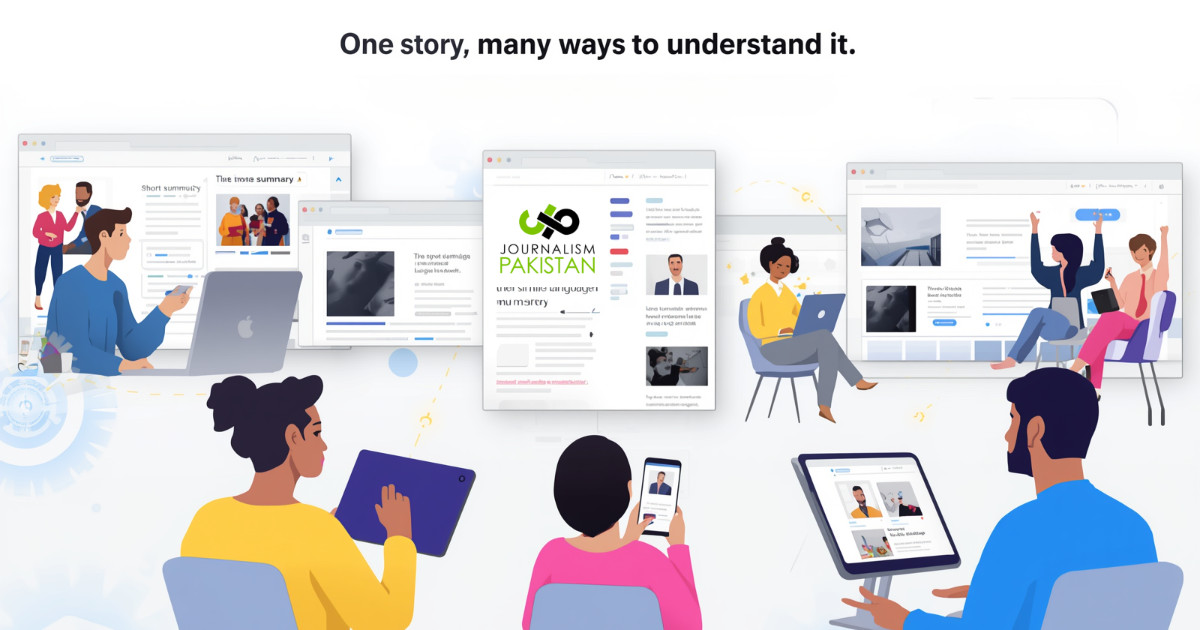
Journalism Pakistan's AI feature lets readers view each article in multiple formats - summaries, simple language, bullet takeaways, Urdu explanations, background and practical implications, while keeping our original reporting intact. It adapts presentation to reader needs to improve comprehension and engagement.Summary
ISLAMABAD — Digital journalism is changing. For many years, news websites followed the same pattern: publish a story, present it in one format, and expect every reader to engage with it in the same way. That model still works to a point, but today’s audiences expect more. They want clarity, flexibility, and the ability to understand news in the way that suits them best.
This is where JournalismPakistan.com is taking an important step forward. Its new AI-powered feature is designed to help readers interact with stories more usefully. Instead of being limited to one format, readers can now explore the same article in different ways depending on what they need.
The problem
Traditional article pages usually offer only one version of a story. The same headline, structure, and writing style are shown to every reader, even though readers have different needs.
Readers are not all the same. Some want a quick understanding of the main issue, while others want more context. Some prefer simple language, while others want practical takeaways or background. A single version of an article cannot serve all of these needs equally well.
What different readers may need
- Some want quick summaries
- Some prefer simple language
- Some need bullet-point takeaways
- Some look for Urdu explanations
- Some want background and context
- Some want practical implications
The gap
This creates a gap between publishing and understanding. A story may be well reported and important, but that does not automatically mean every reader will absorb it in the same way. The information is there, but the understanding may still feel difficult, slow, or incomplete for many readers.
That gap becomes even more noticeable when a story covers complex issues such as media law, press freedom, misinformation, newsroom policy, or the changing role of technology in journalism. These topics matter, but they often require more than one reading style.
The solution
JournalismPakistan.com has introduced this new AI feature to help close that gap. Instead of being limited to a single version of an article, readers can now experience the same story in different formats based on their needs and preferences.
What readers can get
- Summary
- Key points
- Full report format
- Question-and-answer version
- Background explanation
- Why the story matters
- Practical takeaways
- Simple Urdu explanation
- Urdu summary
This means the original article remains central, but the path to understanding becomes more flexible.
Why this matters for readers
This feature gives readers more control over how they engage with a story. A reader who is short on time can choose a summary. Someone who wants a quick scan can choose key points. A person looking for deeper understanding can choose a report format, background explanation, or Q&A version. Readers who are more comfortable in Urdu can choose an Urdu explanation or summary.
This makes the experience more useful and more inclusive. Instead of forcing all readers into one format, the platform allows them to choose the version that works best for them.
Benefits for the readers
The reader benefits in several direct ways. The feature saves time, improves clarity, and makes the article more approachable. It helps readers move quickly from reading to understanding.
How readers benefit
- Stories become easier to understand
- Important points can be found more quickly
- Complex topics feel more accessible
- Readers can choose the format that suits them
- Urdu-speaking audiences can engage more comfortably
- Different readers can get different value from the same story
How this strengthens journalism
The update also reflects a broader shift in digital journalism. Good journalism is not only about reporting facts, but also about making them understandable. This feature helps one story become useful in multiple formats, makes complex topics more accessible, allows students and young journalists to learn more easily, shows how AI can support journalism instead of replacing it, and makes understanding a more active part of reporting.
What this means for journalism
- One story becomes useful in multiple formats
- Complex topics become more accessible
- Students and young journalists can learn more easily
- AI supports journalism instead of replacing it
- Understanding becomes part of reporting
This is important because it shows AI being used as a support tool, not as a substitute for reporting. The original journalism remains the foundation. The AI simply helps readers engage with it more effectively.
A wider shift in journalism
This update reflects a wider shift in how journalism is evolving. In the traditional model, readers came to a website mainly to read a story. In the emerging model, readers can choose how they want to understand it. This marks an important change, where understanding becomes just as important as publishing.
That shift matters because news platforms are no longer judged only by how much content they produce. They are also judged by how clearly and usefully they help audiences engage with that content.
How this gives JournalismPakistan.com an edge
This feature sets JournalismPakistan.com apart from traditional news platforms. Most websites still publish a single version of a story and leave interpretation entirely to the reader. JournalismPakistan.com takes a different approach by actively helping readers understand the news.
Why this matters for JournalismPakistan.com
- Creates a more modern user experience
- Improves engagement
- Adds educational value
- Serves both English and Urdu audiences
- Strengthens digital identity
- Differentiates the platform from standard news sites
This is where the feature becomes more than a technical update. It becomes a strategic advantage. It helps the website offer something more meaningful than a standard article page.
Looking ahead
The future of news platforms is not only about producing more content. It is also about making content more usable, more accessible, and more meaningful for different audiences. By introducing this feature, JournalismPakistan.com is taking an important step toward that future.
This matters because modern audiences want more than access to information. They want understanding, context, speed, flexibility, and relevance. A platform that can offer all of these things is better placed for the future of digital journalism.
Final thoughts
JournalismPakistan.com’s new AI feature is a practical response to a real problem in online journalism. Traditional article pages usually offer just one version of a story, but readers have many different needs. This feature helps close that gap by giving audiences multiple ways to engage with the same reporting.
In simple terms, it moves the platform from a model based only on reading to one based on understanding. That is why this update matters. It improves the reader experience, supports journalism, adds educational value, and helps JournalismPakistan.com stand out in a crowded digital media space.
Key Points
- AI offers multiple presentation formats for a single article to suit diverse reader needs.
- Options include quick summaries, simplified language, bullet-point takeaways and Urdu explanations.
- The feature closes the gap between publishing and understanding by adapting content style.
- Readers can choose formats that prioritize clarity, context, or practical implications.
- The tool aims to boost comprehension, accessibility and audience engagement across audiences.
Key Questions & Answers
How does the AI feature work?
The AI analyzes the original article and generates alternative presentations-summaries, simplified text, bullet takeaways, Urdu explanations and contextual background-so readers can pick the view that fits their needs.
Is my reading data or personalization stored?
Personalization choices are used to tailor the current session and improve experience. JournalismPakistan follows its privacy policy; the feature does not publish personal reading data.
Which languages are supported?
Currently the tool provides English and Urdu presentation options, with simplified and summary formats available for broader accessibility.
How can readers switch formats?
Readers can select their preferred presentation from the article page interface to toggle between summary, simplified text, bullet takeaways, Urdu explanation and full article views.
Relevant Topics
Ask AI: Understand this story your way
AI EnabledDig deeper, ask anything — get instant context, background, and clarity.
Disclaimer: This feature is powered by AI and is intended to help readers explore and understand news stories more easily. While we strive for accuracy, AI-generated responses may occasionally be incomplete or reflect limitations in the underlying model. This feature does not represent the editorial views of JournalismPakistan. For our full, verified reporting, please refer to the original article.