
Press freedom review: Journalists under global pressure
JournalismPakistan.com | Published: 22 February 2026 | JP News Desk
Join our WhatsApp channel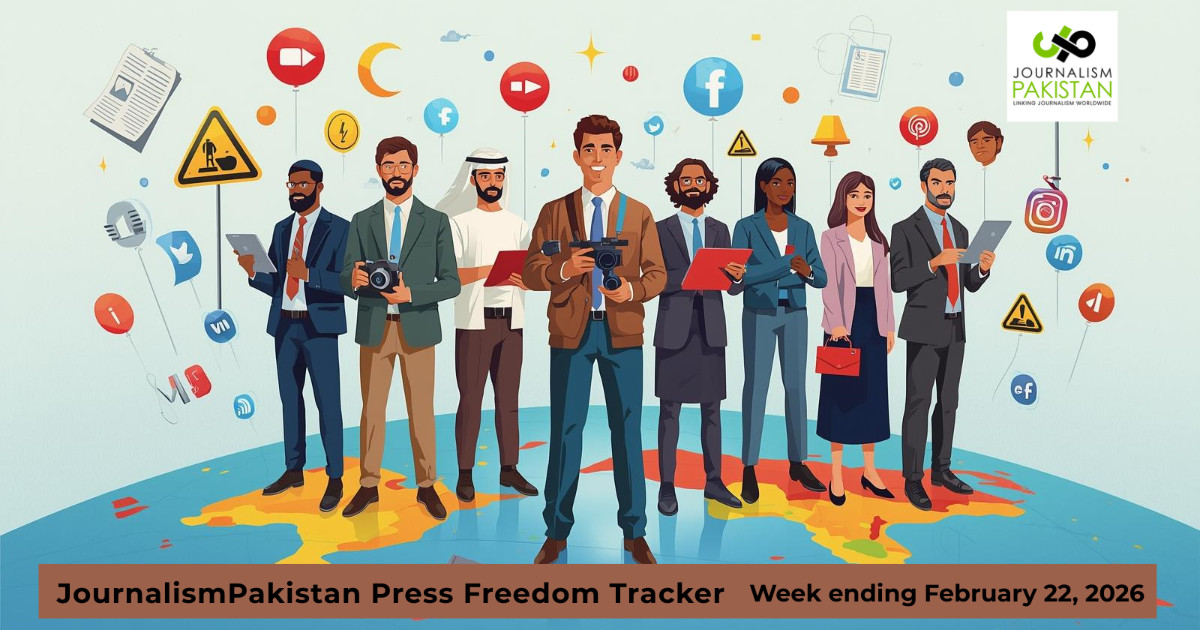
Verified incidents show journalists worldwide facing renewed legal, regulatory, and physical pressure, including arrests, FIRs, cybercrime summonses, and mob attacks, indicating persistent institutional and public constraints on media.Summary
Editor’s note
Press freedom faced renewed legal pressure and judicial scrutiny this week, with cases spanning South Asia, Southeast Asia, Europe, and Africa. From terrorism and treason convictions to cybercrime summons, court-ordered bail rulings, and mob violence against reporters, the developments reflect a persistent pattern: the use of legal instruments, regulatory mechanisms, and public hostility to constrain journalism. This edition documents verified incidents affecting media professionals and outlets worldwide.
Arrests and detentions
Pakistan — Journalist Sohrab Barkat, detained since November 26, 2025, is arrested in a fourth FIR for allegedly disseminating content against state institutions; detention continues despite prior bail orders, raising concerns over repeated legal actions targeting a journalist (Source: JournalismPakistan, statements by Barkat’s counsel on X, verified media reporting).
Legal and regulatory pressure
Pakistan — A FIR was registered by an Excise Department official in Balochistan against Olas News Chief Editor and YouTuber Agha Obaid following a video related to the department, prompting the Balochistan Union of Journalists to call for a transparent investigation (Source: Balochistan Union of Journalists statement).
Pakistan — Journalist Nadir Abbas Baloch filed a writ petition in the Islamabad High Court challenging repeated summons issued by the National Cyber Crime Investigation Agency, stating he was not informed of the allegations against him or provided a copy of the complaint (Source: JournalismPakistan).
Turkey — Deutsche Welle correspondent Alican Uludag was arrested and remanded by a court over social media posts alleged to insult President Recep Tayyip Erdogan, drawing international criticism (Source: Deutsche Welle, Bloomberg).
Cambodia — Two journalists, Phorn Sopheap and Pheap Pheara, sentenced to 14 years for treason over Facebook posts about a border clash, have filed appeals; rights groups criticized the convictions as a threat to press freedom (Source: Associated Press, Committee to Protect Journalists).
Attacks, threats, and harassment
Nigeria — Radio Nigeria sports correspondent Sodiq Adebara was mobbed by supporters in Ilorin, Kwara State, after being mistaken for a match official following a league match between Kwara United and Kano Pillars; the International Federation of Journalists condemned the attack as a threat to press freedom (Source: International Federation of Journalists).
Cambodia — Journalist Luot Sophal was arrested in Samraong, Oddar Meanchey province, and charged with demoralizing the armed forces and incitement after reporting on an alleged water shortage affecting frontline soldiers; the Committee to Protect Journalists called for his immediate release, warning he faces up to seven years in prison if convicted (Source: Committee to Protect Journalists).
Censorship and digital restrictions
No recorded incident.
Policy and court developments
Thailand — Australian journalist Murray Hunter was cleared of defamation charges brought by Malaysian authorities after mediation; Substack access in Malaysia was restored, and no penalties were imposed (Source: Associated Press).
Pakistan — The Supreme Court of Pakistan granted bail to journalist Sohrab Barkat in FIR No. 179/2025 after more than 80 days in custody, but he remained detained following the cancellation of bail in another case by a lower court; the cancellation order has been challenged before the Islamabad High Court (Source: Public court proceedings; statement by lawyer Saad Rasool).
Pakistan — Journalist Matiullah Jan stated that the Islamabad High Court reviewed a Punjab Forensic Laboratory report finding that material allegedly recovered from him was not narcotics and remanded the case to the trial court with directions for a supplementary challan (Source: Matiullah Jan via X).
Press freedom and journalist safety
Philippines — A court denied bail to journalist Frenchie Mae Cumpio, detained since February 2020; the Committee to Protect Journalists condemned the ruling as judicial harassment and called for charges to be dropped (Source: Committee to Protect Journalists statement).
India — The Karnataka state government proposed new regulations to restrict media access and accreditation within the Vidhana Soudha legislative complex, prompting opposition criticism over the potential impact on press freedom (Source: The Hindu).
Global context
This week’s incidents underscore the growing reliance on legal and administrative measures to manage, deter, or punish journalistic activity. In several jurisdictions, criminal statutes, including treason, cybercrime, defamation, and national security provisions, were invoked in cases tied to reporting or social media expression. At the same time, court proceedings in Pakistan and Thailand demonstrated how judicial review can serve as both a corrective mechanism and a prolonged site of contestation for journalists. The geographic spread of cases, from South and Southeast Asia to Europe and Africa, reflects a broader global pattern in which press freedom pressures are not confined to one region or political system. Legal uncertainty, prolonged detention, regulatory ambiguity, and physical intimidation continue to shape the operating environment for media professionals worldwide.
Editorial note: This tracker documents verified incidents affecting press freedom worldwide. It is updated weekly and focuses on factual reporting rather than advocacy or opinion.
For additional context, read last week’s Press Freedom Tracker here.
Key Points
- Journalist Sohrab Barkat remains detained amid a fourth FIR despite previously granted bail.
- An Excise Department FIR targets Olas News chief editor and YouTuber Agha Obaid, prompting calls for a transparent probe.
- Journalist Nadir Abbas Baloch filed a writ petition challenging repeated summonses from the National Cyber Crime Investigation Agency.
- Reported cases span South Asia, Southeast Asia, Europe, and Africa, involving court rulings, bail issues, and mob violence against reporters.
- The incidents illustrate a broader pattern of legal, regulatory, and public mechanisms being used to constrain journalism.
Key Questions & Answers
What incidents does the review document?
It documents arrests, FIRs, cybercrime summonses, bail disputes and attacks against journalists across multiple regions; the edition relies on verified reports and statements.
Which journalists are named in the report?
The report names Sohrab Barkat, Agha Obaid and Nadir Abbas Baloch among those affected; details come from JournalismPakistan, union statements and court filings.
Are legal actions ongoing in these cases?
Yes; some detentions continue despite earlier bail orders, and repeated summonses and FIRs are being legally challenged in court.
What broader pattern do these developments indicate?
The cases reflect the use of legal, regulatory and public pressure to constrain journalism; media groups and legal petitions have raised concerns about these trends.
Relevant Topics
Ask AI: Understand this story your way
AI EnabledDig deeper, ask anything — get instant context, background, and clarity.
Disclaimer: This feature is powered by AI and is intended to help readers explore and understand news stories more easily. While we strive for accuracy, AI-generated responses may occasionally be incomplete or reflect limitations in the underlying model. This feature does not represent the editorial views of JournalismPakistan. For our full, verified reporting, please refer to the original article.