
Press freedom review: Global crackdown on journalists continues
JournalismPakistan.com | Published: 15 February 2026 | JP News Desk
Join our WhatsApp channel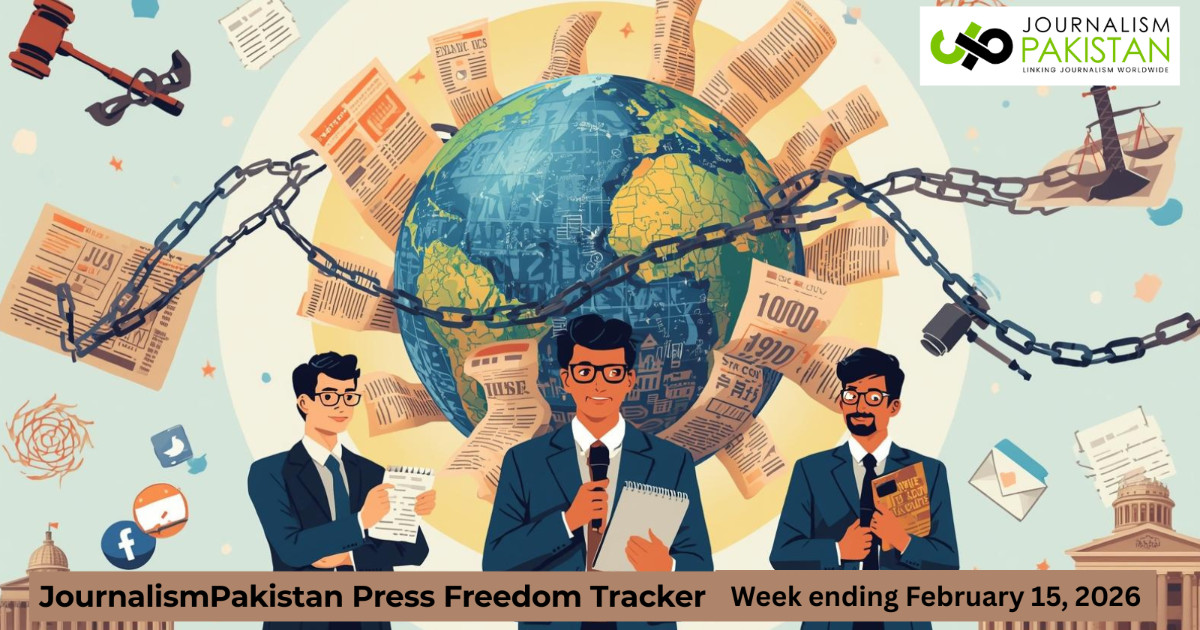
Pressures continued this week on journalists worldwide, including arrests, detentions, digital censorship, and restrictive laws that target media. Cases in Malaysia, Mali, Cambodia, and Pakistan highlight threats to reporters' safety and press freedom.Summary
Editor’s note
This week saw a continuation of pressures on journalists worldwide, ranging from arrests and detentions to digital censorship and restrictive legislation. Independent media in multiple regions faced intensified legal and regulatory scrutiny, while journalists covering sensitive political or economic issues confronted harassment, threats, and imprisonment. The incidents recorded this week illustrate the ongoing global challenge of safeguarding press freedom and the safety of journalists in both established and emerging democracies.
Arrests and detentions
Malaysia — A journalist was briefly detained and accused of sedition after posing a critical question during a public lecture in Kuala Lumpur. The reporter was later released and subsequently resigned (Source: Malaysian media reports).
Mali — Authorities arrested Youssouf Sissoko, editor-in-chief of the weekly L’Alternance, following an article critical of Niger’s military leader. He is charged with spreading false information and insulting a foreign head of state and remains in pretrial detention ahead of a March hearing (Source: Reporters Without Borders; Human Rights Watch).
Cambodia — Journalist Hem Vanna was arrested after reporting on an alleged luxury property scam, prompting calls for his release from Reporters Without Borders and Cambodian civil society groups (Source: Reporters Without Borders).
Pakistan — Hum News producer Khurram Iqbal was detained for several hours by the National Cyber Crime Investigation Agency in Lahore before being released without public charges, drawing condemnation from journalist bodies (Source: Journalism Pakistan).
Legal and regulatory pressure
Ethiopia — The Ethiopian Media Authority revoked the accreditation of three Reuters journalists, blocking their coverage of the African Union summit in Addis Ababa (Source: Reuters).
Attacks, threats, and harassment
Algeria — Freelance journalist Abdelali Mezghiche was arrested on February 9 over social media posts critical of local detentions. He remains in pretrial custody on charges including harming national interest and spreading false news (Source: Committee to Protect Journalists).
Censorship and digital restrictions
India — Meta temporarily blocked The Wire's Instagram account and restricted a satirical cartoon published February 7, 2026, without a clear legal justification. During the same period, the Deshabhimani newspaper and No Cap Instagram accounts were permanently disabled (Source: DIGIPUB News India Foundation; The Wire).
Policy and court developments
Hong Kong — Media owner Jimmy Lai was sentenced to 20 years in prison under the national security law on charges including colluding with foreign forces and publishing seditious materials (Source: Reuters).
India — British-Indian journalist Ravi Nair was sentenced to one year in prison in a criminal defamation case filed by Adani Enterprises (Source: Indian media reports).
Pakistan — Journalist Sohrab Barkat had one of his previously granted bails revoked by a lower court, while his final bail application remains pending before the Supreme Court, keeping him in custody for more than 75 days (Source: Statements by lawyer Saad Rasool).
Press freedom and journalist safety
Iran — Nobel Peace Prize laureate Narges Mohammadi was sentenced to an additional seven-and-a-half years in prison on charges including gathering and collusion against national security, propaganda against the state, along with a two-year travel ban and internal exile (Source: Iranian judiciary statements; international human rights organizations).
Bangladesh — Journalists and media outlets in Dhaka reported threats and intimidation linked to election coverage ahead of national polls, prompting calls from editors’ bodies for protection and accountability (Source: Editors’ Council of Bangladesh).
Iran — Authorities conducted raids on journalists’ homes, seized equipment, blocked communications, and imposed financial restrictions on independent media workers amid early February 2026 protest coverage (Source: Committee to Protect Journalists).
Ireland — The Defamation (Amendment) Bill was approved after clearing both houses of the Oireachtas, marking the first major update to the country’s libel framework since 2009 and aligning it more closely with reforms in England, Wales, and Northern Ireland.
Global context
This week’s incidents highlight the persistent vulnerability of journalists globally. While some countries continue to enforce strict digital and legal controls, others face challenges in balancing press freedom with national security or corporate interests. The rise of digital platform censorship, combined with politically motivated arrests and court rulings, underscores an ongoing global trend: journalists covering political, corporate, or civil rights issues remain at risk, even in regions with historically strong legal protections for the press.
Editorial note: This tracker documents verified incidents affecting press freedom worldwide. It is updated weekly and focuses on factual reporting rather than advocacy or opinion.
Read last week’s Press Freedom Review here for a comparison of key developments.
Key Points
- Worldwide pressures on journalists include arrests, detentions, digital censorship, and restrictive legislation threatening independent media.
- Malaysia: A reporter was briefly detained and accused of sedition after a critical question at a public lecture; he was released and resigned.
- Mali: Editor Youssouf Sissoko was arrested over an article critical of Niger's leader, charged with false information and insulting a head of state.
- Cambodia: journalist Hem Vanna was arrested after probing an alleged property scam, prompting calls for his release.
- Pakistan: Hum News producer Khurram Iqbal was detained by NCCIA in Lahore and later released without public charges.
Relevant Topics
Ask AI: Understand this story your way
AI EnabledDig deeper, ask anything — get instant context, background, and clarity.
Disclaimer: This feature is powered by AI and is intended to help readers explore and understand news stories more easily. While we strive for accuracy, AI-generated responses may occasionally be incomplete or reflect limitations in the underlying model. This feature does not represent the editorial views of JournalismPakistan. For our full, verified reporting, please refer to the original article.