.jpg)
Nahid Rana: Bangladesh's 152km/h fast-bowling force
JournalismPakistan.com | Published: 12 June 2026 | Dr. Nauman Niaz (TI)
Join our WhatsApp channel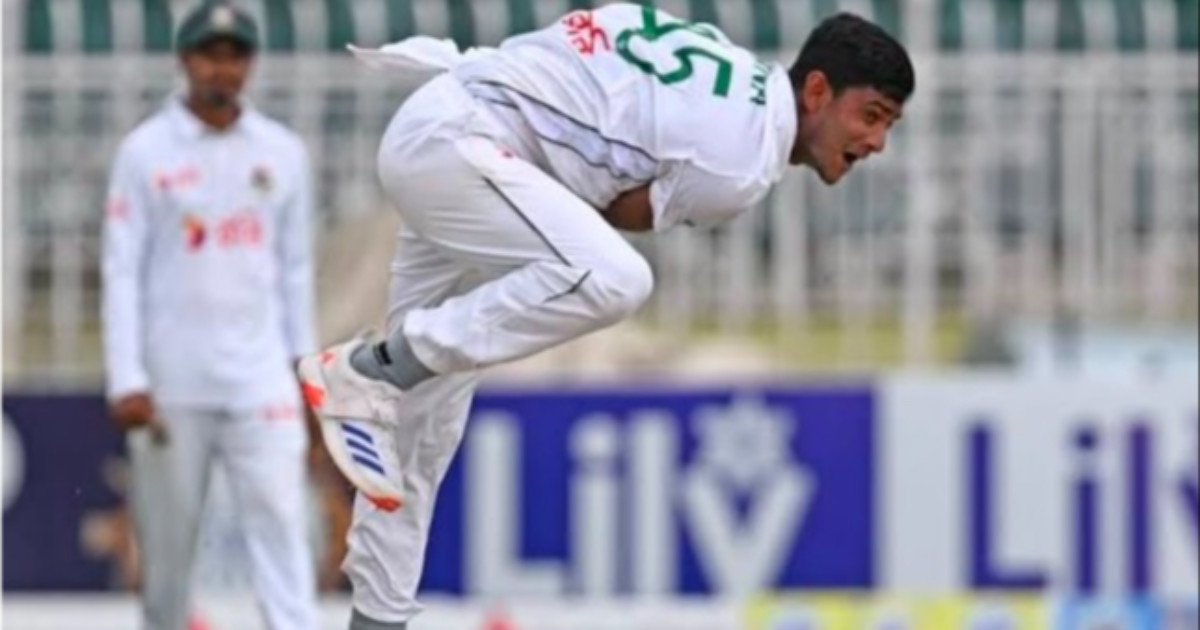
Nahid Rana emerged from Chapai Nawabganj to become Bangladesh's express pacer, often hitting 152.0km/h and ranking among the world's quickest bowlers. Discovered aged 18 after neighbourhood tape-tennis cricket, the 6ft5 pacer was taken to a Rajshahi academy.Summary
ISLAMABAD — There is a corner of Bangladesh that cricket had not previously thought to look. Chapai Nawabganj sits in the far northwest of the country, close to the Indian border, bordered by mango orchards and the slow brown waters of the Mahananda, a district more associated with the cadences of agriculture than with the sequences of a run-up. It is not the kind of place that produces international fast bowlers. Bangladesh, for most of its cricketing life, was not the kind of country that produced international fast bowlers. And yet from this improbable conjunction of improbable place and improbable tradition, something arrived in 2024 that the game on the subcontinent had not felt before, at least not in the colours of green and red. Something fast. Something steep. Something that made the batsmen of Pakistan, India, and Australia recalibrate in the middle of their innings and reach, in press conferences, for words they did not ordinarily need.
Born on October 2nd, 2002, he is an impressive 6ft 5 inches tall fast bowler, rather a genuine tearaway, express type, peaking speed of 152.0km/h, boasting an average 140.93km/h, 2nd fastest globally, behind Mark Wood. Nahid Rana did not come through the academies and age-group structures that produce most international cricketers. He did not toil through years of the National Cricket League with a distant dream slowly clarifying into probability. He was, in the most literal sense, found. Discovered in the northwest, brought to a cricket academy in Rajshahi at eighteen, after years of tape-tennis cricket on neighbourhood streets where the ball was lighter and the run-up shorter and the whole enterprise was play in the purest, most uncommitted sense. He was a net bowler for the Rajshahi Division before he was a player for them. He was a curiosity before he was a prospect. And then the prospect became a phenomenon with a speed that even those who had identified him had not fully anticipated.
By September 2024, in the second Test against Pakistan at Rawalpindi, in the baking, almost vacant stadium of a city that knows something about fast bowling, Rana delivered a ball at 152.0 kilometres per hour. It was the fastest delivery in Bangladeshi international cricket history. Around it, he averaged 145 kilometres per hour for most of his spells and bowled 73% of his deliveries above 140. The Pakistani batsmen, a lineage that has faced Waqar Younis and Shoaib Akhtar from the other end and knows what fast looks like up close, were hurried. They were not just uncomfortable. They were hurried, which is a different and more serious condition, because it means the body has been asked to respond before the mind has completed its assessment. Bangladesh won the series 2-0. Rana took five wickets in the match. Ian Bishop watched from somewhere and called it serious heat. Alex Carey, who faced him for Australia, said that until you face it firsthand, you do not understand. These are not polite observations. These are the instinctive responses of men who recognise, in their nerve endings, something that their experience has told them to respect.
He is twenty-three years old. He has been playing hard-ball cricket for five years. And he stands at the threshold of something that Bangladeshi cricket has been approaching for decades without quite arriving: a fast bowler who does not need to be qualified, who does not need the apology of context, who operates at a level of pace and bounce that belongs to the highest company the game contains. What he has, and where it comes from, is the question this analysis attempts to answer. The answer begins not with the run-up or the action or the wrist, but with the body itself, because in Rana's case, the body is not only the instrument of the craft. It is the craft's primary argument.
From tape-tennis streets to Test arenas: the making of a fast-bowling prodigy
Before any biomechanical analysis can begin, the physical platform must be established, because in Rana's case, it is inseparable from everything the action produces. He is 196 centimetres tall. This is not a detail. It is the structural premise from which every subsequent mechanical observation follows. His tall frame, combined with a long run-up and powerful stride, allows him to generate extra pace and bounce that no coaching intervention alone can replicate. Even on the slower pitches commonly found in the subcontinent, he can make the ball rise sharply and surprise batsmen who have made their calculations based on what the pitch offers rather than what the release point demands.
The release point of a 6 ft 5 in bowler operating at a high-arm position is geometrically elevated to a degree that alters every variable a batsman uses to compute his response. The height at which the ball leaves the hand determines the angle of its descent toward the pitch. A higher release point means a steeper descent angle. A steeper descent angle means the ball climbs off the pitch at a trajectory the batsman's eye has not prepared for. He has watched the ball land where good-length balls land. But the ball does not arrive where good-length balls arrive. It rises to the badge, to the splice, to the leading edge. Every batsman facing Rana is receiving the ball from an angle that requires specific and deliberate technical adjustment, and the adjustment is not always available in the time the pace allows. Alex Carey, after facing him for Australia, said precisely this: he knew the pace was coming, he had been told about the bounce, but until you face it firsthand, you have not truly understood. The body knows things the briefing cannot tell it.
The run-up: momentum as architecture
Rana did not pick up a hard cricket ball until his late teens, having grown up playing tape-tennis cricket in the streets of Chapai Nawabganj, and this background is biomechanically significant in ways that extend beyond the biographical. With the lighter tape-tennis ball, he did not need to generate speed from a long run-up. The ball went fast enough without it. That changed when he transitioned to the hard ball, and the run-up that subsequently developed grew longer with it, shaped by coaches who understood that his large frame required a sustained acceleration phase to transfer energy efficiently into the crease.
The run-up that emerged is long and rhythmic, not the explosive, compressed approach of a short-run tearaway but the progressive, building approach of a tall bowler who is working with his own physics rather than against them. His approach runs straight toward the target, which is the standard alignment for right-arm pace bowlers and serves a purpose well beyond convention: it keeps the hip and shoulder axes in the alignment through the delivery stride that the body requires for both efficiency and safety.
The momentum does not arrive at the crease all at once. It builds through each stride, lengthening as he approaches, as the larger muscle groups of the legs and hips gather force and pass it upward through the trunk. In the final four to five steps, stride frequency increases slightly, compressing all of that accumulated velocity into the pre-bound gathering phase. Nothing is wasted. Nothing is premature. The run-up is not decoration before the action begins. It is the action's first movement.
The bound and gather: conversion
The bound is the critical transitional phase, the moment when horizontal momentum from the run-up is converted into the vertical and rotational forces that generate pace and bounce. For a bowler of Rana's height, this conversion carries particular biomechanical demands and particular biomechanical gifts simultaneously. The jump must be timed with precision, the body reaching its state of maximum coil, shoulders and hips loading against each other, before the back foot contacts the crease. A bound that mistimes this loading leaves the bowler's body in a state of mechanical unreadiness at the most important moment of the action.
At the gather, Rana's non-bowling arm, his left arm, begins to rise as the body achieves maximum coil. The height of this gather phase is accentuated by his stature in a way that smaller bowlers cannot access: his centre of mass is significantly higher than a shorter bowler's, which means the arc of energy transfer through the action covers a greater vertical distance and, when executed correctly, generates the steep release angle that produces his distinctive bounce. The chest opens slightly toward the batsman at the peak of the bound, with the front shoulder beginning its counter-rotation in preparation for the delivery stride, the body already reaching toward what it is about to do.
Back foot landing and coil: the loaded spine
At back-foot contact, the biomechanical requirement for a fast bowler is the alignment of hips and shoulders to protect the lumbar spine from the torsional forces that a mixed action generates. Rana has, in the language of the analysts who have studied his action most closely, a relatively uncomplicated action. In biomechanical terms, this means his hip and shoulder alignment at back-foot contact is reasonably consistent across deliveries, reducing the shearing load on the lower vertebrae that has ended the careers of numerous fast bowlers who bowl with a more pronounced mixed or front-on action, described simply as uncomplicated. That word, in this context, is not faint praise. It is the description of a young bowler who has, whether by instinct or by coaching or by the particular fortune of how his body naturally organises itself under load, avoided the mechanical pattern that destroys fast bowlers.
His back foot lands broadly parallel to the bowling crease, placing the hips in a side-on orientation. The right knee is slightly flexed at contact to absorb the impact load and maintain dynamic stability. At this moment, the body is in maximum coil. The left shoulder is turned away from the batsman, the bowling arm beginning its downswing from behind the body. The entire posterior chain from hip through thoracic spine is loaded with the rotational tension that the delivery will release, the body coiled around itself like a spring whose release has been deliberately delayed.
The delivery stride and front foot planting: the brace
The delivery stride is where Rana's height translates most directly and most visibly into pace and bounce. The stride is long, consistent with his frame, placing the front foot well down the pitch and creating a pronounced bracing angle through the left leg at contact. The front foot plants behind and close to the batting crease, with the heel landing first before the foot rolls through to the ball, which is the technically correct sequence for a fast bowler seeking to create a firm brace against which the bowling arm can accelerate.
It is a sequence that takes years to internalise, and in Rana's case it required specific attention: his coaches, working with him as he transitioned from tape-tennis to hard-ball cricket, identified early that the way his foot landed on the popping crease needed work, that the mechanics formed in informal cricket had to be refined before his action could hold up to the sustained stresses of international bowling.
The front knee at plant is slightly flexed to absorb the initial impact before stiffening into extension during the arm acceleration phase. This progressive stiffening of the front leg is the primary mechanical source of pace in a fast bowler, the movement through which the forward momentum of the run-up is converted into an explosive rotational force around the hip axis. In Rana's case, the greater height of his hip and shoulder axis means this bracing force is applied over a longer lever, amplifying the velocity generated at the wrist and fingertips at release.
A taller bowler who braces correctly produces more pace than a shorter bowler bracing with equal efficiency, because the lever is longer and the amplification is correspondingly greater. The front foot plants broadly in line with the back foot, maintaining the side-on alignment established at back-foot contact and ensuring that the rotational chain initiated at the gather arrives at release without mechanical interruption.
The high-arm action and release: where everything converges
This is the defining dimension. This is where the analysis arrives at its centre. Rana possesses a high-arm seam bowling action, and India's preparation for facing him in their 2024 home series was so specifically organised around this single fact that they drafted in Gurnoor Brar, a fast bowler of comparable height, specifically to simulate the angle and the arc of what was coming. You cannot do that with a shorter net bowler. The ball does not arrive from the same place. The body does not have to compute the same problem. Brar was brought in because Rana's high-arm action from six feet five inches is not something that can be approximated by those who do not share the physical precondition.
The high-arm position means the bowling arm travels in a near-vertical plane through the delivery arc, with the elbow reaching or approaching the level of the ear at the highest point of the arc before rotation begins. This vertical arm plane, combined with the elevated release point that his frame provides, produces two related effects that operate simultaneously and reinforce each other.
The first is bounce. The release point is geometrically higher than the typical fast bowler's, meaning the ball's descent angle from release to pitch is steeper. This steeper angle of incidence at the pitch surface produces the disconcerting bounce that has repeatedly troubled high-quality batsmen. The ball does not arrive at the expected height. It climbs sharply from a good length, catching the leading edge or the splice of the bat rather than meeting the full face, rising to places that the batsman's preparation has not accounted for. Throughout his breakthrough Pakistan series, Rana demonstrated the ability to extract this bounce from a difficult length, ball after ball, spell after spell, even from the flat surface of Rawalpindi where the game is supposed to be kinder to the batsman than this.
The second is seam. The high-arm position keeps the seam more consistently upright through the delivery arc than a lower-arm action typically allows. At the moment of release, Rana's wrist is positioned behind and slightly above the equator of the ball, with the index and middle fingers loading on the seam directly behind the centre of the ball. This configuration, seam vertical at release and the wrist driving through behind it, is the mechanical foundation of seam movement: the upright seam hitting the pitch surface creates the conditions for the ball to deviate in either direction depending on the minor imperfections of the landing spot.
The wrist position is firm rather than relaxed, which favours seam-up delivery over conventional swing, though the same high-arm position with slight wrist adjustment can generate both inswing and outswing depending on seam orientation and the angle of the fingers at release. And this wrist, it is worth noting, carries something from the streets of Chapai Nawabganj. The way he used his wrist in tape-tennis cricket gave him a measure of extra pace and instinctive seam control, qualities developed informally that formal coaching has preserved and directed rather than dismantled and rebuilt.
Pace generation: the kinetic chain
The reason Rana generates the pace he does is best understood as a kinetic chain working from the ground upward through every dimension of his body. The long run-up builds horizontal momentum. The bound converts that momentum into vertical energy. The back-foot planting coils the hip and shoulder system. The front-foot bracing stiffens the left leg into a rigid pivot. The hip rotation pulls the shoulders through, which accelerates the bowling arm, which whips the wrist and fingers through the release point. The chain delivers force cumulatively from the largest muscle groups to the smallest, with each transfer amplifying the velocity available to the fingertips at the moment of release.
His height amplifies this chain at every stage. Longer legs mean a longer delivery stride and greater horizontal-to-vertical energy conversion at the bound. A higher centre of mass means more potential energy at the top of the action. A longer bowling arm means a greater arc of acceleration, with the hand travelling a longer distance before release and therefore reaching higher terminal velocity at the fingertips.
The pace that results is not the product of muscular effort alone, not something that can be manufactured through strength training and force of will. It is the product of a physique that happens to be configured, across every relevant dimension, for extreme pace generation. Rana is clearly the quickest of Bangladesh's seamers, discovered at the Champions Trophy in February 2025, frequently hitting 145 kilometres per hour and above. This is the kind of pace that you can hear.
The non-bowling arm: the hidden engine
The left arm in Rana's action performs the dual function it performs in all high-quality fast-bowling biomechanics, and it is the function most routinely undervalued by those who watch the game rather than study it. In the gather phase, the left arm rises high as the body loads, with the elbow pointing broadly toward the batsman and the hand above the shoulder. This elevated left-arm position amplifies the shoulder axis counter-rotation, deepening the coil and storing additional rotational energy that the delivery will release. The left arm at this stage is not passive. It is loading.
At front-foot contact, the left arm begins its pull. It is drawn sharply downward and inward toward the left hip in a movement that, by the law of conservation of angular momentum, simultaneously accelerates the right shoulder and the right arm through the delivery arc. The timing and force of this pull is one of the primary determinants of bowling arm speed at the moment of release. A late or weak pull dissipates the stored rotational energy and the pace it was about to generate. A sharp and well-timed pull converts it directly into arm speed, which is why the left arm deserves to be understood not as a counterweight but as an accelerator. In Rana's case the pull is vigorous and committed, consistent with the pace he generates. The left elbow drives down past the hip, and the left hand finishes beside or slightly behind the left thigh at the moment of release, its work entirely and efficiently complete.
The follow-through: completion
The follow-through is biomechanically the release of all the energy that the action has generated, and its quality is both the consequence of what came before it and the condition of what may come after. For a fast bowler operating at Rana's pace, the follow-through must be both uninhibited and controlled: uninhibited because any premature braking of the arm or trunk rotation converts force into stress rather than velocity, increasing the risk of injury at the very joint the braking was intended to protect; controlled because a chaotic follow-through compromises landing accuracy on the follow-through stride and places disorganised deceleration forces on a lower back that has already been comprehensively loaded.
Rana's follow-through is full and committed, the bowling arm continuing its arc across and down past the left hip in the classical pattern for a high-arm right-arm fast bowler. The trunk rotates fully through the delivery, the chest finishing broadly facing the batsman by the completion of the arc. The head remains stable through the delivery and follow-through, giving the bowler visual continuity through the release point. His follow-through stride lands well down the pitch on the left-hand side, consistent with a side-on to semi-open finishing position, the body's natural terminus after a delivery in which every phase has worked in the direction it was supposed to work.
Why Bangladesh cricket cannot afford to mismanage its greatest fast-bowling asset
Many of Rana's fundamentals when he made his Test debut were rooted in informal cricket, and it is important to name this plainly, not as diminishment but as context. He is a work in progress, and he needs to be handled with the particular care that Bangladesh cricket owes a bowler it cannot afford to lose. The principal biomechanical vulnerability for a bowler of his profile is the lower back. The combination of extreme pace, a tall frame, a high-arm action, and the torsional forces generated by the coil-and-release cycle places sustained compressive and shear load on the lumbar vertebrae at the moment of front-foot contact. Managing that load through consistent alignment of hips and shoulders at back-foot contact, which his relatively uncomplicated action broadly achieved, is the key structural protection. Any drift toward a mixed action, in which the hips are side-on but the shoulders have rotated past them at back-foot contact, would significantly increase the injury risk and introduce the pattern that has shortened so many fast-bowling careers before they reached their full expression.
The front-foot landing mechanics require ongoing monitoring, specifically the angle of the foot at plant and the degree of knee flexion at impact. A foot that plants at too wide an angle increases the rotational demand on the knee joint. Too straight an angle reduces the bracing effect and dissipates pace. The balance between these is precise and individual, and finding it is the technical refinement that his coaches, most prominently Talha Jubair, have been working on since his emergence in domestic cricket. It is not a crisis. It is simply the ordinary, necessary, patient work that every fast bowler requires, the recognition that the raw gift has arrived and that the institutional responsibility now is to develop it without destroying it.
The unfinished sentence
There is a moment in the development of a rare fast bowler when you stop watching the action and start watching what the action does to the world around it. When the batsman at the non-striker's end leans against his bat and watches with an attention that is no longer collegial but wary. When the wicketkeeper shifts his feet just slightly further back. When the opposing captain walks back to his fielding position and says something to the slip cordon that the stump microphone does not catch but that everyone watching understands as recalibration. That moment, the moment when the game's participants recognise that something different is in the air, had arrived for Nahid Rana somewhere in the middle of the second Test at Rawalpindi in August 2024. It has not left.
He is 23. He has played a handful of Tests. He has played barely five years of hard-ball cricket in any form. And yet the numbers he has produced sit in the kind of company that does not apologise for itself. Second only to Mark Wood among all Test bowlers globally in average pace in 2024. Faster across a full series than Mitchell Starc, than Gerald Coetzee, than every Bangladeshi fast bowler who has ever lived. 152 kilometres per hour in a Test match, in Rawalpindi, in August, in heat that would have been the default excuse for doing less. He did not do less. He did more.
He came back the next over after being struck for a boundary and bowled every single delivery at 147 or above, which is not the response of a young bowler finding his feet in international cricket. It is the response of a competitor who understands what pace is for. What makes the prospect of Rana at full development something that the subcontinent should approach with genuine anticipation and genuine attentiveness is that the architecture is already largely in place. The kinetic chain works efficiently from the ground through the body to the wrist. The high-arm action is a structural asset that cannot be coached into a shorter bowler. The seam is upright. The bounce is steep. The wrist action, developed on the streets of the northwest before anyone thought to formalise it, carries qualities that formal instruction has wisely preserved. He has not yet played in Australia. He has not yet played in South Africa. He has not yet stood at the top of his mark on the fast, bouncy surfaces that reward high-arm quicks most completely, surfaces where the ball does what Rana asks of it naturally and without the negotiation that slower pitches require. Ian Bishop, who has seen fast bowling from both ends and knows what it costs and what it produces, said that the prospect of Rana in those conditions was mouthwatering. The word was chosen carefully. It is the word of someone who can see what is coming.
Fast bowlers from the subcontinent have always had to establish, against the weight of expectation, that they exist. That the subcontinent is not only a place of turning pitches and patient spinners but a place where men can run in hard and bowl fast and break things. Imran Khan established it for Pakistan. Kapil Dev established it for India. Chaminda Vaas established, in his own quieter way, that Sri Lanka could produce genuine pace.
Bangladesh has been working toward its own statement for twenty years, through Mashrafe Mortaza and through Taskin Ahmed and through the various promising young bowlers who arrived with pace and left with injury or diminishment or the quiet dilution of franchise cricket. Rana is the clearest articulation yet of what that statement might finally sound like. Not an approximation of pace, not a fast-medium bowler who operates at the upper end of that category on his best days, but actual, genuine, top-of-the-order pace that the best batsmen in the world are required to adjust to.
The sentence that Bangladesh fast bowling has been trying to complete for two decades is still in progress. Rana is not the full stop. He is, at twenty-three, still forming, still being coached and shaped and protected. The lower back must be monitored. The front-foot mechanics must be refined. The workload must be managed with the care that a piece of machinery this valuable and this new requires. But the sentence, which for so long seemed to trail off into the distance without resolution, has found a voice that carries. And somewhere in Chapai Nawabganj, where the mangoes grow heavy on the branch, and the Mahananda moves without hurry toward the border, there is a story that has not yet arrived at its most remarkable passage. The run-up is still building. The bound has not yet reached its peak. The release is coming.
ABOUT THE WRITER: Dr. Nauman Niaz, a Post Doctorate (Oxford), PhD (UWA), FRCP (London), FRCP (Edinburgh), FRCP (Ireland), FRCP (Glasgow), CST (Endo, UK), MSc Biomechanics & Kinesiology (UWA), MRCP (UK), MBBS (Pb) is a civil award winner (Tamagha-i-Imtiaz) in Sports Broadcasting & Journalism, a regular cricket correspondent having covered 54 tours and three ICC World Cups, having written over 3700 articles. He has authored 19 books and is the official historian of Pakistan Cricket (Fluctuating Fortunes IV Volumes - 2005). His signature show Game On Hai has been the highest in ratings and acclaim.
Key Points
- Origin: Chapai Nawabganj in northwest Bangladesh.
- Physical profile: 6ft 5in tall, an express or tearaway pace type.
- Speed: recorded top speed of 152.0km/h and a very high average pace.
- Pathway: discovered aged 18 after years of neighbourhood tape-tennis cricket and brought to a Rajshahi academy.
- Impact: his pace prompted notable reactions from international batsmen and opponents.
Key Questions & Answers
Who is Nahid Rana?
Nahid Rana is a fast bowler from Chapai Nawabganj who rose to attention for his high pace and international performances.
How fast does he bowl?
He has recorded a top speed of 152.0km/h and averages very high bowling speeds.
How was he discovered?
He was noticed after playing informal neighbourhood tape-tennis cricket and was taken to a Rajshahi academy at age 18.
What impact has he had?
His extreme pace forced opposing batsmen to adjust and prompted commentary from teams across the subcontinent.
Relevant Topics
Ask AI: Understand this story your way
AI EnabledDig deeper, ask anything — get instant context, background, and clarity.
Disclaimer: This feature is powered by AI and is intended to help readers explore and understand news stories more easily. While we strive for accuracy, AI-generated responses may occasionally be incomplete or reflect limitations in the underlying model. This feature does not represent the editorial views of JournalismPakistan. For our full, verified reporting, please refer to the original article.