
Killings and courtrooms define another difficult week for journalism
JournalismPakistan.com | Published: 26 July 2026 | JP News Desk
Join our WhatsApp channel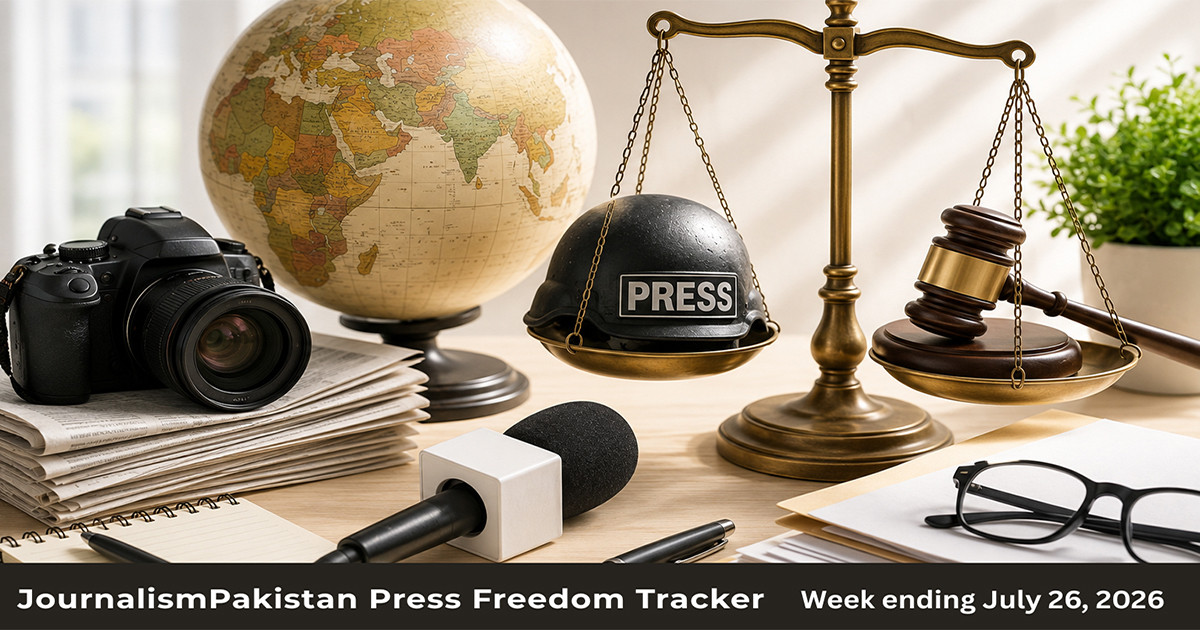
The Press Freedom Tracker reports arrests, detentions, deadly attacks and prosecutions targeting journalists worldwide, raising alarm over use of criminal and regulatory powers. Courts and labor actions show legal protections and solidarity defend press freedom.Summary
Editor's note
This week's Press Freedom Tracker highlights the diverse pressures confronting journalists worldwide, from imprisonment and criminal investigations to physical violence, intimidation, and legal proceedings. While some governments continue to rely on criminal laws and regulatory powers to pursue journalists, deadly attacks and harassment remain persistent threats in several regions. At the same time, judicial decisions and labor action demonstrate that legal safeguards and professional solidarity continue to play an important role in defending press freedom. Together, these developments underscore that protecting journalism requires more than condemning attacks; it also depends on preserving the legal, institutional, and economic conditions that allow independent reporting to thrive.
Arrests, detentions, and kidnappings
ZAMBIA—Journalist MacPherson Mukuka has been detained since July 17 over allegations that he published a secretly recorded conversation in violation of the Cyber Crimes Act. The Committee to Protect Journalists (CPJ) has called for his immediate release, saying the case criminalizes reporting in the public interest. (Committee to Protect Journalists, July 21, 2026)
Why this matters: The case raises concerns that cybercrime legislation could increasingly be used against journalists reporting on matters of public interest, potentially discouraging investigative journalism.
CAMBODIA—Journalist Luot Sophal has been sentenced to two years in prison after reporting on an alleged water shortage among frontline troops during border tensions with Thailand. CPJ condemned the conviction and called for his immediate release. (Committee to Protect Journalists, July 21, 2026)
Why this matters: The conviction highlights the risks journalists face when reporting on national security issues and may discourage independent reporting on sensitive public-interest matters.
Legal and regulatory pressure
PHILIPPINES—Former SunStar Cebu editor-in-chief Marchel Espina surrendered to authorities and posted bail after facing criminal charges linked to a published opinion article. Philippine media organizations say the case raises concerns about the use of legal proceedings against journalists. (Crux, July 21, 2026)
Why this matters: Criminal proceedings arising from journalistic work can have a chilling effect on opinion writing and investigative reporting, even before a case reaches trial.
PAKISTAN—Journalist Azaz Syed said on X that veteran journalist and Naya Daur commentator Sajjad Anwar has been served with a notice by the National Cyber Crimes Investigation Agency (NCCIA) in Faisalabad requiring him to appear on July 27. The agency has not publicly stated the reason for the notice. (Azaz Syed on X, July 25, 2026)
Why this matters: If the summons is linked to Anwar's journalistic commentary, it could raise concerns about the use of cybercrime laws or investigative powers in matters involving media analysis and freedom of expression.
Digital rights and online censorship
No confirmed press freedom incidents or verified cases meeting the Tracker's criteria were identified this week.
Attacks, threats, harassment, and killings
ITALY—Italian authorities are investigating the killing of freelance sports journalist Luca Esposito, whose body was found near Eboli. While investigators suspect homicide, no motive has been established. International media organizations have called for a prompt investigation to determine whether the crime was connected to his journalistic work. (International Federation of Journalists, July 20, 2026)
Why this matters: Prompt and independent investigations are essential whenever journalists are killed to determine whether their work was a motive and to help combat impunity for crimes against the press.
INDIA—The Mumbai Press Club condemned the reported attack on journalists covering a protest at Jantar Mantar in New Delhi, urging authorities to investigate the incident, hold those responsible accountable, and ensure the safety of media personnel. (Mumbai Press Club statement, July 22, 2026)
Why this matters: Journalists covering public demonstrations play a vital role in informing the public. Attacks during news coverage can discourage independent reporting from the field.
COLOMBIA—Community journalist Jader Durango was killed on July 18 in Tierralta, Córdoba, where multiple armed groups operate. Press freedom organizations said his death highlights the growing risks faced by journalists in conflict-affected areas. Durango is the third journalist killed in Colombia in 2026, prompting renewed calls for stronger government protections for the press. (El Espectador; FLIP; Indepaz, July 2026)
Why this matters: The continued killing of journalists in areas affected by armed conflict underscores the urgent need for stronger protection mechanisms and greater accountability for crimes against the press.
CUBA—State security agents allegedly threatened independent journalist Austin Llerandi with imprisonment unless he stopped distributing news through Amanecer Habanero. CPJ condemned the interrogation and intimidation, saying the case reflects Cuba's continuing repression of independent journalism. (Committee to Protect Journalists, July 21, 2026)
Why this matters: Threats of imprisonment against independent journalists can discourage critical reporting and reinforce a climate of fear that limits media pluralism.
MEXICO—CPJ condemned the killing of journalist Josué Martínez, who was shot dead in broad daylight in front of his child. The organization said his murder is the fourth fatal attack on a Mexican journalist in just over four weeks, following the killings of Luis Ángel López, Roxana Guzmán, and Alex Serna, and criticized authorities for failing to end the cycle of impunity. (Committee to Protect Journalists, July 23, 2026)
Why this matters: The continuing killings reinforce Mexico's reputation as one of the world's most dangerous countries for journalists and highlight the urgent need to end impunity for crimes against the press.
PAKISTAN—The Human Rights Commission of Pakistan (HRCP) urged the Sindh government to expedite efforts to recover Fayaz Janjhi, the missing son of senior journalist Sohail Sangi and brother of BBC Urdu reporter Riaz Sangi. The family reportedly informed police immediately after his disappearance but said they had received no meaningful response. HRCP called for urgent action to ensure his safe return. (Human Rights Commission of Pakistan on X, July 21, 2026)
Why this matters: Although Janjhi is not a journalist, the disappearance of a close family member of prominent journalists raises broader concerns about the security of media families and the environment in which journalists operate.
Economic pressure and media viability
No confirmed entries meeting the Tracker's criteria were identified this week.
Access to information and reporting restrictions
No confirmed entries meeting the Tracker's criteria were identified this week.
Policy and court developments
PAKISTAN—Lawyers representing journalist Rehan Tariq said a Lahore sessions court granted his post-arrest bail in a case linked to an interview on religious issues. The reported decision followed legal arguments over the evidence presented by investigators. (Statement by Mian Dawood Law Associates on X, July 21, 2026)
Why this matters: Bail provides temporary relief but does not end legal proceedings. Cases involving journalists continue to highlight concerns about the use of criminal investigations in matters related to journalistic work and public debate.
UNITED STATES—The Justice Department withdrew subpoenas requiring three New York Times reporters to reveal confidential sources after a federal judge sharply criticized prosecutors for disregarding safeguards designed to protect journalists. The investigation into classified leaks remains ongoing. (Associated Press, July 24, 2026)
Why this matters: Protecting confidential sources is fundamental to investigative journalism. The decision reinforces the importance of legal safeguards that enable journalists to gather information in the public interest without exposing sources to unnecessary risk.
INDIA—Journalist Irfan Mehraj remains free on bail while his trial continues after spending more than two years in custody. The Delhi High Court's bail order allows him to remain out of custody provided he stays in New Delhi and complies with the court's conditions. (International Federation of Journalists, July 24, 2026)
Why this matters: While bail is a significant legal development, the continuation of criminal proceedings illustrates how lengthy prosecutions can place sustained pressure on journalists and investigative reporting.
Media labor and union activity
TÜRKİYE—Journalists at AFP's Istanbul bureau concluded a 12-day strike after securing a collective agreement that includes a 27 percent wage increase, bonuses, and additional benefits following negotiations with management. (International Federation of Journalists, July 20, 2026)
Why this matters: Fair wages and stronger working conditions contribute to more sustainable newsrooms and help strengthen journalists' ability to work independently and professionally.
Media operations and industry pressures
No confirmed entries meeting the Tracker's criteria were identified this week.
Press freedom and journalist safety
No standalone developments requiring placement in this section were identified this week. Relevant incidents have been classified under the sections above.
Press freedom review
Legal pressure remained one of the defining themes this week, with journalists facing criminal proceedings, detention, and continuing court cases in several countries. Zambia, Cambodia, the Philippines, Pakistan, and India all saw developments illustrating how legal mechanisms continue to shape the environment in which journalists work. Violence also remained a grave concern, particularly in Mexico and Colombia, where the killings of journalists once again underscored the deadly risks associated with reporting in high-threat environments. Meanwhile, intimidation in Cuba and attacks on journalists in India highlighted that physical safety remains under pressure even outside active conflict zones.
There were also encouraging developments. The withdrawal of subpoenas against New York Times reporters in the United States reinforced the importance of protecting confidential sources. At the same time, journalists in Türkiye demonstrated how collective bargaining can strengthen newsroom conditions. Together, this week's developments show that press freedom depends not only on protecting journalists from violence but also on ensuring legal safeguards, independent institutions, and sustainable working conditions that allow journalism to serve the public interest.
Global context
This week's developments reflect several enduring global trends affecting journalism. Governments continue to rely on criminal laws, cybercrime legislation, and judicial processes in cases involving journalists. At the same time, violence against the press remains a persistent threat in countries where impunity is entrenched. At the same time, courts, labor organizations, and press freedom groups continue to play an important role in defending journalists' rights and reinforcing the legal protections that independent media depend upon.
The cases documented this week also demonstrate that threats to press freedom increasingly extend beyond arrests and censorship. They include prolonged legal proceedings, intimidation, surveillance, attacks during news coverage, and the economic realities facing newsrooms. Together, these developments reinforce the need for continued vigilance to ensure that journalists can report freely, safely, and in the public interest.
For additional context and recent developments, readers can review last week's Press Freedom Tracker.
SUGGESTED TAGS: Press Freedom, Press Freedom Tracker, Journalism, Journalists, Media Freedom, Freedom of Expression, Journalist Safety, Attacks on Journalists, Legal Pressure, Media Rights, Global Journalism, Investigative Journalism, Cybercrime Laws, Censorship, Press Freedom Violations, Independent Media, Human Rights, News Media, JournalismPakistan
ATTRIBUTION: Compiled and analyzed by JournalismPakistan
PHOTO: AI-generated; for illustrative purposes
Key Points
- Report documents arrests, detentions and prosecutions of journalists in multiple countries.
- Cybercrime and other criminal laws are being used to target reporting in the public interest.
- Deadly attacks, threats and harassment remain persistent dangers for media workers.
- Judicial rulings and labor actions demonstrate legal safeguards and professional solidarity can defend press freedom.
- Cases from Zambia and Cambodia highlight how prosecutions and sentences affect investigative reporting.
Key Questions & Answers
What does the Press Freedom Tracker show this week?
It records arrests, detentions, prosecutions, deadly attacks and ongoing intimidation of journalists, while noting judicial and labor responses that sometimes protect press freedom.
Why are cybercrime laws a concern for journalists?
Authorities may use broad cybercrime or secrecy provisions to criminalize reporting, deter investigations and punish journalists for publishing information in the public interest.
Can courts and labor actions help defend journalists?
Yes. Judicial rulings that uphold rights and collective actions by media workers can provide legal and practical protections for independent reporting.
Which country examples are highlighted in the report?
The tracker cites cases including the detention of a Zambian journalist and the sentencing of a Cambodian reporter, illustrating varied legal pressures worldwide.
Relevant Topics
Ask AI: Understand this story your way
AI EnabledDig deeper, ask anything — get instant context, background, and clarity.
Disclaimer: This feature is powered by AI and is intended to help readers explore and understand news stories more easily. While we strive for accuracy, AI-generated responses may occasionally be incomplete or reflect limitations in the underlying model. This feature does not represent the editorial views of JournalismPakistan. For our full, verified reporting, please refer to the original article.