
IFJ women move forward struggle for gender equality
JournalismPakistan.com | Published: 11 January 2016
Join our WhatsApp channel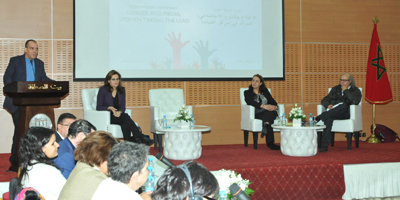
The IFJ Gender Council held a conference in Morocco to address gender equality in media. Participants discussed various issues and strategies related to women's rights and empowerment.Summary
BRUSSELS: The IFJ Gender Council held on January 9 its statutory mid-term conference on the theme 'Gender and Media: Women Taking the Lead', hosted by the IFJ member union, the Syndicat national de la presse marocaine, at its newly inaugurated Maison de la presse in Tangier, Morocco.
The first day was opened by the Gender Council co-chair Mounia Belafia, IFJ president Jim Boumelha and union officials attracting scores of journalists from the union as well as members of the Gender Council from IFJ regions.
During the conference, participants discussed issues relating to gender and media in three sessions: (i) Global media and women’s rights, (ii) Women empowerment: comparison and common ground and (iii) Gendered advocacy: leadership, goals and activities.
Finally a workshop on collective bargaining on equal rights was delivered by the General Secretary of the National Union of Journalists in the UK and Ireland, Michelle Stanistreet. "It is understood that men are competent by nature, whereas women have always to prove themselves," said Mounia Belafia. "Why aren't men also asked how to reconcile work and family life?
It is not just a question for women." In opening of the conference, IFJ president Jim Boumelha praised the work the Council has accomplished in tackling discrimination against women and reduce inequality between women and men since the Council was launched by the IFJ at its congress in 2001 in Seoul, Korea.
“Issues that women journalists grappled with a decade ago on women’s choices, working hours and family responsibilities, on atypical and precarious work, glass ceiling and the equal pay gap are still with us today as they were a decade ago.
The decent work deficit for women is more profound than it is for men, and has proved that gender inequality is universal, complex in its multiple dimensions, and also that it has proven remarkably resistant to the action so far taken to eradicate it,” said Boumelha.
Speaker after speaker brought different experiences from their own regions but they were all united in their analysis of the worsening political and social conditions and their impact on women journalists’ working conditions.
"Women in Latin America and the Caribbean face physical violence, attacks against their moral integrity, cyber bullying, instability of employment and wage gap," added Zuliana Lainez, a member of the IFJ Gender Council and the IFJ Executive Committe. Women from the Arab world stressed the serious situation for women journalists following the impact of the recent political turmoil.
Gender-based violence in the world of work was also a recurrent theme in the debates.
The conference continuing its second day as a statutory meeting received reports on various aspects of its work and delegates set out a plan of action for the rest of the mandate of the council, which included campaigning for sound policies and enforceable legislation for the promotion of gender equality and the empowerment of women at all levels at the workplace, promoting international commitments covering national norms and laws on gender equality, working towards harmonising equal rights for women in collective agreements, and generally turning the general commitment to gender equality into concrete activities.
Great emphasis was made in strengthening the commitment to work with the ITUC on their campaign for an ILO convention dealing specifically with the issue of gender-based violence in the world of work and developing the IFJ participation in the work of UNESCO’s Global Alliance on Media and Gender, following the election at its first general assembly, of gender council co-chair Mounia Belafia on its international steering committee. - IFJ
Key Points
- IFJ Gender Council conference held in Tangier, Morocco.
- Focus on gender equality and women's rights in the media.
- Participants from various regions shared experiences and strategies.
- Emphasis on combating gender-based violence and advocating for policies.
- Continued efforts needed to address gender inequality in the workplace.
Relevant Topics
Ask AI: Understand this story your way
AI EnabledDig deeper, ask anything — get instant context, background, and clarity.
Disclaimer: This feature is powered by AI and is intended to help readers explore and understand news stories more easily. While we strive for accuracy, AI-generated responses may occasionally be incomplete or reflect limitations in the underlying model. This feature does not represent the editorial views of JournalismPakistan. For our full, verified reporting, please refer to the original article.