.png)
Four journalists injured in Nepal amid deadly protests over social media ban
JournalismPakistan.com | Published: 9 September 2025 | IFJ Media Release/Photo: AFP
Join our WhatsApp channel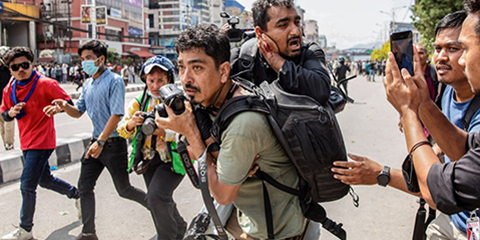
Journalists were injured during protests in Kathmandu against a social media ban affecting 26 platforms. The violence sparked widespread condemnation from local and international media organizations.Summary
KATHMANDU— Four journalists were injured in Kathmandu on September 8 during violent clashes with police over the country’s controversial social media bill and the recent banning of 26 social media platforms. The International Federation of Journalists (IFJ) joins its affiliates, the Federation of Nepali Journalists (FNJ) and Nepal Press Union (NPU), in condemning violence against journalists covering protests and calling on the Nepali government to launch a swift, independent investigation into the deadly crackdown.
Nineteen people were killed and over 100 were injured, including four working journalists, during the mass demonstrations after police used live ammunition, water cannons, tear gas, and rubber bullets to disperse crowds. Kantipur TV journalist Shyam Shrestha, Naya Patrika Daily reporter Dipendra Dhungana, and Nepal Press journalist Umesh Karki were all hit by rubber bullets fired by police while covering the protests in Kathmandu, with independent journalist Shambhu Dangal also injured.
Tens of thousands of young people, primarily students, flooded the streets of Kathmandu on September 8 in response to the government’s abrupt ban on 26 major social media platforms, including Facebook, Instagram, YouTube, X, LinkedIn, Pinterest, Reddit and Signal, with TikTok and Viber among those left accessible. The ban came after an August 17 Supreme Court order directed Nepal’s Ministry of Communications and Information Technology to require social media companies to formally register with the ministry by September 3, citing threats of misinformation, obstruction of judicial proceedings, and erosion of public trust in the courts. When all but five failed to do so, the government deactivated the platforms on September 4.
The protests, which followed ongoing public criticism of institutionalised political corruption and the government’s failure to deliver progress on economic issues, climaxed as thousands of demonstrators attempted to storm Nepal’s parliament, prompting police to open fire indiscriminately. The country’s army was deployed and a curfew imposed around the prime minister’s residence and the government precinct. The government lifted the social media ban the same evening, though an indefinite restriction on rallies and mass gatherings remains in place in Kathmandu.
Human rights organisations condemned the four-day shutdown as a violation of freedom of expression. In a statement released on May 1, a coalition of 31 Nepal-based civil society organisations and media groups stated that the registration directive “lacks legal clarity” and is deemed “imbalanced, impractical, and premature.” The ban is part of a broader clampdown on digital media in Nepal, following the controversial ‘Social Media Bill’ introduced in February 2025, which the IFJ and its affiliates urged the government to withdraw, warning it will undermine press freedom and free expression. Nepal also banned TikTok in November 2023, citing alleged ‘disruption to social harmony,’ according to the IFJ’s South Asia Press Freedom Report.
The FNJ said: “The FNJ condemns incidents of police oppression, demands proper compensation to the families of the deceased, and action against those involved in the oppression. We demand the government respect freedom of the press and expression, and refrains from responding with violence or by restricting access to social networks.”
The NPU said: “The NPU strongly condemns and denounces the police’s violent suppression of peaceful protesters and the killing of citizens. The Union calls for addressing the concerns of the youth by ensuring their right to peaceful protest, conducting an investigation into the incidents, and taking action against those responsible.”
The IFJ said: “The IFJ condemns the highly concerning violence and threats against journalists amid Kathmandu’s deadly protests and calls on authorities to take immediate measures to guarantee accountability and the safety of all media workers and civilians. The shutdown of social media platforms under vague registration requirements is a severe threat to press freedom and the right to information, and the Oli administration must ensure access remains permanently reinstated.”
Key Points
- Four journalists injured amid protests in Kathmandu over social media ban.
- Violent clashes with police resulted in 19 deaths and over 100 injuries.
- International Federation of Journalists condemns violence against the media.
- Government faced backlash for restricting access to major social media platforms.
- Calls for independent investigation into police actions during the protests.
Relevant Topics
Ask AI: Understand this story your way
AI EnabledDig deeper, ask anything — get instant context, background, and clarity.
Disclaimer: This feature is powered by AI and is intended to help readers explore and understand news stories more easily. While we strive for accuracy, AI-generated responses may occasionally be incomplete or reflect limitations in the underlying model. This feature does not represent the editorial views of JournalismPakistan. For our full, verified reporting, please refer to the original article.