
Enforced journalist disappearances: IFJ counts the missing days
JournalismPakistan.com | Published: 30 August 2016
Join our WhatsApp channel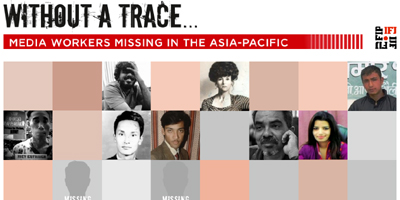
The International Federation of Journalists highlights ongoing concerns over enforced disappearances of media workers in the Asia-Pacific region. The call for action coincides with the International Day of the Victims of Enforced Disappearances, emphasizing the need for accountability.Summary
The International Federation of Journalists (IFJ), on the eve of the International Day of the Victims of Enforced Disappearances (August 30), calls on Asia-Pacific governments incriminated by enforced disappearances of media workers to take active steps to investigate critical cases and tackle impunity around missing media workers in the region.
The IFJ notes with serious concern that little progress has been made in the investigations of 11 documented cases in the Asia Pacific since it released its first report on missing Asia-Pacific media workers in 2015. Since then, an additional case has been added to the list – that of 24-year-old Pakistani journalist Zeenat Shahzadi, who went missing on August 19, 2015.
The young journalist was taken in broad daylight on her way to work. She is the first female journalist in Pakistan to be forcefully disappeared.
The IFJ’s monitoring record Without A Trace: Media Workers missing in the Asia-Pacific lists the cases of media workers from five countries in the region whose cases remain cold, where investigations have either faltered or failed to adequately determine the circumstances or perpetrators. Collectively, the 11 people have been missing for a total of over 46,000 days.
Across the region, the missing include, Juanta Nielsen (Australia), Prakash Singh Thakuri, Chitra Narayan Shrestha, Milan Nepali, Madan Paudel (all of Nepal), Ahmed Rilwan Abdulla (Maldives), Zeenat Shahzadi (Pakistan), Joey Estriber (Philippines), and Prageeth Eknaligoda, Subramaniam Ramachandran and Vadivel Nimalarajah (all of Sri Lanka).
The IFJ said: “Enforced disappearances are aimed to spread terror and fear. These 11 cases are indicative of the endemic impunity problem for attacks against journalists in the Asia-Pacific.
The lack of progress in the cases only increases the suffering and loss; and serves to stifle press freedom in communities and societies more broadly.” The IFJ today commended Sri Lanka for ratifying the ICPAED convention on May 25, 2016.
A breakthrough in the case of Prageeth Eknaligoda has seen the case two accused of involvement is his abduction facing local courts in May 2016, is also demonstrative of steps being taken by the new Sirisena government to repair press freedom.
The Convention came into effect on 2010 with the aim to prevent enforced disappearances, uncover the truth, and make sure survivors and victims’ families receive justice and reparation. So far 96 states have signed the convention and 52 have ratified the convention. Most countries in Asia-Pacific are yet to sign.
“The disappearance of Zeenat Shahzadi has brought immense suffering to her family and is understood to be linked to Pakistan’s intelligence agency ISI. Political leaders in these countries must take action on these cases.” “The fact that Australia, Nepal, Pakistan and the Philippines are yet to sign is also a red card on their human rights responsibilities,” the IFJ said.
The IFJ calls on the media to join the campaign by highlighting the cases, writing stories and using the hashtags #withoutatrace and #ifjmissing and #IDVED Total days missing – 46,134 Approximately – 6,590 weeks 126 years 1,107,216 hours Juanita Nielsen – Australia – July 4, 1975 – 15033 days Milan Nepali – Nepal – May 21, 1999 – 6311 days Chitra Narayan Shrestha – Nepal – May 30, 2000 – 5936 days Joey Estriber – Philippines – March 3, 2006 – 3833 days Subramaniam Ramachandran – Sri Lanka – February 15, 2007 – 3484 days Prakash Singh Thakuri – Nepal – July 5, 2007 – 3344 days Vadivel Nimalarajah – Sri Lanka – November 17, 2007 – 3209 days Prageeth Eknaligoda – Sri Lanka – January 24, 2010 – 2410 days Madan Paudel – Nepal – September 16, 2012 – 1444 days Ahmed Rilwan – Maldives – August 8, 2014 – 753 days Zeenat Shahzadi – Pakistan – August 19, 2015 – 377 days. - IFJ media release
Key Points
- The IFJ reports 11 unresolved cases of missing journalists in the Asia-Pacific.
- Zeenat Shahzadi is identified as Pakistan's first female journalist to be forcefully disappeared.
- Since 2015, the total days missing for the documented journalists exceed 46,000.
- The conventions aimed at preventing enforced disappearances are ratified by only a few Asia-Pacific nations.
- Political leaders are urged to address these critical human rights issues.
Relevant Topics
Ask AI: Understand this story your way
AI EnabledDig deeper, ask anything — get instant context, background, and clarity.
Disclaimer: This feature is powered by AI and is intended to help readers explore and understand news stories more easily. While we strive for accuracy, AI-generated responses may occasionally be incomplete or reflect limitations in the underlying model. This feature does not represent the editorial views of JournalismPakistan. For our full, verified reporting, please refer to the original article.