
'Alarming' decline in media freedom as Turkey fights rebels
JournalismPakistan.com | Published: 15 September 2015
Join our WhatsApp channel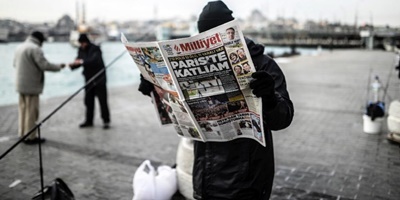
The situation for media freedom in Turkey is worsening as President Erdogan clamps down on opposition voices ahead of upcoming elections. Numerous journalists have been fired, and international reporters face arrests and deportations.Summary
ANKARA: When suspected Islamic State jihadists organized a deadly attack on Turkish activists in Suruc on the Syrian border in July, respected newspaper commentator Kadri Gursel responded with a tweet critical of President Recep Tayyip Erdogan.
"It's embarrassing that foreign leaders call the person who is the number one cause of the IS terror in Turkey to present their condolences for Suruc," he tweeted. Gursel was referring to allegations -- vehemently denied by Ankara -- that Erdogan had supported jihadists in Syria in the hope they would oust the Syrian regime.
The response by his newspaper Milliyet -- long seen as a respected and mainstream title -- was swift and merciless. Gursel, who started working for the paper in the 1990s and began his column in 2007, was fired the same day. The paper said Gursel's comments were journalistically unethical and violated its editorial principles.
His case highlights the problems faced by the Turkish opposition press as Erdogan pushes a relentless offensive against Kurdistan Workers' Party (PKK) rebels and prepares for snap legislative elections on November 1.
Turkey already has a history of cracking down on media freedoms and was the world's top jailer of journalists in 2012 and 2013 before improving slightly, according to International Committee to Protect Journalists.
The situation appears to have again deteriorated in recent weeks with the arrests and deportations of international journalists, attacks on the Hurriyet newspaper and a police raid on a holding company that owns opposition media. 'No surrender' "Erdogan wants to restore his party as the single party of government," Gursel told AFP.
"To achieve his goal, he is seeking to silence remaining critical voices in traditional media," he said. Karin Deutsch Karlekar, director of free expression programs at PEN American Center, agreed. "As the elections approach, the space for media to operate freely continues to shrink at an alarming rate," she told AFP.
Milliyet is owned by the Demiroren Group, one of Turkey's largest conglomerates with interests in energy, construction and media. Its chief, Erdogan Demiroren, is widely seen as close to the president. Mehves Evin, another pro-opposition Milliyet columnist, was fired last month. "I will not surrender. I will keep on writing!" she tweeted.
At least 140 journalists have been fired over the last couple of months, according to a report from EU-funded Press for Freedom Project. "There is no sign of hope. Press freedom is declining in Turkey," said Yusuf Kanli, veteran journalist and project coordinator.
'Crush you like a fly' Meanwhile, the pro-government Star newspaper's columnist Cem Kucuk accused leading Hurriyet columnist Ahmet Hakan of backing the outlawed PKK, and media outlets perceived to show similar backing earn routine accusations of treachery. "We could crush you like a fly if we want. We have been merciful until today and you are still alive," Kucuk wrote on September 9.
Hurriyet's Istanbul headquarters was attacked twice last week by pro-government demonstrators who accused the paper of misquoting Erdogan. It came after the president repeatedly criticized the Dogan Media Group, which owns Hurriyet and does not always toe the government line.
In another incident earlier this month, Turkish police swooped on the Ankara-based offices of Koza-Ipek media group -- close to Erdogan's political rival, the US-based Muslim cleric Fethullah Gulen -- after a report documenting weapons shipped from Turkey to IS in Syria. And on Monday, authorities raided the premises and detained the managing editor of the magazine Nokta for a cover satirising Erdogan.
The government however denies meddling with Turkey's press freedom and Erdogan has repeatedly stated that the country has "the freest press in the world". But Korkmaz Alemdar, professor of communications, said "we cannot talk about media freedom" in Turkey under Erdogan's Justice and Development Party (AKP), in office since 2002.
He added that the general public was often unaware of critical media sites and many took their information mostly from national television channels. 'Full submission' International media have also been affected.
Dutch journalist Frederike Geerdink was deported this month after being detained during clashes between Kurdish rebels and Turkish security forces, while the BBC was accused by Ankara of PKK propaganda over a recent report on the group's female fighters. Last month, Turkish authorities arrested on terror charges two British reporters and their Iraqi translator working for US-based Vice News.
The Britons were deported but translator Mohammed Ismael Rasool is still being held.
The European Union voiced concern about the arrests and warned that any country seeking to join the bloc "needs to guarantee respect for human rights, including freedom of expression." Turkey is a long-standing candidate for membership of the 28-nation EU, beginning its accession talks in 2005, but the process has been bogged down for years over complaints on its human rights record.
"The repression of press freedom in Turkey has continued systematically since 2008," Gursel told AFP. "This latest wave is only a new chapter towards the full submission which is the ultimate target," he added.- AFP
Key Points
- Kadri Gursel fired for criticizing Erdogan's policies.
- Turkey has a history of media repression and arrests of journalists.
- Threats against independent media increase as elections approach.
- International media also faces repression and deportation.
- EU expresses concerns over Turkey's deteriorating human rights record.
Relevant Topics
Ask AI: Understand this story your way
AI EnabledDig deeper, ask anything — get instant context, background, and clarity.
Disclaimer: This feature is powered by AI and is intended to help readers explore and understand news stories more easily. While we strive for accuracy, AI-generated responses may occasionally be incomplete or reflect limitations in the underlying model. This feature does not represent the editorial views of JournalismPakistan. For our full, verified reporting, please refer to the original article.