.png)
Pioneering reporter Helen Thomas aged into legend
JournalismPakistan.com | Published: 21 July 2013
Join our WhatsApp channel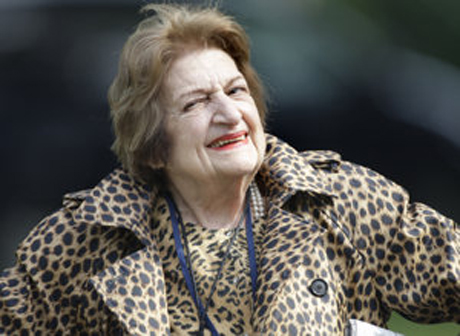
Helen Thomas, a trailblazing journalist, covered the White House for five decades and became a prominent figure in American journalism. She faced challenges but remained a fierce advocate for press freedom and women's rights until her death at 92.Summary
WASHINGTON: Covering 10 presidents over five decades, Helen Thomas aged into a legend. She was the only reporter with her name inscribed on a chair in the White House briefing room — her own front row seat to history.
Starting as a copy girl in 1943, when women were considered unfit for serious reporting, Thomas rose to bureau chief.
Working at a news service, where writers expect obscurity, she became one of journalism's most recognized faces. Thomas embraced her role as a Washington institution, doing cameos in movies, giving lectures, writing books about her life until the spotlight landed on inflammatory remarks she made about Israel.
The uproar pushed her out of the White House press room at age 89.
Thomas, 92, died surrounded by family and friends at her Washington apartment on Saturday, the family said in a statement. A friend, Muriel Dobbin, told The Associated Press that Thomas had been ill for a long time, and in and out of the hospital before coming home Thursday.
Thomas made her name as a bulldog for United Press International in the great wire-service rivalries of old, and as a pioneer for women in journalism.
She was persistent to the point of badgering. One White House press secretary described her questioning as "torture" — and he was one of her fans.
In her later years, her refusal to conceal her strong opinions, even when posing questions to a president, and her public hostility toward Israel caused discomfort among colleagues.
In 2010, that tendency ended her storied career at the White House. She told a rabbi making a video that Israeli Jews should "get the hell out of Palestine" and "go home" to Germany, Poland or the United States. The video circulated on the Internet and brought widespread condemnation of Thomas, forcing her to quit her job as a Hearst columnist.
Months later, in January 2011, she started a column for a free weekly paper in a Washington suburb. In her long career, Thomas was indelibly associated with the ritual ending White House news conferences. She was often the one to deliver the closing line: "Thank you, Mr. President" — four polite words that belied a fierce competitive streak.
Her disdain for White House secrecy and dodging spanned five decades, back to President John Kennedy. Her freedom to voice her peppery opinions as a speaker and a Hearst columnist came late in her career.
After she quit UPI in 2000 — by then an outsized figure in a shrunken organization — her influence waned. The Bush administration marginalized her, clearly peeved with a journalist who had challenged President George W. Bush to his face on the Iraq war and declared him the worst president in history.
Thomas was accustomed to getting under the skin of presidents, if not to getting the cold shoulder. "If you want to be loved," she said years earlier, "go into something else."
There was a lighter mood in August 2009, on her 89th birthday, when President Barack Obama popped into the White House briefing room unannounced. He led the roomful of reporters in singing "Happy Birthday to You" and gave her cupcakes. As it happened, it was the president's birthday too, his 48th.
Thomas was at the forefront of women's achievements in journalism. She was one of the first female reporters to break out of the White House "women's beat" — the soft stories about presidents' kids, wives, their teas and their hairdos — and cover the hard news on an equal footing with men.
She became the first female White House bureau chief for a wire service when UPI named her to the position in 1974. She was also the first female officer at the National Press Club, where women had once been barred as members and she had to fight for admission into the 1959 luncheon speech where Soviet Premier Nikita Khrushchev warned: "We will bury you."
The belligerent Khrushchev was an unlikely ally in one sense. He had refused to speak at any Washington venue that excluded women, she said.
Thomas fought, too, for a more open presidency, resisting all moves by a succession of administrations to restrict press access.
"People will never know how hard it is to get information," Thomas told an interviewer, "especially if it's locked up behind official doors where, if politicians had their way, they'd stamp TOP SECRET on the color of the walls." - AP
Key Points
- Covered ten U.S. presidents over five decades.
- First female White House bureau chief for UPI in 1974.
- Known for persistent questioning and challenging presidential authority.
- Received widespread criticism for her controversial remarks on Israel.
- Died at 92 in her Washington apartment, surrounded by family.
Relevant Topics
Ask AI: Understand this story your way
AI EnabledDig deeper, ask anything — get instant context, background, and clarity.
Disclaimer: This feature is powered by AI and is intended to help readers explore and understand news stories more easily. While we strive for accuracy, AI-generated responses may occasionally be incomplete or reflect limitations in the underlying model. This feature does not represent the editorial views of JournalismPakistan. For our full, verified reporting, please refer to the original article.