

Social media becomes top source of online news worldwide
JournalismPakistan.com | Published: 16 June 2026 | JP Global Monitoring
Join our WhatsApp channel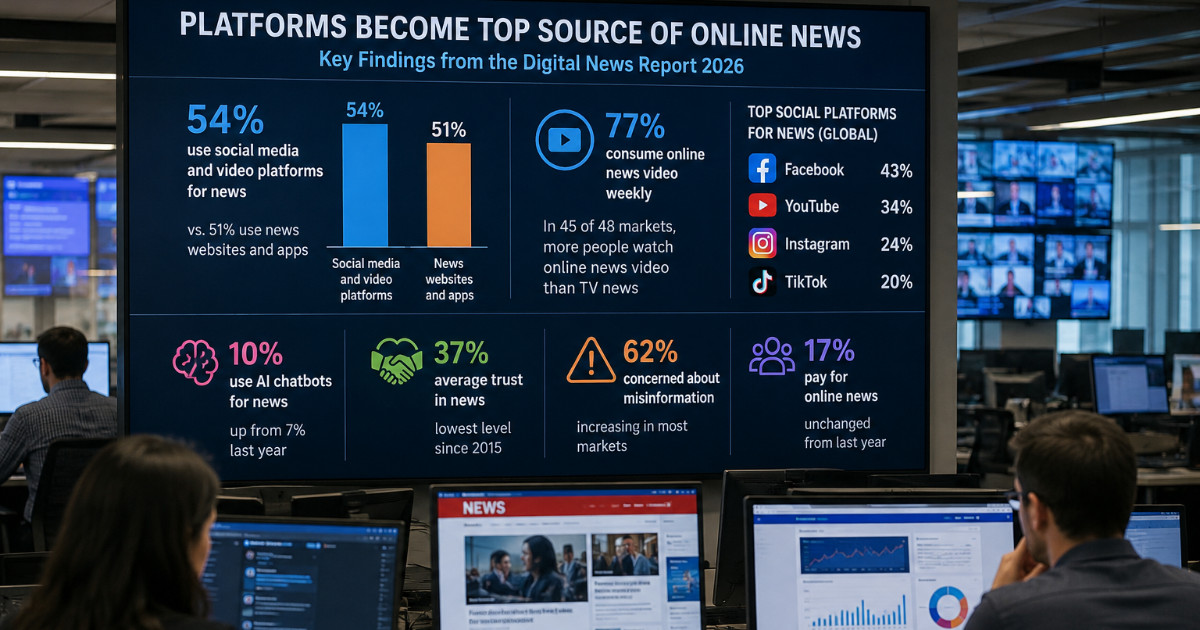
The Reuters Institute Digital News Report 2026 found 54% in 48 markets get news from social media and video platforms, versus 51% from publishers' websites and apps. It noted rising online video use, falling trust and growing concern about misinformation.Summary
LONDON— Social media and video platforms have overtaken news websites and apps as the world's most widely used source of online news for the first time, according to the Reuters Institute Digital News Report 2026, highlighting a profound shift in how audiences access journalism worldwide. The report, published June 16, found that 54% of respondents across 48 markets use social media and video networks for news, compared with 51% who access news through publishers' own websites and apps.
The findings point to a rapidly changing media environment in which audiences increasingly consume news through third-party platforms, watch rather than read, and experiment with emerging technologies such as artificial intelligence chatbots. Researchers also reported declining interest in news, record-low trust levels, and growing concern about misinformation.
Platforms reshape global news consumption
Online video continued its rise across all surveyed markets. The report found that 77% of respondents consume online news video weekly, while in 45 of the 48 markets studied, more people now watch online news video than broadcast television news. Growth is being driven largely by platform-based consumption rather than publishers' own websites and apps, where video usage declined by five percentage points during the year.
Among major platforms, Facebook remained the largest source of news globally, used by 43% of respondents, while YouTube reached 34%. Instagram and TikTok recorded some of the strongest growth, reflecting the increasing influence of video-first environments on news discovery and audience engagement. The report also highlighted the growing role of creators and influencers, with 27% of respondents receiving news from news-focused creators and 46% obtaining some news from creators of any type.
AI emerges as a new news gateway
Artificial intelligence is becoming a more significant intermediary in news consumption. Ten percent of respondents said they use AI chatbots for news, up from 7% a year earlier. Adoption remains highest among younger audiences and those already highly interested in current affairs. Users cited the ability to ask follow-up questions and obtain additional context as the most valued feature of AI-powered news interactions.
Despite growing experimentation with AI and social platforms, audiences expressed deepening concerns about trust and misinformation. Trust in news fell in 29 of the 48 markets surveyed, reaching an overall average of 37%, the lowest level recorded since Reuters Institute began measuring trust in 2015. Concerns about misinformation also rose to 62% on average, increasing in most markets.
News organizations face engagement challenges
The report found a continuing decline in audience engagement with news. Since 2021, the share of people who describe themselves as very or extremely interested in news has fallen by an average of 13 percentage points across surveyed markets. Meanwhile, the proportion of casual or passive news users has increased from 16% to 25%.
Financial pressures on publishers are also evident. The proportion of people paying for online news remained unchanged at 17% across a basket of 20 countries tracked by the study. Researchers warned that attracting new subscribers may become more difficult as fewer users access news directly through publisher-owned platforms. However, the report noted that many paying subscribers continue to support journalism for both content value and broader civic reasons.
Despite the turbulence, support for impartial journalism remains strong. Nearly half of respondents said they prefer news that does not take sides, suggesting that traditional journalistic values continue to resonate even as audience behavior evolves and news consumption becomes increasingly fragmented across digital platforms.
WHY THIS MATTERS: The report provides one of the clearest indicators yet that audience relationships with journalism are increasingly mediated by platforms, creators, and AI systems rather than direct publisher channels. For media organizations, the findings underscore the urgency of adapting distribution, video, and audience-engagement strategies while preserving trust, credibility, and sustainable business models in a fragmented information environment.
ATTRIBUTION: Reporting by JournalismPakistan, based on the Reuters Institute Digital News Report 2026 overview and findings published June 16, 2026.
PHOTO: AI-generated; for illustrative purposes
Key Points
- 54% of respondents across 48 markets use social media and video platforms for news, versus 51% for publishers' websites and apps.
- 77% consume online news video weekly, and in 45 of 48 markets more people watch online news video than broadcast TV.
- Growth is driven by platform-based consumption while video use on publishers' sites fell by five percentage points.
- Facebook remains the largest global news source at 43%, YouTube 34%, with strong growth on Instagram and TikTok.
- The report also records declining interest in news, record-low trust levels, and rising concerns about misinformation and AI chatbots.
Key Questions & Answers
What did the Reuters report find about social media and news?
It found that social media and video platforms are now the most used sources of online news globally, with 54% using them versus 51% using publishers' websites and apps.
How common is online news video consumption?
Online news video is widely consumed: 77% watch it weekly, and in 45 of 48 markets more people watch online news video than broadcast television news.
Which platforms are the main news sources?
Facebook is the largest global news source at 43%, YouTube reaches 34%, and Instagram and TikTok showed some of the strongest growth.
What concerns did the report highlight?
Researchers reported falling trust in news, declining interest in news, and growing worries about misinformation and the role of AI chatbots.
Relevant Topics
Ask AI: Understand this story your way
AI EnabledDig deeper, ask anything — get instant context, background, and clarity.
Disclaimer: This feature is powered by AI and is intended to help readers explore and understand news stories more easily. While we strive for accuracy, AI-generated responses may occasionally be incomplete or reflect limitations in the underlying model. This feature does not represent the editorial views of JournalismPakistan. For our full, verified reporting, please refer to the original article.