

Open-Source Intelligence (OSINT): How journalists verify information in the digital age
JournalismPakistan.com | Published: 14 June 2026 | JP Staff Report
Join our WhatsApp channel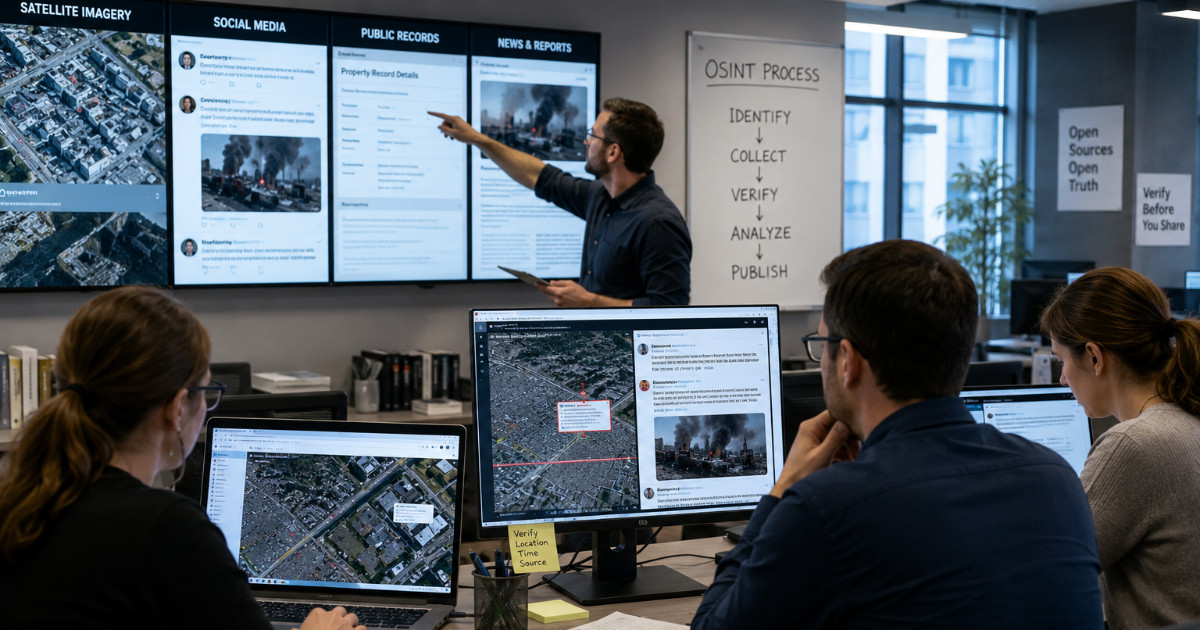
Open-Source Intelligence (OSINT) helps journalists use public data, social posts, satellite images, maps, and records to verify events and investigate misinformation. In Pakistan and South Asia, reporters turn to OSINT when field access is limited.Summary
ISLAMABAD — Open-Source Intelligence, commonly known as OSINT, has become one of the most important tools in modern journalism, particularly as reporters increasingly work in digital environments shaped by social media, satellite imagery, public databases, and online records.
The term has gained prominence in recent years as news organizations, researchers, and investigative teams have relied on publicly available information to verify events ranging from armed conflicts and natural disasters to political campaigns and human rights investigations. International reporting on wars in Ukraine and the Middle East, for example, has frequently incorporated OSINT techniques to analyze videos, photographs, and geographic data when access to conflict zones has been limited.
In Pakistan and across South Asia, journalists are also using publicly accessible digital information to verify claims, investigate misinformation, and strengthen reporting. As digital platforms continue to influence how news is gathered and distributed, understanding OSINT has become increasingly relevant for both media professionals and news consumers.
What Open-Source Intelligence (OSINT) means
Open-Source Intelligence refers to the collection, analysis, and verification of information obtained from publicly available sources. Unlike classified intelligence or confidential documents, OSINT relies on information that anyone can legally access.
These sources can include government records, court filings, corporate databases, social media posts, public websites, satellite imagery, maps, videos, photographs, academic research, and archived internet content. Journalists, researchers, fact-checkers, and investigators use these materials to establish facts, verify claims, and uncover information that may not be immediately visible.
The key distinction is that OSINT is not defined by the type of information alone but by the process used to gather and analyze it. A single social media post, for instance, may have limited value on its own. However, when combined with geolocation techniques, public records, timestamps, and other sources, it can help journalists verify where and when an event occurred.
In journalism, OSINT often supports traditional reporting rather than replacing it. Reporters may combine digital investigations with interviews, field reporting, official statements, and documentary evidence to produce a more complete account of an event.
Why it matters now
The rise of digital communication has dramatically expanded the amount of information available in the public domain. At the same time, misinformation, manipulated content, and coordinated influence campaigns have increased the need for robust verification methods.
News organizations are under pressure to confirm information quickly while maintaining accuracy. OSINT provides tools that help journalists verify user-generated content before publication. This can be particularly important during breaking news events, elections, armed conflicts, protests, and natural disasters, when false information can spread rapidly online.
Advances in artificial intelligence have further increased the importance of OSINT. AI-generated images, videos, and audio recordings are becoming more sophisticated, creating new challenges for verification. Journalists increasingly use open-source methods to identify altered content, establish authenticity, and trace the origins of digital material.
OSINT also plays a role in accountability reporting. Public procurement records, company ownership databases, campaign finance disclosures, environmental data, and court documents can help reporters investigate issues affecting the public interest. As governments, corporations, and institutions generate more digital records, the ability to analyze publicly available information has become a valuable journalistic skill.
For readers, understanding OSINT can provide insight into how credible reporting is produced and how journalists substantiate claims using transparent and verifiable evidence.
Real-world examples
One of the most widely cited examples of OSINT in journalism is the work conducted by investigative organization Bellingcat. The group has used publicly available videos, photographs, satellite imagery, and online databases to investigate international incidents, including military operations and human rights allegations. Its methods have influenced newsrooms worldwide and demonstrated how publicly accessible information can support major investigations.
International news organizations such as BBC News, Reuters, and The New York Times have also developed visual investigations teams that employ OSINT techniques to verify events and reconstruct incidents using publicly available evidence.
In South Asia, fact-checking organizations and independent media outlets have increasingly adopted OSINT methods to verify viral social media content, identify misleading images, and trace the origins of online claims. During elections, protests, and emergency situations, journalists have used geolocation tools, reverse image searches, and public records to distinguish authentic information from manipulated or recycled content.
In Pakistan, digital verification techniques have been used by newsrooms and fact-checking initiatives to assess viral videos, verify the location of incidents, and identify misleading content circulating on social media platforms. As online misinformation becomes a growing concern, these methods help strengthen the reliability of public information.
The future importance of OSINT is likely to grow as journalism becomes more data-driven and digitally focused. While traditional reporting remains essential, the ability to analyze and verify publicly available information has become a critical part of the reporting process. For journalists, policymakers, and readers alike, understanding Open-Source Intelligence offers valuable insight into how facts are established in an increasingly complex information environment and how trustworthy reporting is produced in the digital age.
MORE JOURNALISM TERMS: You may also find the following JournalismPakistan explainers useful:
PHOTO: AI-generated; for illustrative purposes
Key Points
- OSINT is the collection and analysis of publicly available information for reporting and verification.
- Common sources include social media posts, videos, satellite imagery, maps and public records.
- Journalists use OSINT to verify events, investigate claims and expose misinformation when access is restricted.
- Techniques involve geolocation, time verification, metadata review and cross-referencing multiple sources.
- While powerful, OSINT requires careful validation and ethical consideration to avoid errors and harm.
Key Questions & Answers
What is OSINT?
Open-Source Intelligence (OSINT) is the gathering and analysis of information from publicly accessible sources to verify facts and inform reporting.
How do journalists verify content using OSINT?
Reporters cross-check timestamps and locations, geolocate images or videos, examine metadata, compare multiple sources and consult official records to confirm authenticity.
Is using OSINT legal?
Generally yes, when information is publicly available and accessed legally; journalists must still respect privacy laws and ethical guidelines.
What are the limitations of OSINT?
OSINT can be hampered by manipulated media, incomplete data, false attribution and the need for expert analysis to avoid misinterpretation.
Relevant Topics
Ask AI: Understand this story your way
AI EnabledDig deeper, ask anything — get instant context, background, and clarity.
Disclaimer: This feature is powered by AI and is intended to help readers explore and understand news stories more easily. While we strive for accuracy, AI-generated responses may occasionally be incomplete or reflect limitations in the underlying model. This feature does not represent the editorial views of JournalismPakistan. For our full, verified reporting, please refer to the original article.