.png)
CPJ urges Maldives president to reject ‘regressive’ media bill
JournalismPakistan.com | Published: 23 August 2025 | CPJ News Alert
Join our WhatsApp channel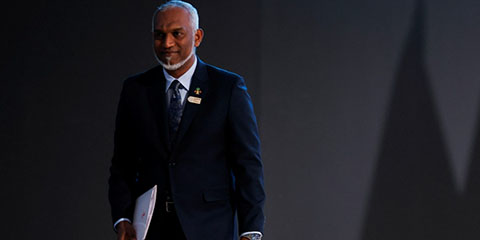
The Committee to Protect Journalists (CPJ) has called on Maldives President Mohamed Muizzu to abandon a new media bill that threatens press freedom. The proposed legislation aims to replace existing regulatory bodies with a government-controlled commission, jeopardizing independent journalism.Summary
NEW DELHI—Maldives president Mohamed Muizzu should reject a bill that was recently introduced in the country’s parliament that would dismantle press freedom and place the media under government control, the second such bill in a year after earlier attempts failed, the Committee to Protect Journalists said Thursday.
“President Mohamed Muizzu must uphold his pledge to support media freedom by ensuring this regressive bill is withdrawn,” said CPJ Asia-Pacific Regional Director Beh Lih Yi. “Creating a new commission, stacking it with presidential appointees, and then granting it sweeping powers to fine, suspend, and shutter news outlets as it sees fit would destroy independent journalism and erode the Maldives’ fragile democratic space.”
The bill would dissolve two existing regulatory bodies, the Maldives Media Council and the Maldives Broadcasting Commission, and replace them with a new entity — the Maldives Media and Broadcasting Commission.
The proposed commission would have seven members, with the president empowered to appoint three of them. The president would also select the chairperson. The four remaining members, elected by the media, could be removed by a parliamentary vote. The bill would give the commission the power to:
- Fine journalists between US$325 and US$650 and media outlets up to US$6,500 for code of conduct violations, failing to comply with the commission’s orders and legal violations.
- Temporarily suspend registrations of outlets during commission probe
- Pursue judicial order to cancel registrations of media outlets
- Block websites and halt broadcasts during commission probe
- Investigate cases retroactively (up to a year before the creation of the new commission)
The Maldives Journalists Association (MJA), a local press freedom organization, warned that the bill would dismantle press freedom and place the media under government control. MJA called the bill a “grave threat” that criminalizes reporting and said journalists and media outlets were not consulted during its drafting.
Independent parliamentarian Abdul Hannan Aboobakuru introduced the bill in the People’s Majlis, the country’s legislative body, on August 18, after similar attempts last year. That bill was rejected after President Muizzu said he opposed controlling the press and wanted greater media freedom. He asked his party, the People’s National Congress, which controls parliament, to vote against that bill.
Muizzu and Hannan did not immediately respond to CPJ’s email requesting comment.
Photo caption: Maldives' President Mohamed Muizzu attends the United Nations climate change conference in Baku, Azerbaijan, on November 12, 2024. (Photo: Reuters/Maxim Shemetov)
Key Points
- CPJ urges President Muizzu to reject the regressive media bill.
- The bill would dissolve existing media regulatory bodies.
- A new commission will be appointed by the President, threatening independence.
- The legislation allows heavy fines and suspension of media outlets.
- Maldives Journalists Association warns of a grave threat to press freedom.
Relevant Topics
Ask AI: Understand this story your way
AI EnabledDig deeper, ask anything — get instant context, background, and clarity.
Disclaimer: This feature is powered by AI and is intended to help readers explore and understand news stories more easily. While we strive for accuracy, AI-generated responses may occasionally be incomplete or reflect limitations in the underlying model. This feature does not represent the editorial views of JournalismPakistan. For our full, verified reporting, please refer to the original article.