

What journalists need to know about hash values
JournalismPakistan.com | Published: 19 August 2026 | JP Staff Report
Join our WhatsApp channel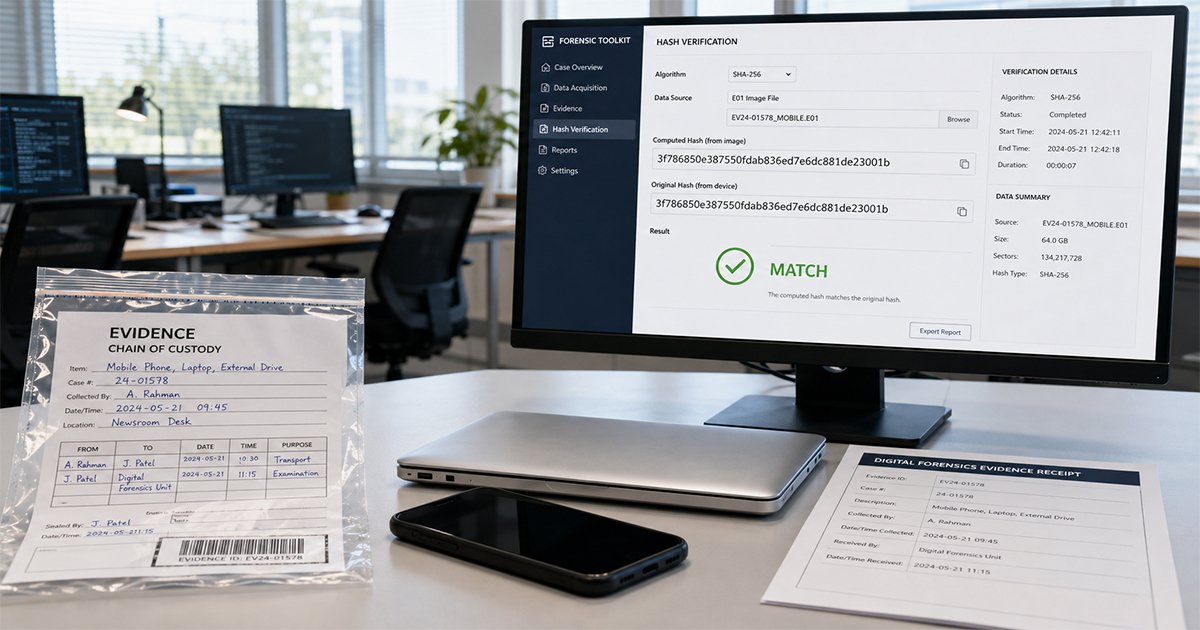
Hash values are fixed-length cryptographic strings that act as fingerprints for digital files; any tiny change alters the hash. Newsrooms use them to verify leaked documents, preserve photos and videos, transfer sensitive files, and record integrity for investigations and court use.Summary
ISLAMABAD — The seizure of journalists’ phones, laptops, and storage devices has made an unfamiliar technical term increasingly important to newsrooms: hash value. The term drew attention in August 2026 after Gujarat Police searched the residences of Indian journalist Ravi Nair and seized several electronic devices.
Indian media organizations said investigators had reportedly failed to provide hash values for the seized devices or their forensic copies. Their concern was not merely technical. Without a properly documented digital fingerprint recorded at the time of collection, it can become harder to demonstrate that electronic evidence remained unchanged while in official custody.
Hash values also matter beyond police investigations. News organizations use them when verifying leaked documents, preserving photographs and videos, transferring sensitive files, and establishing the integrity of material that may later be challenged in court. As artificial intelligence makes digital manipulation easier, the ability to show that a particular file has not changed is becoming more valuable.
What a hash value means
A hash value is a fixed-length string of letters and numbers generated by running digital data through a mathematical process known as a hash function. It acts like a fingerprint for the data being examined.
The data may be a document, photograph, video, email archive, hard drive, or forensic copy of a phone. If the contents change, even by a single character or bit, the resulting hash value will ordinarily change as well. Investigators and forensic specialists can therefore calculate a hash when evidence is collected and calculate it again later. A matching result indicates that the data being compared is identical.
One widely used algorithm is SHA-256, which produces a 256-bit hash commonly displayed as a 64-character hexadecimal string. Older algorithms such as MD5 and SHA-1 are still encountered, but weaknesses that allow theoretically different files to produce the same hash have made them unsuitable for many security-sensitive uses. Modern forensic work generally favors stronger algorithms, including SHA-256.
Hashing is not the same as encryption. Encryption scrambles information so that an authorized person can restore and read it with the correct key. A hash function is designed to work in one direction: it creates a fingerprint but is not intended to reconstruct the original information.
A hash value also does not establish that a document is truthful or that a video depicts an authentic event. It only helps show whether the specific data being tested has changed. Questions about who created the material, how it was obtained, and whether it accurately represents events require additional evidence.
Why it matters now
Modern journalists store extensive reporting material on digital devices, including interview recordings, draft articles, unpublished photographs, contact lists, and communications with confidential sources. When authorities seize a device, questions immediately arise about privacy, chain of custody, the scope of any search, and the integrity of the evidence.
Forensic examiners usually create a bit-for-bit copy, known as a forensic image, rather than conduct their full examination on the original device. Hash values calculated for the collected data and the forensic copy can help demonstrate that the copy accurately reflects what was acquired and that later analysis did not alter it.
The process must still be properly documented. A hash recorded only after a device has spent time in custody cannot, by itself, establish what its contents were when it was first taken. Devices may also change data during normal operation, particularly if they are switched on or connected to a network. This is why collection procedures, timestamps, access records, forensic tools, and the identities of those handling the evidence remain part of the chain of custody.
In Pakistan, electronic evidence is addressed through legislation including the Qanun-e-Shahadat Order, 1984, the Electronic Transactions Ordinance, 2002, and the Prevention of Electronic Crimes Act, 2016. Article 164 of the Qanun-e-Shahadat Order permits courts to receive evidence made available through modern devices or techniques. However, admissibility does not automatically settle authenticity or evidentiary weight. Courts may still examine how material was collected, preserved, verified, and connected to a person or alleged act.
Real-world examples
The August 2026 searches involving Ravi Nair provided a South Asian example of why hash values can become a press freedom issue. Gujarat Police seized phones and other devices during an investigation linked to his social media posts about reporting he co-authored for The Washington Post. Some devices reportedly belonged to people who were not named as accused.
The Press Club of India and DIGIPUB News India Foundation criticized the searches and raised concerns about the reported failure to provide hash values. DIGIPUB said such safeguards were important for maintaining the integrity, authenticity, and forensic reliability of digital evidence. The criticism did not determine whether any evidence had been altered; it focused on whether procedures allowing later verification had been followed.
An international example emerged in the United States after federal agents seized electronic devices from Washington Post reporter Hannah Natanson during a national security leak investigation in January 2026. Natanson was not accused of wrongdoing. In February, a federal magistrate judge rejected the Justice Department’s request to conduct an unsupervised, broad search of the seized data and ordered a court-supervised review.
That dispute centered largely on the permissible scope of the search and the protection of journalistic material rather than a reported disagreement over hash values. Still, the case illustrated the wider forensic process in which investigators must preserve acquired data, separate relevant evidence from unrelated newsroom material, and demonstrate that electronic records were handled reliably.
As news production, source communication, and government investigations become increasingly digital, hash values are likely to appear more often in court filings, police procedures, cybersecurity reports, and press freedom statements. Understanding the term helps readers distinguish between proof that a file remained unchanged and the much broader question of whether the file is authentic, accurate, lawfully obtained, or sufficient to support a legal claim.
Key Points
- Hash values are fixed-length strings produced by hash functions that act as unique fingerprints for data.
- A single bit change in a file produces a different hash, making hashes useful to detect tampering.
- Newsrooms use hashes to verify leaked documents, preserve multimedia, and securely transfer sensitive files.
- Recording the hash, algorithm, timestamp, and method at collection helps document chain of custody.
- Hashes support integrity claims but should accompany proper forensic procedures and custody records.
Key Questions & Answers
What is a hash value?
A hash value is a fixed-length alphanumeric string created by a mathematical hash function that uniquely represents the contents of a file; any small change to the file will normally produce a different hash.
Why do hash values matter to journalists?
They allow journalists to prove a file has not changed, aiding verification of leaks, preservation of photos and videos, secure transfers, and documentation of evidence for investigations or legal challenges.
How should journalists generate and record a hash?
Use a standard algorithm (for example SHA-256), record the algorithm and tool used, note the timestamp and device, and store the hash alongside the original file and any forensic copies to maintain provenance.
Can a hash alone prove a file was not altered in court?
A matching hash supports claims of integrity but is not usually sufficient by itself; courts typically require documented chain of custody, forensic methods, and contextual evidence to accept digital proof.
Relevant Topics
Ask AI: Understand this story your way
AI EnabledDig deeper, ask anything — get instant context, background, and clarity.
Disclaimer: This feature is powered by AI and is intended to help readers explore and understand news stories more easily. While we strive for accuracy, AI-generated responses may occasionally be incomplete or reflect limitations in the underlying model. This feature does not represent the editorial views of JournalismPakistan. For our full, verified reporting, please refer to the original article.