
How Dr. Nauman Niaz built the world's greatest private sports museum
JournalismPakistan.com | Published: 19 February 2026 | JP Staff Report
Join our WhatsApp channel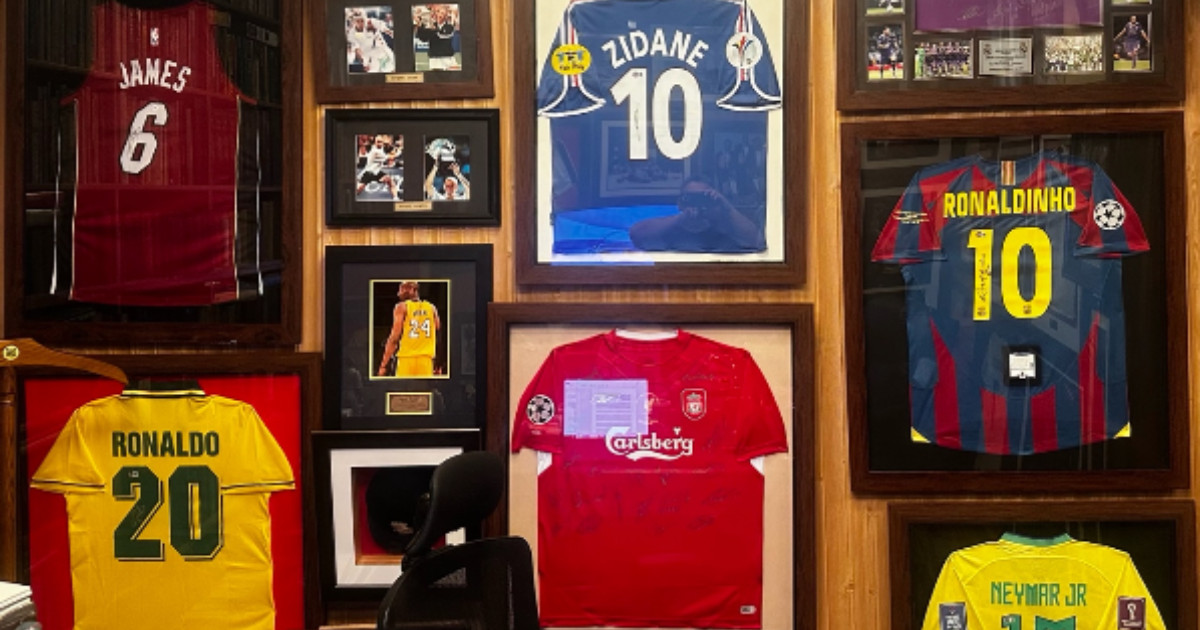
Dr. Nauman Niaz's private sports museum in Rawalpindi presents a large collection of cricket and multi-sport artifacts, including Shane Warne's World Cup 1999 final shirt and a Test shirt marking his 500th wicket. Visitors find a curated, reverent atmosphere.Summary
ISLAMABAD — You do not approach such a place casually. You go with a prepared stillness, as one might approach an old cathedral, or a manor whose walls have absorbed generations of breath and triumph. You reach out to Dr. Nauman Niaz not simply to view a collection, but to stand before what time and devotion, and an almost pastoral fidelity to sport, have chosen to spare from disappearance. And yet for all the readiness of mind, at the first glance, you are undone. Dumbfounded is the only word that does not diminish the feeling.
For this is not a room. It is not even a house. It is history rendered tangible, a sanctuary of clothing and match-played equipment, of print and memory, where sweat has dried into immortality.
Cricket Stands First, But Does Not Stand Alone
Cricket stands first, as it must. But cricket does not stand alone. As you climb the stairs, the air alters. There is a hush that seems to arise from the objects themselves. Directly before you hangs Shane Warne's match-worn ICC World Cup 1999 final shirt. It does not simply hang. It lingers. Beside it rests Warne's Test match shirt from the Test in which he completed his 500th wicket, a garment that once carried anticipation and the sudden crack of destiny. The cloth appears still, yet the mind insists on seeing it lift in the breeze of that moment when history conceded another milestone. You pause, because pause is required. Then you move forward.
A Study Room Where Football Royalty Meets Living Legend
In the study room, you must gather yourself again. Breath becomes deliberate. There is a hand-signed match-worn Brazil shirt of Pelé from the 1970 FIFA World Cup. It glows without ostentation, warmed by the knowledge of what those shoulders once achieved. Next to it is Maradona's signed Argentina shirt, restless even in repose, bearing within its seams the echo of impossible footwork and the hand that altered a century's narrative. Then Lionel Messi's signed FC Barcelona shirt, blue and red intertwined like devotion given visible form. Cristiano Ronaldo's Manchester United signed match-played shirt stands near it, disciplined and exacting, a testament to ambition pursued without apology.
Below them rests England's 1966 FIFA World Cup final shirt. Beside it, Italy's 2006 World Cup winning shirt signed by the full team, collective triumph inscribed in careful ink. Germany's 2014 FIFA World Cup final signed shirt stands nearby, resolute and precise.
You begin to feel that you are not walking across a floor but across decades. There is the Real Madrid shirt signed by Zidane, Pepe, Ronaldo, Morata, Modric, Bale, Isco, Kovacic, Caravajal, Navas, Benzema, Rodriguez, Casemiro, Casilla, Kroos, and Coentrao, a gathering of names that once moved in unison. Below it Ronaldinho's signed match-worn shirt from the UEFA Championship Final 2006 appears playful even in stillness. Neymar Jr.'s Brazil shirt carries the brightness of youth. Zidane's signed France shirt hangs near Ronaldo's Brazil World Cup 1994 shirt, the early hint of greatness yet to crest.
In solemn transatlantic dignity stands LeBron James' hand-signed shirt. Beneath it rests a hand-signed Kobe Bryant photograph, capturing not motion but the tension before elevation. Above them are Andre Agassi and Steffi Graf's signed photographs, poised, meeting poise across time.
It does not end. There is the 2002 to 2003 Liverpool team signed shirt, red with memory. Another Manchester United shirt. Another Cristiano Ronaldo shirt, hand signed again, as though ambition insisted on repetition. Spain's Euro Cup-winning 2008 shirt gleams nearby. Cafu's signed shirt and another Real Madrid team-signed shirt continue the procession.
Seven tennis balls sit almost modestly, signed by Rod Laver, Bjorn Borg, John McEnroe, Andre Agassi, Roger Federer, and Rafael Nadal. They are small, round testaments to contests that once divided stadiums. Roberto Carlos's shirt lies close by. A Maradona signed photograph captures him mid-glory, ink sealing the image to permanence.
When Boxing Changes the Temperature of the Room
Then boxing alters the temperature of the room. A boxing trunk signed by five heavyweight champions: Muhammad Ali, Joe Frazier, George Foreman, Ken Norton, and Larry Holmes. Teo Phantom Punch portraits of Muhammad Ali signed with a script that carries dignity and defiance in equal measure. There is the iconic photograph signed by Ken Norton, Joe Frazier, Larry Holmes, George Foreman, and Muhammad Ali, bearing both signatures, Cassius Clay and, after conversion to Islam, Muhammad Ali. A dual identity preserved without compromise.
Nearby rests a winning photograph of Muhammad Ali signed after he had been diagnosed with Parkinsonism, the signature unsteady yet resolute, testimony rather than frailty. Four gloves follow. Mike Tyson signed. Tyson Fury signed. Muhammad Ali from Rumble in the Jungle, Manila, 1974. Sylvester Stallone's glove used in Rocky 4. Then the Joe Frazier and Muhammad Ali bout photograph, the rivalry crystallized into permanence. Joe Frazier's signed trunk rests close, as if still holding the sobriety of collision.
Cristiano Ronaldo's signed shoes. Maradona's signed shoes. Footsteps that altered continents.
Cricket Returns: Bradman, Fossils of Competition, and the First Test Ball
Cricket returns, as it must. A bat signed by Mark Taylor and Sir Donald Bradman after he scored 334, equaling the highest Test score of a legend. A ball signed by Brett Lee, Jeff Thomson, Muttiah Muralitharan, and Freddie Flintoff, speed and spin pressed into leather. Then, almost impossibly, the first Test match ball from 1876. A Test-used 1877 ball. A Test played 1902 ball. Alf Valentine's hat-trick ball from a club final. These are not objects. They are fossils of competition.
Two match-played bats of Sir Donald Bradman, one from 1930 and the other from 1934. Two beautifully signed photographs, one from the 1948 Invincibles signed by all the players and one from the tied Test 1960 to 1961. A portrait of Joe Darling, hand-signed. The 1932 Bodyline series picture of the Orient Line ship Orontes, with England's complete team autographs upon it.
On the right side, a library. Four thousand books, all on cricket. First editions from 1818 to the present day. Mostly hand-signed. Deluxe editions. Presentation copies. And among them his own seventeen books, as though the collector has entered the lineage he preserves.
The room continues, but you are already saturated. There hangs Kylian Mbappe's shirt, hand-signed. And David Beckham's. You leave not with envy but with reverence. Dr. Nauman Niaz has not assembled a collection. He has reassembled history. A field in which eras graze side by side. Where balls, shirts, ink, and memory converge into continuity. In that house, sport is not a pastime. It is heritage.
The Man Behind the Museum: Custodian of Time
There are collectors in this world, patient men who gather relics as farmers gather seed. And then there is Dr. Nauman Niaz. He belongs to a rarer loyalty, preservation as vocation.
In Islamabad, Pakistan, where the Margalla Hills observe with ancient indifference the tremors of modern life, stands a house that breathes history. Within it resides a man whose vocation is medicine, whose calling is memory, whose devotion is cricket. Dr. Nauman Niaz is known in public life as a sports broadcast journalist, the Official Historian of Pakistan Cricket, and a recipient of Pakistan's Tamgha-e-Imtiaz, a civil honor bestowed for distinguished contribution. By profession, he is a clinical endocrinologist. By discipline, a scholar. By temperament, a custodian of time. For years, he hosted the analytical programme Game on Hai on PTV Sports and co-founded Caught Behind with Rashid Latif. Outwardly, his life appears divided between medicine and media. Yet beneath both runs a single current.
The philosopher Walter Benjamin once wrote that to collect is to rescue things from the anonymity of the commodity and restore to them their destiny. In this house, that idea finds shelter. These shirts and balls, these gloves and bats, are no longer transient equipment. They are arguments against oblivion. They assert that effort matters, that striving leaves residue, that memory is not indulgence but obligation.
As you descend the stairs, you carry a new awareness. History does not survive by accident. It survives because someone chooses to remember. And when memory is tended with such care, time itself seems to consent to remain.
From Autograph Collector to Conservator of Historical Memorabilia
When one speaks with him, and I have had that privilege, one senses not accumulation but reverence. The instinct in him is not acquisitive hunger but custodianship. His journey as a collector did not begin beneath the chandeliers of grand auction houses, nor in the fever of competitive bidding. It began in recognition. As his medical career carried him across continents, he saw how easily history slips from inattentive hands, how casually significance can be reduced to surplus. In meeting collectors such as Michael Down and John McKenzie, he came to understand that collecting is not hoarding but curation. They impressed upon him that true collecting is an art, that it seeks not price but meaning. A fragment of bat touched by a master, a page inscribed by its author, clothing worn in a contest, these are not commodities. They are witnesses. They testify to moments when human will was pressed against limitation and refused surrender.
So he moved from autograph collector to conservator of historical memorabilia. Auctions became his field. Provenance his compass. Each acquisition is deliberate, each addition is weighed not only for rarity but for narrative. His collection of cricket books alone would occupy the lifetime of a scholar. First editions stretch from 1745 to 1915 and onward into the modern era. Many bear the signatures of their authors and subjects.
Yet the shelves do not stop at literature. Paintings, art prints, sketches, signed photographs, autograph sheets, match-played bats, balls, stumps, bails, shoes, attire, helmets, caps, the long paraphernalia of cricket's theatre, all find sanctuary there. One must imagine the room. Leather and ink mingling with varnished wood. The faint aroma of age rising from bindings that have crossed centuries. Around seven thousand cricket books stand in ordered ranks, yet the full library extends to nearly 19000 items. One could converse for hours on cricket's bibliography alone and remain only at the threshold.
Authenticity as Moral Duty: The Principles of a Serious Collector
Collecting, as he explains, is a blend of vigilance and patience. He acquires from credible sources and auctioneers, each item accompanied by a certificate of authenticity. For him, authenticity is not financial reassurance but moral duty. To preserve history falsely would be to betray it.
Among his treasures stand match-played bats from William Gunn, W.G. Grace, Victor Trumper, Shri Kumar Ranjitsinhji, Sir Donald Bradman, and Sir Garfield Sobers. There is W.G. Grace's walking cane, almost mythic in its quiet authority. Douglas Jardine's bat from 1932. Sir Garfield Sobers' bat from the 1968 Bourda Test against England. Rare prints, autographed photographs, and caps from legends accompany them like annotations to greatness.
One episode in his collecting life carries its own astonishment. At an English auction, he acquired an album whose modest exterior suggested nothing remarkable. Yet within lay hand-signed photographs of All India Test players from 1932 to the present day. It was as though time had folded in upon itself and waited patiently for discovery.
For those who would follow his path, Dr. Niaz counsels discernment. Collect original memorabilia with original signatures, preferably in ink. Plan acquisitions. Bid wisely. Secure certificates of authenticity. Decide whether one's focus shall be on books or autographs. Pursue first editions where possible. These are practical instructions, yet beneath them lies an ethic. Collect with respect.
His two-volume publication, Collector's Eye, offers entry into this universe. It is a catalogue and confession at once. It displays memorabilia but also articulates the philosophy behind its preservation. The philosopher Hannah Arendt wrote that memory stabilizes human action, granting durability to what would otherwise dissolve. In that sense, his museum is not about possession but about duration. It grants second lives to objects that might otherwise be surrendered to decay.
The Roots of Devotion: A Childhood Shaped by Cricket and Lineage
The roots of this devotion reach back to childhood. His maternal uncle, Khawaja Rauf Zakria, a former First Class cricketer, planted the first seed. As a boy, Nauman received two books. The first edition of the Jubilee Book of Cricket by Shri Kumar Ranjitsinhji from 1897 and Imperial Cricket by Sir Pelham Warner from 1912. He kept them near his pillow and slept little that night, so alive did they seem in his imagination. His mother gifted him an autograph book filled with signatures of legendary cricketers from MCC, New Zealand, Pakistan, and India of the early 1950s. The ink of those names marked not only paper but direction.
He also acknowledges the influence of lineage. His late father, Lieutenant General Hamid Niaz of the Pakistan Army, passed to him discipline and inheritance, among them two signed cabinet cards of Abraham Lincoln, presented to Hamid during a trip to the United States. There is warrior blood in him, he says, yet it is channeled into guardianship rather than conquest. The martial impulse transformed into preservation.
His education traces its own formidable arc. St. Mary's Academy in Rawalpindi. Aitchison College in Lahore. Rawalpindi Medical College for his first degree. Further degrees at the Royal College of Physicians in London, Edinburgh, Ireland and Glasgow. A PhD from the University of Western Australia. A post-doctorate from Oxford University. It is said, and he confirms it lightly, that he sleeps three hours a night. The remainder he gives to study and stewardship.
Beyond Cricket: Churchill, Dickens, Fleming, and the Search for Shakespeare
Beyond cricket, his bibliographical passions expand widely. Charles Dickens' fifteen novels are present, nine second editions and six first, among them a copy of Oliver Twist signed by Dickens. The thirteen James Bond novels of Ian Fleming appear complete, signed, and preserved with original dust jackets. Winston Churchill's seventy-two published works occupy their own dignified space, all first editions, around half signed, including the six-volume History of the Second World War. Gandhi's eight-volume collection of his writings from 1953, one volume signed, and copies from the limited South African edition bound in cloth from Gandhi's dhoti. Bertrand Russell's A History of Western Philosophy from 1945, first edition. The three volumes of Principia Mathematica from 1910 to 1913 are signed treasures of intellect.
When asked what he longs for above all else, he answers without hesitation. The signature of William Shakespeare. Only six examples are known. Five reside in British institutions. The solitary example in private hands last changed ownership in 2006 for 4.6 million dollars. The Bard remains elusive, perhaps fittingly so. Desire, after all, sustains the collector as much as acquisition.
A Sanctuary and Beacon in a World of Hidden Collections
In a world where remarkable collections remain hidden in private vaults, unseen by those who love the game, Nauman's museum stands as a sanctuary and beacon. It is communion with eighteenth and nineteenth century Britain, with cricket's golden summers, with literature and philosophy, and the restless grandeur of human striving. He does not collect for vanity. He likes to converse with time.
There is melancholy, too, in the knowledge that collections can disperse. David Frith possessed a remarkable archive of books, pamphlets, and fragile printed ephemera. That collection has begun to pass under the hammer. There is sadness in dispersal. Yet though one may never smell or touch the Frith archive, one may hold its monument in print and imagine its scope. Only one other private collection has been granted similar preservation in published form, and with pleasing symmetry by the same publisher. That is Collector's Eye, published in 2021. Unlike Frith's, this collection continues to grow. Its owner sends occasional updates concerning new acquisitions, as though history itself were unfolding in installments.
Previous generations knew their collectors. Pat Mullins and Tony Baer assembled remarkable holdings in the latter 20th century. Before them stood Joe Goldman and Sir Julien Cahn. Their collections now rest at the Melbourne Cricket Ground, accessible to public gaze. There is comfort in that continuity. Yet none were assembled quite in the manner of Nauman's. He is a polymath, and such breadth seems inevitable in a life extended across disciplines.
Eclecticism With Coherence: Hitler, Monroe, Lincoln, and Maradona
Cricket may constitute half of his museum. The remaining half is no less arresting. What does he collect beyond cricket? Signed photographs offer the first clue. One might expect W.G. Grace or Ranjitsinhji. Instead, one finds Adolf Hitler, Erwin Rommel, Abraham Lincoln, Marilyn Monroe, Winston Churchill, King George VI, and Diego Maradona. It is not eclecticism for its own sake. It is engagement with the full spectrum of human history, luminous and dark alike.
There exists a photograph of Ian Chappell, Vivian Richards, and Rashid Latif standing within the collection. None are easily impressed men. Yet awe registers upon their faces. Even Nauman, guiding them, appears reflective, as though he remains surprised at what patience and devotion have assembled.
A Childhood Covenant: The Seven-Year-Old Who Never Forgot
From a very young age, he was inclined to preserve whatever belonged to him. Unlike his contemporaries, he cleaned his toy cars and kept them in special pouches. He preserved report cards and even sharpened pencils. Whether it was ownership, memory keeping, or early custodianship, he cannot say. Perhaps it was all three.
He was seven when he first witnessed live cricket. The first Test between Pakistan and New Zealand at Lahore's Gaddafi Stadium. Javed Miandad made his debut and scored 163. In his hand was a match brochure signed by Javed, by the entire Pakistan team, and by all the New Zealand players. Around that same age, his maternal uncle presented him with the Jubilee Book of Cricket and Imperial Cricket. He placed them near his pillow and scarcely slept. His mother added her autograph book, containing signatures of the 1951 MCC team that toured Pakistan, the Pakistan team that traveled to India in 1952 to 1953, the India team of 1954 to 1955, the New Zealanders of 1955, the MCC A team led by Donald Carr, the Australians of 1956, the West Indians of 1958 to 1959 and the Australians of 1959 to 1960.
In those early signatures lay a quiet covenant. To remember is to resist erasure. To collect with conscience is to serve something larger than oneself. In Islamabad, beneath the watch of the Margalla Hills, there stands a house where time is not allowed to fray. History, loved enough, consents to remain.
By 12, he was already gathering autographs of First Class cricketers, persuading signatures onto brochures and magazines with the earnest insistence of youth. Books followed soon after. By 13, he was acquiring them deliberately, not as trophies but as companions. There was, he says, no looking back.
He speaks of a childhood steeped in affection. Pampered, loved without condition. His father shaped the passion with a simple covenant. A grades at school were rewarded with cricket books. Achievement opened the door to another volume, another life. Both maternal and paternal uncles encouraged him. In that household, ardor was not restrained. It was cultivated.
The Rarest Quarry: Pre-War and Edwardian Memorabilia
Though his interests remain wide, he now gravitates toward pre-war and Edwardian memorabilia. Signed postcards, autograph sheets, and rare handkerchiefs that once rested in the pockets of gentlemen at Lord's and The Oval. Increasingly, he seeks first editions of the rarest books, preferably inscribed or signed, and prints by J.C. Anderson, George Beldam, and Chevallier Tayler, alongside match-used bats and stumps. The quarry grows rarer. The pursuit grows finer.
Felix On The Bat, inscribed and hand signed by the author in 1845. A presentation copy of W.G. Grace's Cricket from 1891, one of ten printed. Hand-signed Lillywhite's Scores and Biographies, Volumes I and II from 1862, signed by Fred Lillywhite. Victor Trumper's match-played bat from the 1899 Lord's Test. Sir Donald Bradman's match-played bat. Australia to England 1909, large original hand-signed photograph. MCC to England, 1907 to 1908, hand-signed team photograph. Match-used bat of W.G. Grace from 1905. Match-used bat of Shri Kumar Ranjitsinhji from 1896. The original ball used in the 1902 Test between Australia and England where Gilbert Jessop struck a match-winning century. Ten objects, yet within them centuries.
There is something pastoral in such devotion. The instinct to preserve against attrition. To gather fragments of glory before they dissolve into dust. In Nauman's museum, history does not sit inert. It draws breath.
Fifteen Essential Titles: A Library Within a Library
In the end, he names 15 further titles. They arrive without flourish and in no strict order, yet each carries quiet authority.
Kings of Cricket by Richard Daft from 1893. His copy is number six of the subscriber's edition. A small distinction to some, yet in rare printings, such numbering marks intimacy between writer and reader. The Cricket Field by James Pycroft, 1922 edition edited by Ashley Cooper. The first edition appeared in 1851 and traveled through multiple incarnations, yet the 1922 edition was issued in a special limited run. His is number 60 of 100 published. He prefers this last incarnation over the original. Not for age but for finality. It holds the sense of closure, the last word spoken.
Beyond a Boundary by C.L.R. James, 1963. Many have called it the greatest cricket book ever written. It is not a study of technique but of empire, class, and conscience. His copy is a first edition, inscribed by James to G. Neville Weston, collector and authority on W.G. Grace. The essay on Grace within it exerts its own pull. In that book, cricket becomes a moral inquiry.
Scores of Matches 1786 to 1822 by Henry Bentley, 1823. A simple gathering of scorecards, austere in presentation yet monumental in implication. His copy includes the supplements for 1823 and 1824 to 1825. Completeness elevates rarity toward myth.
A Few Short Runs by Lord Harris, 1921. Autocratic by temperament, fine player by record, Harris led England in four Tests. Here are his reflections, the voice of command turned inward.
An Australian Cricketer on Tour by Frank Laver, 1905. Before tour narratives hardened into formula, Laver wrote with vitality of distant grounds and long sea passages.
With Stoddart's Team in Australia by K.S. Ranjitsinhji, 1898. England won the first Test of 1897 to 1898 largely through Ranji's 175, yet the series was lost. Returning home he composed this account. Resilience transmuted into record.
Stray Thoughts on Indian Cricket by J. Framjee Patel, 1905. The first comprehensive history of cricket in India beyond the narrower Parsi chronicle. His copy is a first edition.
With the MCC in Australia by Philip Trevor, 1908. The sole account of the 1907 to 1908 Ashes series, printed on fragile stock. Few copies endure. His remains, delicate as survival itself.
Memento of Arthur Shrewsbury and Alfred Shaw, Cricketers by W.F. Grundy, 1907. Ninety-three pages honoring two Nottinghamshire figures of the Golden Age. Death hovers over its sentences.
WG by W.G. Grace, 1899. The autobiography was ghostwritten by Arthur Porritt. His copy retains its original dust jacket, an improbable survivor from the nineteenth century.
10 for 66 and all that by Arthur Mailey, 1958. A memoir whose humor has aged with grace. Some voices remain lively long after solemn ones fade.
Lambert's Cricketer's Guide by William Lambert, 1816. Instructional in intent. One of at least thirteen editions. His is a second edition, rare as winter light.
Curiosities of First Class Cricket by F.S. Ashley Cooper, 1901. An anthology of oddities and anomalies. His copy comes from the limited run of one hundred signed and specially bound editions.
Alfred Lyttelton, His Home Training and Earlier Life by Edward Lyttelton, 1916. A slender biography of the double international, written by his brother. His copy includes a lengthy letter from Edward to a member of the Hunter Blair family. Ink extending life beyond print.
Thus concludes, for now, an interrogation of his library. It will not last long. There are further corridors to wander.
Felix, Lillywhite, and the Rarest Editions of All
Interestingly, you come across a full set of first editions of Cricket Scores and Biographies; however, Nauman's are special. The first two volumes are signed and inscribed by Fred Lillywhite in 1862. Then he has a set of Felix On The Bat, all three editions printed in 1845, the second in 1850, and the third in 1855. Again, collectors around the world keep these as essentials, nonetheless Nauman's are rarest and most exclusive. The 1845 edition has Nicholas Wanostrocht's inscription, and the 1855 edition has his signature. This is incredible.
Passion, when pure, renders cost secondary. As a schoolboy in Rawalpindi, he chased autographs and pursued history not with calculation but with curiosity. Investment followed later. Devotion came first. His museum is not of objects alone. It is a thought. A philosophy made tangible. He gathers, yes. But more than that, he consecrates. He animates. He enters covenant with time.
Brittle Pamphlets, Ephemera, and the Weight of the Frith Legacy
For generations, cricket's relics have been assembled by men who loved the game not only beneath bright skies but in dust-laden corners where memory sleeps. Such collections rarely reveal themselves. Drawers remain closed. Contents guarded. One may visit Lord's and admire what stands behind the glass. Yet for those whose allegiance is to cricket's printed soul, brittle pamphlets, obscure circulars, and fading newsprint, the experience can feel incomplete. The fuller story lies elsewhere.
Nigel Wray's collection is said to be colossal. David Frith's archive once thrived with pamphlets and ephemera, remnants of summers long past. Even now that the kingdom disperses under the auctioneer's hammer. What remains is The David Frith Archive, a volume vast enough to resemble a mausoleum to a vanished civilization. Through its pages, one imagines Frith moving among his relics, summoned by cricket's echo.
Visitors to Nauman's museum soon understand that his tastes have never been narrow. Cricket forms much of his orbit, yet his interests range across eras and temperaments. Still, he is drawn to the pre-war and Edwardian worlds. Signed postcards fading at the edges. Autograph sheets yellowed with dignity. Rare handkerchiefs once raised in applause at Lord's and The Oval. The hunt grows more refined. The quarry is more elusive.
Twenty Thousand Photographs and the Stumps That Remember
One dares not open the albums of exclusive original cricket photographs, more than twenty thousand of them. Then there are stumps used in international and Test matches. A couple from the Hamilton Test between Pakistan and New Zealand in 1993 returns like sea winds that refuse to fade. Or from the Sydney Test match in 1995, where he picked a record number of catches, each ball descending as though ordained. Or from the Durban Test in 1997, with Shoaib Akhtar winning the match in a blaze of pace. The stumps are uncountable, felled timbers of remembered battles. There are those from the England versus West Indies Test in 1963. Even the one from The Oval Test in 1938, when Sir Len Hutton made 364 not out, then the world record, a vigil of bat and nerve that seemed to suspend time.
Within such objects resides a deeper question. What is preservation if not resistance? The philosopher Paul Ricoeur wrote that memory requires guardians lest it be distorted or erased. In guarding these relics, Nauman resists oblivion. He affirms that effort once expended does not deserve disappearance.
In Rawalpindi, beneath the watch of the Margalla Hills, stands a house where centuries convene. There, history is not confined to pages. It stands upright with all its grandeur. And in that house, a man continues his quiet dialogue with time, knowing that to collect is to remember, and to remember is to keep faith.
The Ceremonial Staircase: Botham, Kohli, Lara, and Gavaskar
As you move upward, the staircase ceases to be architectural and becomes ceremonial. A vast frame of signed photographs of Sir Ian Botham greets you first, ten autographs gathered around him as affirmations of a life lived at full stretch. It is beautifully made, yet its beauty does not lie in craft alone. It lies in memory disciplined into form. Next to it stands a Virat Kohli bat, signed and accompanied by autographed photographs, ambition captured in wood. Then Brian Lara. Then Sunil Gavaskar. The staircase begins to resemble a pilgrim's ascent, each step accompanied by a reminder that greatness is not abstract but lived in sweat and risk.
Pataudi, Kardar, and the Coronation Gown of the Maharajah of Patiala
On the second floor, the air seems to thicken with history. Directly before you rests Nawab Iftikhar Ali Khan Pataudi's blazer, dignified even in stillness. Beside it lies A.H. Kardar's scarf, worn on the tour to India in 1952 to 53, and his Pakistan blazer, still holding the outline of endeavour. To turn left is to encounter Wasim Hassan Raja's first Pakistan blazer from the 1972 to 73 tour of New Zealand and Australia. Clothing here is no longer attire. It is a residue of intent.
Then comes one of the rarest presences. The coronation gown of Maharajah of Patiala Sr., dated 1911. He was India's first captain to lead the team to the British Isles. The gown commands attention, yet it is the two pocket watches, his Tashkent, and the coronation belt that hold the gaze. Time measured, time worn, time fastened at the waist. Objects that once accompanied the ceremony now accompany remembrance. The philosopher Heidegger wrote that objects gather worlds around them. In this room, the gathering is palpable.
Below rests Pakistan's 1992 World Cup-winning shirt signed by Imran Khan. Triumph reduced to cloth and ink yet expanded into myth. Nearby stands the Benson and Hedges bat signed by the 1992 World Cup team. Aamir Sohail's Gray Nicolls bat with which he scored a Test hundred against Australia in 1994 to 95. A Duncan Fernley bat used by Zaheer Abbas in a One Day International. A Reader's bat signed by the Lashings team, including Sir Vivian Richards, Wasim Akram, Herschelle Gibbs, and others. Each blade carries the memory of contact, the brief crack when bat met ball and possibility turned into fact.
Rare Photographs, Bahawalpur Blazers, and 28,000 Hours of Cricket Visuals
On the right side of the doors are rare Pakistan cricket photographs. A.H. Kardar, Imtiaz Ahmad, Fazal Mahmood, Nazar Muhammad, Khalid Qureshi, with Professor Mohammad Aslam as part of the Islamia College team. Nearby are the portraits of the first Indian team to England in 1932. A trail of original photographs from Pakistan's 1954 tour to England extends before you. Two paintings of Imtiaz Ahmad. A bail was used at The Oval in the Test Pakistan won. Such small things. Such an immense consequence.
Bahawalpur blazers belong to Imtiaz Ahmad and Amir Elahi. Saqlain Mushtaq's Surrey blazer. His signed Pakistan shirt. Above, 50 water-painted portraits of great cricketers, neatly signed. Virat Kohli's India A shirt signed. Hashim Amla's South Africa A shirt autographed. Jerseys from various international players. The room insists on continuity.
We have not yet entered the main collection room. We are still on the pavement. A cupboard houses 28,000 hours of original protected cricket visuals from 1890 to the present day. Hundreds of books tucked within. The sheer abundance threatens exhaustion. One senses that memory here has been catalogued against forgetting.
Nineteenth-Century Signatures and the Pantheon Assembles
What draws the eye most in this outer chamber are the signed photographs of nineteenth-century players. Original. Rare. The frames are aged yet dignified. Charles Robson of England, London County and Middlesex, who played at Lord's between 1881 and 1906. His signature unfaded, almost defiant. Harold Lindsay. Walter Livsey. George Brown. Alec Bowell. Phil Mead, whose first-class career extended until 1936. Charles Llewellyn of early South Africa and London County. George Geary, who toured India from 1936 to 37. Les Berry. Edward Dawson. Then, suddenly, a beautifully signed portrait of Sir W.G. Grace. Sir Jack Hobbs is nearby. The pantheon assembles without proclamation.
The Main Room: A Chronicle Without End
Inside the main room, the sense of scale deepens. A portrait signed in ink by Charles Marriott, who once played for the International XI at Lahore's Bagh-i-Jinnah. Percy Freeman's autograph. Maurice Tate. Herbert Sutcliffe. Victor Richardson. Leslie Ames. Charlie McCartney. Bill Ponsford. The front wall is dense with Sir Donald Bradman memorabilia, signed photographs, and paintings. A handwritten letter by Sir W.G. Grace. Letters bearing the names of Lord Hawke, Lord Harris, Bobby Abel, and Sir Pelham Warner. One begins to feel dazed.
John Crawford. Harold Larwood. Bill Voce. Sir Walter Hadlee. Sydney Santall. Douglas Jardine. Alf Gover. Sir Garfield Sobers. Sir Everton Weekes. Sir Frank Worrell. Sir Clyde Walcott. Rohan Kanhai. Sir George Headley. Andrew Sandham, first triple centurion in Tests. Billy Murdoch. Charlie Bannerman. Alfred Shaw. Frank Spofforth. Jack Blackham. Ivo Bligh. All originally signed. The roll call becomes almost liturgical.
There are mosaics of the top 100 ICC batsmen, each signed. The top 100 ICC bowlers. Modern greats. Players of the 1960s, 1970s, 1980s. Original autograph sheets mounted on another wall. Ashes teams from 1905 and 1909. Signatures from the 1912 triangular series. The 1932 Bodyline team sheets. MCC's 1932 to 33 tour to India. The 1948 Invincible Australia. Ashes sheets from 1950, 1954, 1956, 1959, 1963, 1968, 1972. West Indies tour to Australia 1960. Autographs from the tied Test at Brisbane. West Indies teams to England in 1963 and 1966. India in Pakistan 1954 to 55. Pakistan's signed brochure of their first tour to India in 1952 to 53. The room becomes a chronicle without end.
Shirts of Shane Warne from the 1999 World Cup. Shirts of Chris Gayle, Sourav Ganguly, Kumar Sangakkara, Sanath Jayasuriya, Daniel Vettori, Muttiah Muralitharan, Misbah Ul Haq, Mohammad Hafeez, and Curtly Ambrose, whose signed shoes rest nearby. Fifty signed cricket balls framed. A ball signed by Ray Lindwall, Keith Miller, Brian Statham, Freddie Trueman, Charlie Griffith, and Wesley Hall. Velocity and spin captured in leather.
Nauman's most prized possession is a beautifully signed photograph of Victor Trumper, rare beyond measure. Nearby hangs Rashid Latif's signed last One Day International shirt, given on the day he left Pakistan cricket. A reminder that departure, too, is part of history.
The number of books is close to eight thousand in this room alone. First editions of Felix on the Bat. Sir W.G.'s signed autobiography. With the 15th Australian XI. Walkers of the Southgate from 1900. Wisden Almanacks from 1876 to 77 onwards. Lillywhite's cricket annuals, including the 1893 copy in mint condition. Albums containing more than twenty thousand exclusive cricket photographs remain unopened, their contents almost too abundant to face. Brochures from 1888 to 1970. Signed ephemera from series after series. One senses that much has still been missed.
Complete sets of Sir Pelham Warner, Neville Cardus, Robertson Glasgow, Lord Harris, the autobiography of Lord Hawke, and Ashley Cooper. Most are signed by authors or players. This is cricket, not as a pastime but as a civilization.
Blazers of Arthur Gilligan. Percy Fender. Douglas Jardine. Bats signed by Majid Khan, Younis Khan, Imran Khan, Mudassar Nazar, Sanath Jayasuriya, Andrew Symonds, Herschelle Gibbs, Jonty Rhodes, Dean Jones, Sachin Tendulkar, Ravi Shastri, Mahendra Singh Dhoni, Brendon McCullum, Chris Gayle, Joe Root, Alistair Cook, Allan Border, Graeme Smith, and many more. Signed shirts of Brian Lara, Shane Warne, Chris Gayle, Richie Richardson, Sanath Jayasuriya, Muttiah Muralitharan, Courtney Walsh, Shivnarine Chanderpaul, Hamilton Masakadza, Shoaib Akhtar, Craig McMillan, and Daniel Vettori. Arthur Shrewsbury's bat rests with quiet dignity. The belt of Alfred Shaw, Test cricket's first bowler to deliver a ball.
Standing within it all, one realizes that collecting at this scale is not accumulation but defiance. It resists erosion. It asserts that effort and brilliance deserve endurance. In this house, cricket is not confined to memory alone. It persists in wood and ink, in leather and thread, in names that continue to speak long after their bearers have fallen silent.
Beyond the Boundary Rope: Jesse Owens to Usain Bolt
His appetite for remembrance does not end at cricket's boundary rope. It stretches across arenas, courts, rings, and tracks, gathering the signatures of those who bent time to their will. Originals of Jesse Owens, who ran against tyranny and outran it. Henry Lacoste, elegance in motion. Muhammad Ali, whose name carried the weight of transformation. Michael Jordan, suspended between earth and possibility. Tiger Woods, solitary beneath pressure. Diego Maradona, flawed and incandescent. Rod Laver, Pele, Roger Federer, Carl Lewis, Lance Armstrong, Michael Phelps, Ayrton Senna, Jack Nicklaus, Babe Ruth, Bjorn Borg, Michael Schumacher, Pete Sampras, Michael Johnson, Joe Frazier, Rafael Nadal, John McEnroe, Zinedine Zidane, Kareem Abdul Jabbar, Usain Bolt. The roll call continues through all the Wimbledon champions of the Open Era.
These are not autographs alone. They are signatures of velocity, endurance, collapse, and resurgence. Each name recalls a moment when the human body refused its prescribed limits. In collecting them, he gathers not celebrity but testimony. Aristotle once wrote that excellence is habit. In these signatures, one reads the residue of habit refined into greatness.
Hollywood on the Walls: From Johnny Depp to Gregory Peck
There are signed photographs of Manchester United legends, each bearing the club's emblem, red and insistent, memory sealed in crest and ink. Nearby, originally signed photographs of Hollywood actors and actresses line the walls. Johnny Depp. Al Pacino. Robert De Niro. Brad Pitt. Angelina Jolie. Leonardo DiCaprio. Sylvester Stallone. Nicolas Cage. Bruce Willis. Tom Hanks. Stewart Granger. Richard Burton. Sophia Loren. Sean Connery. Richard Gere. George Clooney. Jack Nicholson. Nicole Kidman. Gregory Peck. Christopher Lee. The gallery widens into performance and imagination.
It may appear eclectic, yet there is coherence in it. Sport and cinema share a parsing of spectacle. Both ask the human being to stand before an audience and risk failure. Both create moments that outlive their hour. By preserving these signed images, he preserves not fame but fragility. The philosopher Kierkegaard spoke of the individual standing alone before eternity. In these photographs, one senses that solitude, that charged instant before action.
Philosophy, Literature, and Seven Thousand Books of Inquiry
On his shelves stand approximately seven thousand books on literature, philosophy, and verse. Complete sets of Sir Winston Churchill. Will and Ariel Durant. Bertrand Russell. Jean Paul Sartre. Fyodor Dostoyevsky. Jean Louis Guez de Balzac. William Makepeace Thackeray. The collection extends beyond sport into inquiry itself. Here are meditations on war and peace, on faith and doubt, on society and self. If cricket provides the theatre of contest, these volumes provide its reflection.
One begins to see that the museum is not about accumulation but conversation. Cricket speaks to football. Boxing answers tennis. Literature interrogates sport. Philosophy steadies all of it. The shelves and walls form an argument against forgetting. They suggest that history is not a procession of dates but a chain of human striving.
Preservation as Vocation: Why Dr. Nauman Niaz Refuses to Let Cricket Fade
Such passionate people are rare. In an age inclined toward disposability, he insists on endurance. Cricket lives on because men like Dr. Nauman Niaz refuse to allow it to fade into anecdote. They gather its relics, yes, but they also gather its meaning. And in doing so, they keep alive not only a game but a belief that effort matters, that excellence deserves remembrance, that the past remains present if we care enough to tend it.
Key Points
- Founded and curated by Dr. Nauman Niaz, the collection is housed in Rawalpindi.
- Cricket is central, featuring high-profile items such as Shane Warne's World Cup 1999 final shirt.
- The collection also includes a Test shirt associated with Warne's 500th wicket, and other match-worn garments.
- A dedicated study room contains signed and football-related memorabilia alongside other sporting artifacts.
- The museum's presentation emphasizes preservation and an evocative, reverent atmosphere for sports history.
Key Questions & Answers
Who created the museum?
Dr. Nauman Niaz is the owner and curator of the private sports museum described in the article.
Where is the museum located?
The museum is located in Rawalpindi, according to the article excerpt.
What notable items are on display?
The collection includes Shane Warne's match-worn ICC World Cup 1999 final shirt and a Test shirt marking his 500th wicket, plus football and other sports memorabilia.
Does the excerpt provide visiting details?
The excerpt does not specify visiting hours or public access; it focuses on the collection and its atmosphere.
Ask AI: Understand this story your way
AI EnabledDig deeper, ask anything — get instant context, background, and clarity.
Disclaimer: This feature is powered by AI and is intended to help readers explore and understand news stories more easily. While we strive for accuracy, AI-generated responses may occasionally be incomplete or reflect limitations in the underlying model. This feature does not represent the editorial views of JournalismPakistan. For our full, verified reporting, please refer to the original article.