
Singapore court orders Bloomberg to pay ministers damages
JournalismPakistan.com | Published: 15 July 2026 | JP Asia Desk
Join our WhatsApp channel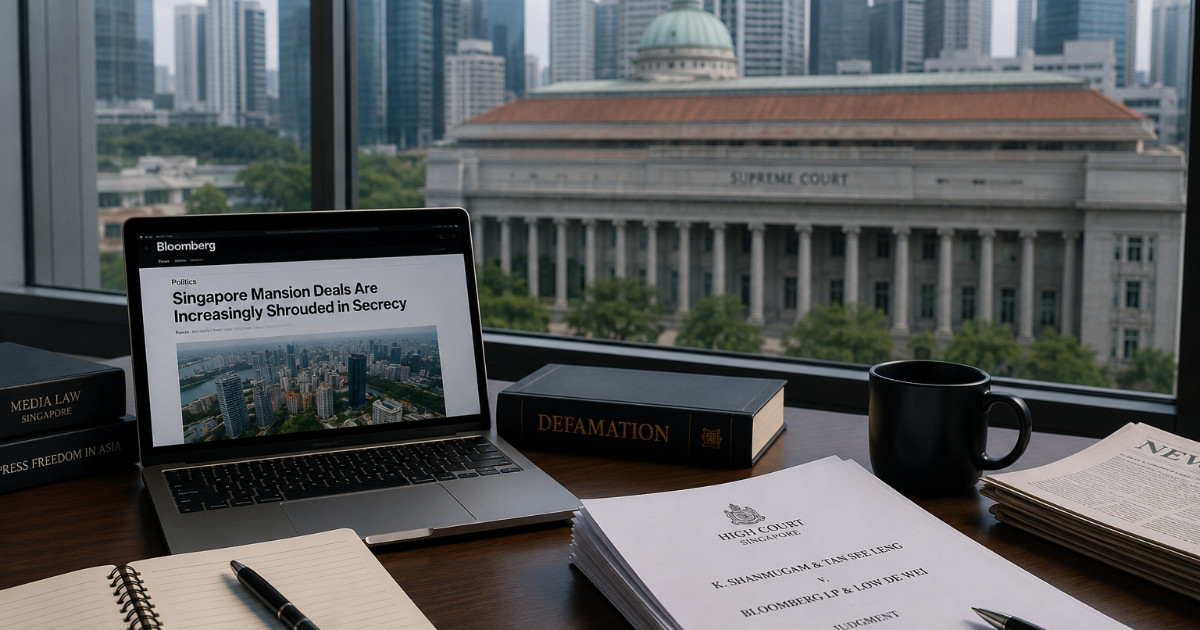
Singapore's High Court ordered Bloomberg to pay S$460,000 to ministers K. Shanmugam and Tan See Leng after ruling a December Bloomberg article on luxury property transactions defamatory, prompting concern from press freedom advocates including CPJ.Summary
SINGAPORE — Singapore's High Court has ordered Bloomberg News and one of its reporters to pay S$460,000 (US$356,000) in damages to two senior government ministers after finding that a report on luxury property transactions was defamatory, a decision that has drawn concern from international press freedom advocates over its potential impact on public interest journalism.
The ruling, delivered by High Court Judge Audrey Lim on Tuesday, awards S$230,000 each to Coordinating Minister for National Security K. Shanmugam and Manpower Minister Tan See Leng. The lawsuit stemmed from Bloomberg's December 12, 2024, article titled Singapore Mansion Deals Are Increasingly Shrouded in Secrecy, which examined the use of confidential property transaction structures in the country's high-end real estate market and referred to property purchases involving the two ministers.
CPJ warns of chilling effect
The Committee to Protect Journalists (CPJ) criticized the judgment, saying it could discourage reporting on issues of public interest in Singapore, a regional financial and media hub.
"We are alarmed by Tuesday's court decision, which will chill public interest reporting," said Beh Lih Yi, CPJ's Asia-Pacific director. She urged Singaporean public officials to stop using defamation laws to pursue legal action against journalists over their reporting and said the country should demonstrate that it remains open to scrutiny, including reporting on major property transactions.
Judge Lim ruled that the Bloomberg article was defamatory and had been published with malice. In her written judgment, she said the broader discussion of how wealthy individuals use trust structures and non-caveated transactions to keep property dealings "off-radar" served as a vehicle for the allegations concerning the ministers. Each plaintiff was awarded S$230,000 in damages.
Bloomberg stands by its reporting
Bloomberg said it disagreed with the court's findings and defended both the story and its journalist.
Editor-in-Chief John Micklethwait said the news organization continued to believe its reporting was accurate and addressed an important matter of public interest. He said Bloomberg considered the ministers' interpretation of the article to be "an extremely strained meaning" imposed on what he described as a well-reported story.
The legal dispute began after Shanmugam and Tan filed defamation lawsuits against Bloomberg and reporter Low De Wei on January 6, 2025.
The case followed earlier regulatory action against Bloomberg and several other media organizations. On December 23, 2024, Singapore authorities directed Bloomberg and three other news outlets to publish correction notices under the country's Protection from Online Falsehoods and Manipulation Act (POFMA). According to the government's fact-checking website, Factually, officials argued that Bloomberg's reporting falsely undermined the transparency of Singapore's property transaction system.
Broader implications for media
The judgment is likely to attract close attention from international news organizations operating in Singapore, where civil defamation actions involving public officials have periodically raised questions about the balance between protecting reputations and safeguarding robust reporting on matters of public interest.
For international media, the case underscores the legal risks associated with reporting on powerful public figures in jurisdictions with strong defamation laws. Press freedom organizations have long argued that such litigation can increase the financial and editorial pressures facing newsrooms covering government accountability, while supporters of the legal framework maintain that it protects individuals against false and damaging claims.
Neither Shanmugam nor Tan immediately responded to CPJ's request for comment following the ruling, according to the organization.
WHY THIS MATTERS: The ruling highlights the growing legal exposure facing international news organizations reporting on influential political figures in Asia. For journalists and editors, it reinforces the importance of rigorous reporting, legal review, and understanding local defamation frameworks, while also renewing debate over whether such lawsuits may discourage reporting on matters of public interest.
ATTRIBUTION: Reporting by JournalismPakistan, based on publicly available statements from the Committee to Protect Journalists (July 15, 2026) and Bloomberg's public statement reported by CPJ (July 15, 2026).
PHOTO: AI-generated; for illustrative purposes only.
Key Points
- Singapore High Court ordered Bloomberg News and a reporter to pay S$460,000 in damages.
- The award grants S$230,000 each to Coordinating Minister for National Security K. Shanmugam and Manpower Minister Tan See Leng.
- The lawsuit arose from Bloomberg's December 12, 2024 article on secretive luxury property transactions that mentioned the ministers.
- High Court Judge Audrey Lim found the article defamatory and published with malice.
- The Committee to Protect Journalists warned the ruling could chill public interest reporting in Singapore.
Key Questions & Answers
What did the Singapore court rule?
The High Court found a Bloomberg article on luxury property transactions defamatory and ordered Bloomberg and a reporter to pay S$460,000 in damages to two ministers.
Who received the damages and how much?
Coordinating Minister for National Security K. Shanmugam and Manpower Minister Tan See Leng were each awarded S$230,000.
Which article prompted the lawsuit?
The suit concerned Bloomberg's December 12, 2024 article examining confidential structures in high-end property transactions that referenced purchases involving the ministers.
How did press freedom groups respond?
Groups including the Committee to Protect Journalists said the ruling could chill public interest reporting and urged officials not to use defamation laws to target journalists.
Relevant Topics
Ask AI: Understand this story your way
AI EnabledDig deeper, ask anything — get instant context, background, and clarity.
Disclaimer: This feature is powered by AI and is intended to help readers explore and understand news stories more easily. While we strive for accuracy, AI-generated responses may occasionally be incomplete or reflect limitations in the underlying model. This feature does not represent the editorial views of JournalismPakistan. For our full, verified reporting, please refer to the original article.