

News credibility in Pakistan in the age of AI
JournalismPakistan.com | Published: 25 November 2026 | Opinion | By Anusha Mehak
Join our WhatsApp channel
AI is changing Pakistan's media, enabling faster, automated reporting and digital anchors while raising credibility concerns; deepfakes, misinformation spread and opaque AI use demand stronger verification and transparency.Summary
From AI-generated news anchors and political deepfakes to automated reporting and misinformation, artificial intelligence is transforming Pakistan's media landscape. The challenge is to embrace technological innovation without compromising accuracy, transparency, and public trust.
JOURNALISM is undergoing a profound transformation. Artificial intelligence (AI) can now generate news reports, translate interviews, analyse data, produce headlines, and even present television bulletins through digital anchors. Tasks that once required hours of work can now be completed within minutes. However, as news production becomes faster and more automated, an important question confronts the journalism community: can technology strengthen news credibility without undermining the professional standards on which public trust depends?
For Pakistan, this question matters especially. Political polarisation, intense competition among television channels, the expansion of digital journalism and the rapid circulation of unverified information have made credibility an increasingly important concern. AI offers opportunities for innovation, but it also creates new challenges involving fabricated information, manipulated visuals, and uncertainty about the authenticity of news.
AI enters Pakistan's newsrooms
Artificial intelligence is no longer a distant possibility for Pakistani journalism. A 2024 study examining conversational AI adoption among 202 Pakistani media professionals found that 58.4 per cent of respondents reported that their organisations had adopted conversational AI, while another 22.8 per cent said implementation was underway.
AI applications now extend to transcription, translation, research assistance, graphics, content summaries and automated drafts.
Television broadcasters are also experimenting with the technology. In May 2025, 92 News introduced what it described as Pakistan's first AI news reporter, delivering news in Urdu through a digital presenter. In August that year, Discover Pakistan launched its Pakistan Today English News project, featuring AI-generated presenters and reporting formats.
These developments demonstrate technological progress, but they also raise questions about the nature of journalism. An AI presenter can deliver a bulletin convincingly, but it cannot reliably establish whether a source is trustworthy, whether a quotation is authentic or whether a political statement requires additional context.
A digital face does not automatically represent credible journalism. The credibility of a news organisation ultimately depends on its reporters, editors, verification procedures and accountability.
Political misinformation and deepfakes
One of the most serious challenges for Pakistani journalism is the use of AI and digital manipulation in political communication.
Pakistan's 2024 general elections illustrated how manipulated audio and video could complicate the political information environment. Freedom House's Freedom on the Net 2024 report documented the circulation of deepfake audio clips and videos falsely portraying political figures, including former prime minister Imran Khan, as calling for an election boycott.
Such incidents demonstrate how synthetic media can be used to create political narratives, misrepresent public figures, and influence audience perceptions.
The challenge becomes greater when fabricated material circulates through WhatsApp, Facebook, TikTok and YouTube before professional newsrooms can investigate it. A television channel that republishes a viral video without verification can transform an online rumour into a national news story.
The May 2025 Pakistan–India military confrontation provided another important example. Misleading claims about airstrikes, military installations, aircraft losses and battlefield developments circulated widely on social media. Investigations by organisations including the Institute for Strategic Dialogue documented the spread of both digitally fabricated and misleadingly presented material during the confrontation.
For journalists, the lesson is clear: popularity is not proof, and a convincing photograph or recording does not establish authenticity. Images, videos and audio recordings, particularly those involving sensitive developments, require careful verification of their source, date, location and context.
When AI errors enter the newsroom
The credibility challenge also exists within established media organisations.
In November 2025, Dawn acknowledged that a business report on automobile sales had been edited using AI, contrary to its editorial policy. An AI-generated prompt was inadvertently published at the end of the printed report, prompting an apology and an internal investigation.
The incident highlighted a potential weakness in newsroom practices: adopting AI without effective editorial supervision can damage institutional credibility.
AI systems can generate fabricated quotations, inaccurate statistics, misleading references, and convincing but unsupported explanations. These errors, commonly described as AI hallucinations, can appear authoritative even when the information is incorrect.
For Pakistani journalists, one principle must remain non-negotiable: AI-generated claims cannot be treated as independently verified evidence. Quotations must be checked against original recordings or documents, statistics against original datasets, and official statements against authentic sources.
AI can assist in preparing a report, but it cannot replace the journalist's responsibility to establish the facts.
Does AI affect public trust?
International research suggests that audiences remain cautious about AI-generated news.
The Reuters Institute's Generative AI and News Report 2025 found that only 12 per cent of respondents across six countries were comfortable with news produced entirely by AI. Comfort increased to 43 per cent when a human journalist led the process with some AI assistance. Meanwhile, 62 per cent were comfortable with news produced entirely by human journalists.
These findings suggest that audiences value human editorial oversight.
Research by Sacha Altay and Fabrizio Gilardi, published in PNAS Nexus in 2024, also found that labelling headlines as AI-generated could reduce their perceived accuracy and readers' willingness to share them, even when the headlines were accurate.
Although these international findings do not necessarily reflect Pakistani audience attitudes, they offer valuable insights for the country's media organisations.
Transparency is therefore essential. Where AI plays a significant role in producing or presenting news, readers should understand how it has been used. A disclosure such as “Translated using AI and reviewed by an editor” is more informative than a generic AI-generated label.
Transparency should demonstrate editorial responsibility, not merely announce technological involvement.
Building responsible AI practices
Artificial intelligence can strengthen journalism when used responsibly. Pakistani reporters can employ it to analyse government budgets, examine large datasets, transcribe interviews, translate international research, and identify emerging news trends. Smaller newsrooms can also use affordable AI tools to improve productivity and expand their coverage.
However, technological efficiency must be accompanied by professional safeguards.
In October 2026, the Election Commission of Pakistan (ECP) proposed amendments to its electoral codes of conduct that would require AI-altered election content to be labelled, while maintaining media organisations' responsibility for the accuracy of AI-assisted material. Such proposals reflect a growing recognition that technological assistance cannot become an excuse for misinformation.
News organisations should establish written AI policies, provide digital verification training and ensure that editorial responsibility for every published report is clearly assigned. They should also protect confidential sources and unpublished investigative material from exposure through public AI platforms.
Journalism schools, press clubs and professional associations should make AI literacy, fact-checking and digital verification essential components of professional training.
Credibility remains journalism's greatest asset
Artificial intelligence will continue to influence how news is gathered, produced, presented and distributed. It can make journalism faster, more accessible and more data-driven. But technological sophistication does not automatically produce credible journalism.
A newsroom may possess advanced AI tools and still publish misinformation. A digital anchor may deliver a flawless bulletin while the information behind it remains unverified.
For Pakistan's journalistic community, the priority must therefore be to balance innovation with professional responsibility. Accuracy, transparency, editorial independence and accountability must remain central to newsroom practices.
Ultimately, audiences do not turn to journalism simply because they want information quickly. They expect journalists to establish what happened, distinguish evidence from claims, and take responsibility for reporting the truth.
Artificial intelligence may transform the tools of journalism, but credibility must remain its defining value.
ABOUT THE WRITER: Anusha Mehak is an MS scholar in the Department of Mass Communication at the National University of Sciences and Technology (NUST).
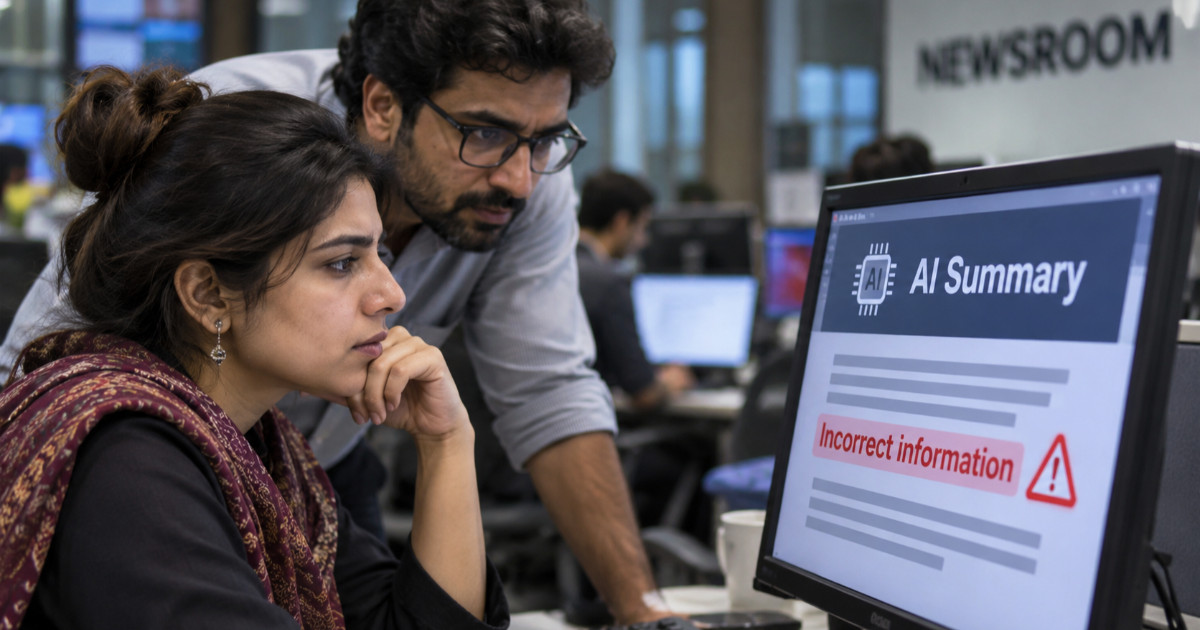
PHOTO: Artificial intelligence is transforming news production while raising concerns about accuracy, editorial accountability, and public trust. (Illustrative image)
Key Points
- AI adoption in Pakistani newsrooms is rising, enabling automated reporting and AI presenters.
- Speed and efficiency gains come with risks of fabricated content, manipulated visuals and rapid misinformation.
- Deepfakes and political manipulation heighten credibility and trust challenges amid polarized media.
- Stronger fact-checking, transparent AI disclosure and media ethics are needed to protect public trust.
- Regulation, newsroom training and collaboration between technologists and journalists can reduce harm.
Key Questions & Answers
What risks does AI pose to news credibility in Pakistan?
AI can enable fabricated text, manipulated images and deepfakes, increase the speed of misinformation spread, and obscure authorship or editorial processes, all of which undermine public trust.
How is AI already being used in Pakistani newsrooms?
Newsrooms use AI for automated reporting, transcription, translation, data analysis, headline generation and digital presenters or anchors, as well as conversational tools for research and scripting.
What safeguards can media organisations adopt?
Outlets should implement clear disclosure of AI use, robust fact-checking, verification workflows, staff training, and editorial oversight to ensure accuracy and accountability.
Can AI be used to improve verification and credibility?
Yes. AI tools can help detect manipulated media, surface inconsistencies, automate verification checks and support fact-checkers, but they must be used transparently and with human oversight.
Relevant Topics
Ask AI: Understand this story your way
AI EnabledDig deeper, ask anything — get instant context, background, and clarity.
Disclaimer: This feature is powered by AI and is intended to help readers explore and understand news stories more easily. While we strive for accuracy, AI-generated responses may occasionally be incomplete or reflect limitations in the underlying model. This feature does not represent the editorial views of JournalismPakistan. For our full, verified reporting, please refer to the original article.