
What AI news errors mean for Pakistani newsrooms
JournalismPakistan.com | Published: 8 November 2026 | JP Special Report
Join our WhatsApp channel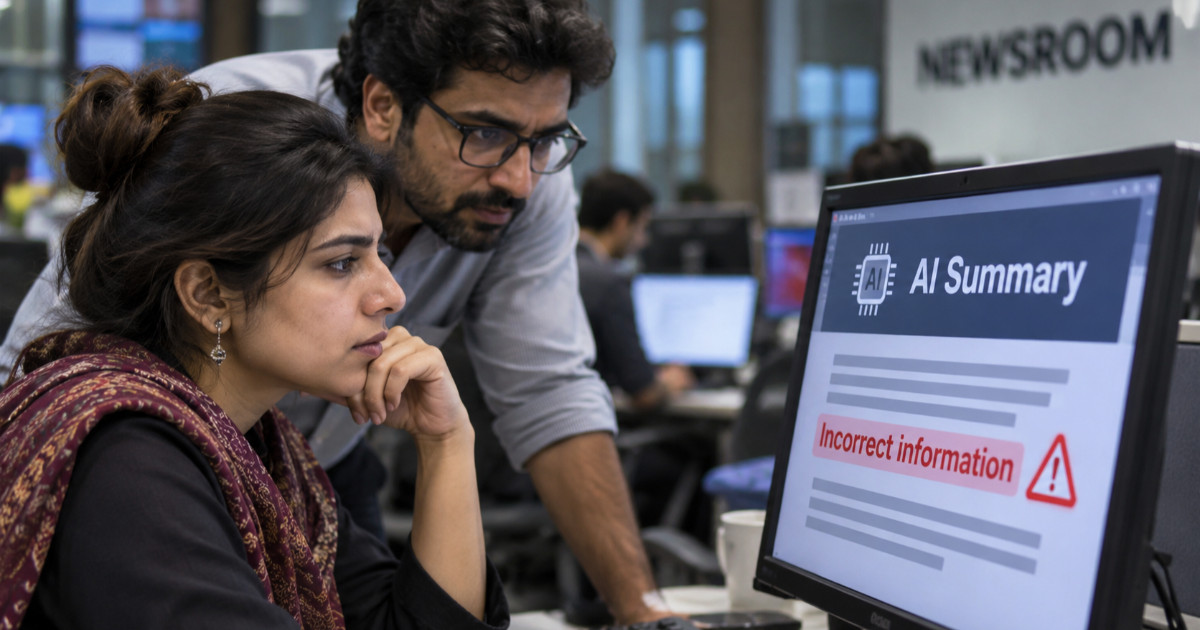
AI tools like automated summaries and chatbots can introduce factual errors, raising urgent questions about who is responsible, reporter, editor, publisher or tech company. A USA Today case where AI misattributed a name highlights the need for clear verification and accountability in Pakistani newsrooms.Summary
Artificial intelligence is transforming how news is produced and presented, but it is also creating new questions about accuracy and accountability. When an AI-generated summary contains false information, who should answer for the mistake? This explainer examines the responsibilities of journalists, editors, publishers, and technology companies, with particular relevance to Pakistani newsrooms.
ISLAMABAD — When an artificial intelligence tool publishes inaccurate information alongside a journalist's reporting, who should be held responsible? Is it the reporter whose name appears on the article, the editor supervising publication, the media organization deploying the technology, or the company that developed the AI system? The question has become increasingly important as news organizations introduce automated summaries, chatbots, translations, and other AI-powered products into their publishing operations.
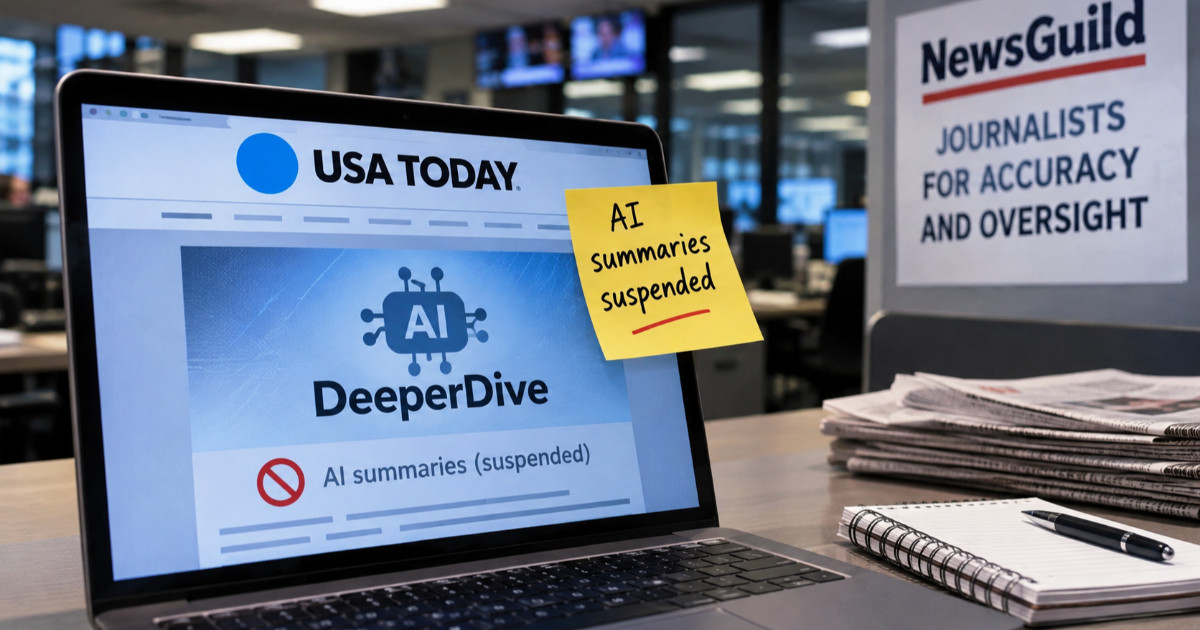
A recent dispute involving USA Today Co. illustrates the problem. Journalists at two Ohio newspapers began withholding their bylines on October 28, 2026, over DeeperDive, an AI-powered tool that generates summaries and answers questions about published reporting. The NewsGuild alleged that the system had produced factual inaccuracies, including an instance in which it substituted a reporter's name for that of a murder suspect. Axios reported on November 6 that the company had suspended AI-generated summaries and restricted the tool to a small beta audience, citing a union representative. USA Today Co. had not independently confirmed the scope of those changes to Axios.
Why does the DeeperDive controversy matter?
The dispute exposes a fundamental weakness in some newsroom AI systems: the separation between the people producing verified journalism and the technology repackaging their work. Readers encountering an automated summary may reasonably assume that it has undergone the same editorial checks as the original article, especially when both appear under the same publication's name.
For journalists, that assumption creates a professional risk. A reporter can spend days verifying sensitive information, only for an automated tool to misrepresent the findings within seconds. The original reporting may remain accurate, but the journalist's credibility can suffer because readers associate the error with the publication and its contributors.
Who carries the ultimate editorial responsibility?
The central principle of journalism has not changed with the introduction of artificial intelligence. The organization publishing information remains responsible for maintaining its editorial standards, regardless of whether the content was produced by a reporter, edited by software or generated by an automated system.
That position is reflected in the policies of major international news organizations. In updated guidance issued on July 23, 2026, The Associated Press emphasized that AI may assist journalists with research, transcription, translation, headlines, and summaries, but editorial judgment, verification, and accountability remain human responsibilities. AP requires AI-generated output to be reviewed and edited before publication.
Reuters takes a similar approach. Its journalistic standards require independent verification of AI-generated facts and preserve the agency's responsibility for published content. These policies establish an important distinction: technology may contribute to production, but it does not independently assume the professional obligations of a newsroom.
Are individual journalists responsible for AI mistakes?
Journalists remain responsible for material they write, verify, and approve. However, accountability becomes more complicated when a publisher introduces an automated product without giving reporters meaningful control over its output.
Consider a reporter who investigates financial misconduct and publishes a carefully checked article. An AI tool subsequently summarizes the story and incorrectly identifies an innocent individual as a suspect. If the reporter neither created nor reviewed that summary, assigning the entire responsibility to the journalist would ignore the publisher's role in deploying the technology.
This distinction was central to the Ohio journalists' protest. The NewsGuild argued that DeeperDive's output did not meet the editorial standards associated with the reporters' names. The union also alleged that the tool violated the company's own requirement for human review before publishing computer-generated material. Those allegations were made by the union and should not be treated as independent findings about every use of the system.
The broader issue is whether journalists should be required to accept public attribution for content produced through processes they cannot inspect or control. News organizations increasingly need to distinguish authorship of original reporting from responsibility for subsequent automated interpretations of that reporting.
What responsibility do editors and publishers have?
Editors traditionally check accuracy, context, sourcing, fairness, and legal risks before publication. Introducing AI into the process does not eliminate these duties. Instead, it creates additional questions about who approves automated material, how errors are identified and whether systems should be allowed to publish without prior human examination.
Publishers have an even wider responsibility because they decide which tools to purchase, how those systems operate, and what level of supervision is financially and operationally acceptable. They also determine whether automated content is clearly identified to readers.
The Reuters Institute for the Study of Journalism examined emerging newsroom governance practices in research published in 2026, emphasizing that human oversight alone cannot guarantee safety. Effective governance also requires system design, defined responsibilities, and mechanisms for detecting and addressing errors.
This matters because a human reviewer cannot realistically inspect every response produced by a public-facing chatbot operating continuously. When a system generates answers directly for readers, a newsroom must consider whether its technical safeguards, source restrictions and monitoring arrangements are sufficient for the potential harm involved.
A publisher cannot reasonably treat AI as an independent editorial employee while retaining the commercial benefits of deploying it. Decisions about automation remain management decisions, and the consequences must be addressed at the organizational level.
Can AI companies be held responsible?
Technology developers also have responsibilities, although these differ from those of publishers. AI providers design the underlying models, establish technical safeguards, supply documentation, and determine what limitations users are told about.
An AI company may be responsible under applicable laws or contractual arrangements when its product is defective, fails to meet promised safeguards, or contributes to legally recognized harm. However, legal liability depends on the jurisdiction, the facts, the contractual relationship, and the nature of the alleged damage. There is no universal rule making every AI developer legally responsible for every inaccurate statement produced through its software.
This distinction between legal liability and editorial accountability is essential. A newsroom may have a contractual dispute with a technology provider, but it still owes its readers accurate and fairly presented information.
Similarly, an AI developer's warning that its system can make mistakes does not automatically resolve the publisher's obligations when the tool is integrated into a news product.
Why do AI systems produce convincing errors?
Generative AI systems work by identifying patterns and generating responses from learned relationships and supplied information. They do not verify facts in the same way that an experienced journalist checks documents, interviews sources or independently confirms evidence.
Such systems can produce what are commonly called hallucinations: statements that sound credible but are unsupported, misleading, or false. They may invent names, confuse dates, misattribute quotations or combine details from unrelated events.
Even systems designed to retrieve information from existing documents can introduce errors when summarizing or interpreting those documents. Access to reliable source material does not guarantee that the output will preserve every relevant fact or qualification.
The risks are particularly serious in crime reporting, court proceedings, health coverage, financial journalism and political reporting, where a seemingly small factual mistake may cause significant reputational or public harm.
An AI summary that incorrectly identifies a criminal suspect, for example, is not merely a technical defect. It can expose an individual to public suspicion and potentially expose a publisher to legal claims.
What does this mean for Pakistani newsrooms?
Pakistan's media industry faces the same technological pressures as publishers elsewhere, but its financial and institutional circumstances can make effective AI oversight more difficult. News organizations operating with limited resources may view automation as a way to reduce production costs, accelerate publishing and expand output across English, Urdu and regional languages.
These benefits are potentially significant. AI can assist with transcription, translation, archival searches, document organization and routine editorial tasks. It can also make existing reporting more accessible to readers who prefer simplified explanations or different languages.
However, the risks increase when automated material reaches publication without adequate checks. A mistranslated legal statement, inaccurately summarized court order, or incorrectly attributed allegation can create consequences extending beyond an ordinary correction.
Pakistan's legal environment makes these questions especially relevant. Publishers and journalists must consider potentially applicable defamation, electronic communications and other laws, including the Prevention of Electronic Crimes Act. Whether an AI-related publication creates legal liability depends on the specific content, conduct, and statutory requirements; the use of AI does not automatically establish an offence.
There is also a practical question about ownership of editorial decisions. If a Pakistani reporter produces accurate coverage but an automated summary distorts it, newsroom management needs a clear policy identifying who must correct the error, communicate with affected individuals, and review the system responsible.
Without such arrangements, responsibility can become blurred between editorial desks, technology teams, outside vendors and management.
What safeguards should news organizations adopt?
The starting point is a written editorial AI policy that identifies permitted uses, prohibited activities, and responsibility for approving tools. Such policies should distinguish assistance with internal newsroom work from systems that generate material directly for public consumption.
Human verification should be mandatory for consequential claims involving criminal allegations, identities, quotations, legal findings, financial figures, and other sensitive information. Automated summaries should be traceable to the original reporting so that errors can be identified and corrected.
Publishers should also maintain records of significant AI-generated errors, regularly test their systems, and establish procedures for suspending products that repeatedly fail accuracy standards. Staff should know how to report problems without facing pressure to protect the technology or the organization from criticism.
Transparency is another requirement. Readers should be informed when AI has played a substantial role in producing or transforming published content. However, simply attaching an AI-generated label is not enough. Disclosure tells audiences how material was produced; it does not establish that the material is accurate.
Newsrooms must also consider confidential sources, unpublished investigations and sensitive personal data before allowing staff to enter material into external AI systems.
For smaller Pakistani publishers, these safeguards need not require expensive governance departments. Clear approval procedures, restricted tools, documented checks and a functioning corrections process can provide a practical starting point.
How should AI-generated mistakes be corrected?
An AI-generated error should be treated with at least the same seriousness as an error introduced through conventional reporting or editing.
The publisher should correct the inaccurate information promptly, explain material changes where appropriate, and ensure that the original error does not continue circulating through automated summaries or related products.
In serious cases, the organization may need to temporarily disable the affected system while investigating the cause. A correction to the original article alone may be insufficient if a chatbot or summary tool continues generating the same inaccurate claim.
Responsibility must also extend beyond fixing individual mistakes. Repeated errors may indicate problems with the system's design, deployment or supervision that require broader changes.
Can AI improve journalism without weakening accountability?
Artificial intelligence offers genuine opportunities to make journalism more efficient, accessible and responsive to audiences. The challenge is not whether newsrooms should use the technology, but how they should govern its use without abandoning established standards.
The DeeperDive controversy demonstrates that disagreements over AI are no longer confined to abstract debates about the future of journalism. They now affect working reporters, newsroom contracts, publishing decisions, and the public's ability to distinguish verified information from automated interpretation.
For Pakistani publishers, the most useful lesson is that editorial accountability must be built into an AI product before its launch, rather than improvised after an error damages public confidence.
Ultimately, the answer to who is responsible is straightforward in professional terms, even if legal responsibility can be more complex. Reporters remain accountable for work they produce and approve. Editors are responsible for the decisions under their supervision. Publishers must answer for the systems they deploy and the information they distribute. Technology providers have their own contractual and legal obligations.
AI may change how journalism is produced and presented, but it does not remove the responsibility of the people and institutions putting information before the public.
ATTRIBUTION: Analysis by JournalismPakistan staff. Sources consulted include The NewsGuild (October 28, 2026), Axios (November 6, 2026), The Associated Press (July 23, 2026), Reuters' journalistic standards, and the Reuters Institute for the Study of Journalism (2026).
PHOTO: AI-generated; for illustrative purposes only.
Key Points
- AI-generated products like summaries, translations and chatbots are increasingly used in newsrooms.
- These tools can introduce factual inaccuracies and misattributions into reporting.
- Responsibility may fall on reporters, editors, publishers or the AI developers, creating accountability gaps.
- High-profile cases, such as the USA Today incident, show real-world risks of automated summaries.
- Pakistani newsrooms need stronger verification, editorial oversight and clear policies when deploying AI.
Key Questions & Answers
Who is responsible when an AI tool publishes an error alongside a journalist's story?
Responsibility can be shared: the reporter, editor and publisher have editorial duties, while technology companies must address systemic flaws; clear internal policies are needed to assign accountability.
Can newsrooms rely on AI-generated summaries without extra checks?
No. AI outputs should be verified by journalists and editors before publication to prevent factual errors and misattributions.
What lessons does the USA Today case offer Pakistani newsrooms?
It highlights how AI can misattribute facts and harm credibility, underscoring the need for testing, limited rollouts, transparency and robust editorial controls.
What practical steps should news organisations take when using AI?
Adopt verification workflows, label AI-generated content, train staff on risks, run pilot programs and require vendors to explain system limits and error rates.
Ask AI: Understand this story your way
AI EnabledDig deeper, ask anything — get instant context, background, and clarity.
Disclaimer: This feature is powered by AI and is intended to help readers explore and understand news stories more easily. While we strive for accuracy, AI-generated responses may occasionally be incomplete or reflect limitations in the underlying model. This feature does not represent the editorial views of JournalismPakistan. For our full, verified reporting, please refer to the original article.