.jpg)
The day Dawn became Herald
JournalismPakistan.com | Published: 27 April 2013
Join our WhatsApp channel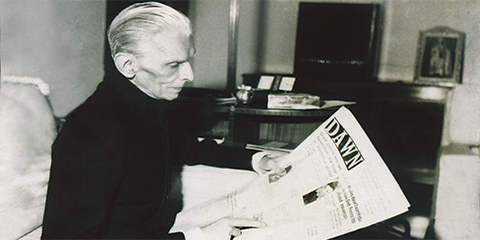
The name change of Dawn to Herald on 1 April 1950 sparked significant public backlash. Fatima Jinnah's appeal to protect Dawn highlighted its historical importance.Summary
It was on 1 April 1950. No, it was not an April fool’s day joke but a pressing matter of where Dawn newspaper belonged – Dawn Trust or Pakistan Herald Ltd. The editorial “Why we change our name” on that fateful day tried to tell the readers the “difference between the Dawn Trust and Dawn as owned by Pakistan Herald Ltd,” according to Zamir Niazi as he narrates the queer episode in his book The Press in Chains.
The editorial, according to the book, “traced the history of Dawn—how it started in Delhi and came to be published in Karachi—and stressed that ‘it belonged, with all the printing presses, other equipment, and property to the company (Pakistan Herald Ltd), which financed its birth, its production, and its development…”
It also referred to a case filed “in the Chief Court asking for the appointment of trustees for the Dawn Trust. However, a new situation arose in the shape of a Bill introduced in Parliament by Malik Feorz Khan Noon which sought to ‘create a new set of trustees from among the members of the Muslim League Parliamentary Party and to set up an ad hoc tribunal which would supersede the jurisdiction of all other courts and decide all matters, not only about Dawn Trust but also Dawn, Karachi.”
Niazi says the “Haroons and Altaf Husain (Dawn editor) panicked and decided to change the name of the newspaper overnight.”
Not an easy decision, it also did not take into consideration the reaction to the name change.
Quoting Maulvi Mohammad Saeed, then news desk-in-charge, Niazi says Altaf Husain stood before a large portrait of the founder of Dawn and with “moist eyes” asked: “Quaid, I am changing the name. Will you not be angry?” For Maulvi Saeed, on that day the “whole atmosphere was heavy with ‘some unknown fear’.”
After some time in the machine room in the presence of the editor and the Haroons, “the first page was locked up. The editor had taken out from his pocket The Herald place and Dawn’s logo was replaced. In the adjacent room, Urdu Dawn’s plate was also replaced. The paper was renamed Naqeeb. Earlier, the same day Altaf Sahib had asked Saeed, ‘What is the equivalent of Dawn in Urdu?” The Gujarati publication became Pakistan Samachar.
If the Quaid’s portrait did not answer Altaf Sahib’s question if he was angry or not over the change of name, Fatima Jinnah was.
In no unclear terms, she told Altaf Husain that “Dawn had always belonged to the Dawn Trust and that the publishers of Karachi Dawn by its suspension of its publication today (1 April) have now planned to throttle this champion of Muslim cause.”
She appealed to the nation to “safeguard this heritage from the doom…planned for it.”
The appeal worked.
As the copies of the Herald, Naqeeb, and Pakistan Samachar were burnt or torn, people demonstrated in front of Dawn offices. On the other hand, hawkers refused to distribute the paper.
Niazi says the “painful episode came to a happy end after three days. Boxed in red ink on the front page under the headline ‘Dawn Zindabad’ the editor announced, ‘the people wanted Dawn. I give them back their Dawn. No one is happier than I.”
Fatima Jinnah in a terse statement thanked Altaf Husain for his “magnanimity” for “returning a thing which did not belong to him.”
Giving the background to the episode, Niazi talks to M A Shakoor, who was part of the newsroom on the day – 15 August 1947 – the first issue of Dawn was brought out.
Shakoor said he was “recruited by the famous correspondent, Desmond Young, to work for joint company, The Pakistan Herald Publications, which planned to bring out an English daily from Karachi. The paper The Pakistan Herald was due to come in July, but due to some technical difficulties it was delayed.”
Dawn was launched as a weekly newspaper by Quaid-e-Azam Mohammad Ali Jinnah. It became a daily in 1942. According to I A Rehman, “The newspaper had gradually transformed itself from an organ of the All India Muslim League into a defender of Pakistan’s broader interests.” Dawn’s offices in Delhi were burnt down in the partition riots, leading to the paper ceasing publication.
Niazi says an advertisement in the Times of India, Bombay, called for applications for The Herald’s editorial staff.
According to Shakoor, “The Quaid-i-Azam had come to Karachi…and wanted a newspaper of his own. He asked Yusuf Haroon to sue the press for Dawn, instead of a new newspaper. Yusuf Haroon explained that press was not his own, but belonged to a joint stock company, of which he was a director. Whereupon the Quaid suggested that the management could remain with the company, the Pakistan Herald Publications, the editorial policy would be his, through Liaquat Ali Khan.”
Niazi explains in February 1947; the Pakistan Herald Ltd was “incorporated with a capital of Rs1,000,000. It had eight directors.”
Key Points
- Dawn was renamed to Herald due to political pressures on 1 April 1950.
- Public protests and demonstrations occurred against the name change.
- Fatima Jinnah played a crucial role in advocating for Dawn's legacy.
- The episode lasted three days before Dawn returned to its original name.
- The editorial decision was influenced by a parliamentary bill regarding trusteeship.
Relevant Topics
Ask AI: Understand this story your way
AI EnabledDig deeper, ask anything — get instant context, background, and clarity.
Disclaimer: This feature is powered by AI and is intended to help readers explore and understand news stories more easily. While we strive for accuracy, AI-generated responses may occasionally be incomplete or reflect limitations in the underlying model. This feature does not represent the editorial views of JournalismPakistan. For our full, verified reporting, please refer to the original article.