
Reuters journalists in Myanmar not jailed because of journalism: Suu Kyi
JournalismPakistan.com | Published: 13 September 2018
Join our WhatsApp channel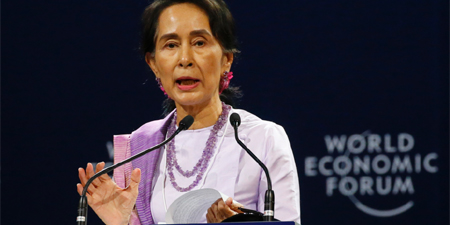
Aung San Suu Kyi defended the imprisonment of Reuters journalists, claiming they were jailed for legal violations. Their sentencing has drawn international criticism as an attack on press freedom.Summary
Myanmar's de facto leader Aung San Suu Kyi said Thursday that two Reuters journalists jailed for investigating a massacre in Rakhine state were not convicted because they were journalists but because they broke the law.
Wa Lone, 32, and Kyaw Soe Oo, 28, were each imprisoned for seven years last week for breaching the country's hardline Official Secrets Act while reporting atrocities committed during the military crackdown in Rakhine.
The sentence prompted a storm of global outcry as an assault on freedom of speech, while erstwhile rights champion Suu Kyi came under intense pressure for failing to speak up for the pair.
She broke her silence on the issue on Thursday during a discussion at the World Economic Forum, robustly defending the court's decision to jail the duo.
"They were not jailed because they were journalists" but because "the court has decided that they had broken the Official Secrets Act", she said in her first direct comments on the issue.
Challenging critics of the verdict - including the United Nations, rights groups who once lionised her and the US Vice President - to "point out" where there has been a miscarriage of justice, Suu Kyi said the case upheld the rule of law.
"The case was held in open court... I don't think anybody has bothered to read the summary of the judge," she added.
Army-led "clearance operations" last August drove 700,000 Rohingya into Bangladesh, carrying with them widespread accounts of atrocities - rape, murder and arson - by Myanmar police and troops.
The Reuters reporters had denied the charges, insisting they were set up while exposing the extrajudicial killing of 10 Rohingya Muslims in the village of Inn Din in September last year.
This week, the UN rights office accused Myanmar of "waging a campaign against journalists".
It decried "the instrumentalisation of the law and of the courts by the government and military in what constitutes a political campaign against independent journalism".
Suu Kyi, who has so far bristled at foreign criticism of her country and defended the crackdown against "terrorists" from the Muslim minority, also addressed the army's handling of the crisis.
"There are of course ways (in) which, in hindsight, the situation could have been handled better," she said in rare comments on the crackdown.
Myanmar has come under intense diplomatic pressure in recent weeks, with the UN rights office singling out its powerful military chief for his role forcing the Rohingya from the country.
The stateless Rohingya are denied citizenship in Myanmar and widely reviled in the Buddhist-majority country. - AFP/Photo: AP
Key Points
- Aung San Suu Kyi claims journalists broke the law, not journalism rules.
- Wa Lone and Kyaw Soe Oo sentenced to seven years for breaching the Official Secrets Act.
- Global outcry over the case perceived as assault on freedom of speech.
- UN rights office criticizes Myanmar's treatment of journalists.
- 700,000 Rohingya fled to Bangladesh due to military operations.
Relevant Topics
Ask AI: Understand this story your way
AI EnabledDig deeper, ask anything — get instant context, background, and clarity.
Disclaimer: This feature is powered by AI and is intended to help readers explore and understand news stories more easily. While we strive for accuracy, AI-generated responses may occasionally be incomplete or reflect limitations in the underlying model. This feature does not represent the editorial views of JournalismPakistan. For our full, verified reporting, please refer to the original article.