

Fox completes $22 billion Roku acquisition
JournalismPakistan.com | Published: 7 November 2026 | JP Global Monitoring
Join our WhatsApp channel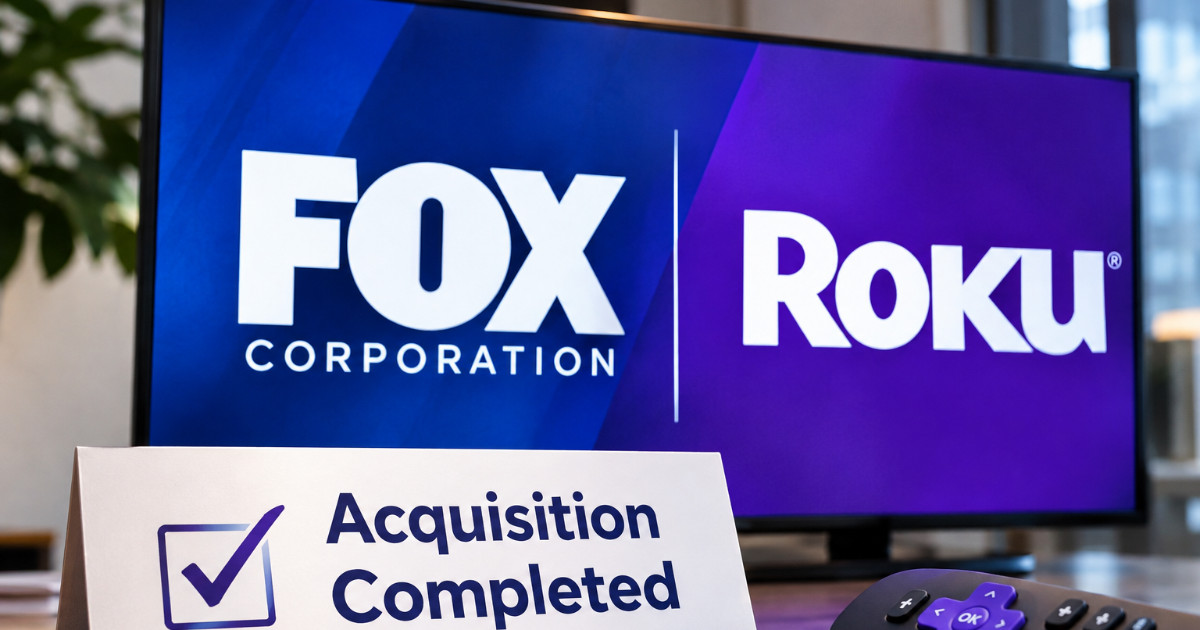
Fox Corporation completed a $22 billion acquisition of Roku on Nov. 6, 2026, bringing Roku's streaming platform to Fox. Roku will join Tubi and Fox One in a new Fox Digital Platforms division co-chaired by Anthony Wood and Paul Cheesbrough.Summary
NEW YORK — Fox Corporation has completed its $22 billion acquisition of streaming technology company Roku, bringing one of the world's largest connected-TV platforms under the ownership of a major American news, sports and entertainment group.
The cash-and-stock transaction, completed on November 6, 2026, gives Fox access to Roku's streaming ecosystem, which reaches more than 100 million households worldwide. The acquisition marks a significant expansion of Fox's digital distribution and advertising capabilities as television audiences continue shifting from traditional broadcasting and cable services toward internet-connected platforms.
Fox expands its digital television business
Fox announced that Roku will operate alongside its existing streaming services, Tubi and Fox One, within a newly established Fox Digital Platforms division. The division also includes Red Seat Ventures and other digital businesses, bringing together content distribution, advertising and streaming operations under a common management structure.
Roku founder Anthony Wood has joined Fox's board of directors and will serve as co-chair of Fox Digital Platforms. Paul Cheesbrough, a senior Fox executive, becomes the division's co-chair and chief executive officer. The leadership arrangement places Roku's technology expertise alongside Fox's established broadcasting and content operations.
Ownership changes and financial expectations
Under the acquisition agreement, Roku shareholders are entitled to receive $95.30 in cash and 0.9799 shares of Fox Class A common stock for each Roku share. Following completion, existing Fox shareholders hold approximately 74 percent of the combined company's outstanding shares, while former Roku shareholders own approximately 26 percent.
Roku also began the process of leaving the Nasdaq stock exchange as an independently traded company. Its regulatory filing confirms that trading in Roku shares will be halted before the market opens on November 9, completing the transition to Fox ownership.
Fox expects the integration to produce approximately $400 million in annualized cost savings within two years. The company also anticipates that the acquisition will contribute positively to free cash flow per share by the second full year after completion. These projections remain dependent on successful integration and future business performance.
The transaction was initially announced in June 2026, with completion originally expected during the first half of 2027. Its November closing brings the two businesses together several months ahead of that timetable.
What the acquisition means for news distribution
The deal is significant beyond its financial value because Fox is acquiring not merely another streaming service but a platform through which audiences discover and access television programming from numerous providers.
Fox's portfolio includes Fox News Media, Fox Sports, Fox Entertainment and its network of local television stations. Roku operates a connected-TV platform that allows viewers to access thousands of applications and channels, including services operated by companies competing with Fox.
Ownership of a major television distribution platform could strengthen Fox's position in the advertising market by combining programming, audience reach and connected-TV advertising technology. It could also improve the company's ability to promote its news and sports services to viewers who increasingly consume television through streaming devices and smart TVs.
The arrangement nevertheless raises broader questions for the media industry about the relationship between content ownership and distribution control. When a broadcaster also owns a platform used by competing publishers and television networks, maintaining equal access and transparent commercial arrangements becomes particularly important.
Fox has said Roku will remain an open distribution platform serving the wider streaming industry. The company has emphasized that preserving consumer choice and relationships with independent content providers is central to its plans.
The practical significance of that commitment will become clearer as Fox integrates the businesses and determines how content promotion, advertising opportunities and distribution arrangements operate within the enlarged group.
A wider shift in global media ownership
The acquisition reflects a continuing transformation of the television business in which control over distribution technology, advertising relationships and audience access is becoming increasingly valuable alongside ownership of news and entertainment content.
For broadcasters and digital publishers outside the United States, including those in Pakistan and other Asian markets, the development illustrates how international media companies are restructuring around streaming platforms rather than relying exclusively on conventional television distribution.
It also highlights a challenge for news organizations seeking sustainable digital audiences. As television viewing becomes more dependent on connected devices and platform interfaces, decisions about content visibility, advertising revenue and access to viewers may increasingly rest with companies controlling those technologies.
For Fox, the immediate challenge will be integrating Roku without undermining the platform's appeal to competing streaming providers. For the wider media industry, the acquisition offers another example of how the boundaries between broadcasters, technology companies and digital distribution businesses are becoming less distinct.
The November 6 completion establishes a new ownership structure. Whether it produces the financial returns, advertising growth, and distribution advantages anticipated by Fox will depend on how successfully the combined company manages its expanded operations.
ATTRIBUTION: Based on Fox Corporation's official announcement and US Securities and Exchange Commission filings (November 6, 2026), with additional context from Reuters and TechCrunch (November 6, 2026).
PHOTO: AI-generated; for illustrative purposes only.
Key Points
- Fox completed the $22 billion cash-and-stock acquisition of Roku on November 6, 2026.
- The deal brings Roku's platform, reaching over 100 million households, under Fox ownership.
- Roku will be organized within a new Fox Digital Platforms division alongside Tubi and Fox One.
- Roku founder Anthony Wood joins Fox's board and will co-chair Fox Digital Platforms with Paul Cheesbrough.
- The acquisition aims to expand Fox's digital distribution and advertising capabilities.
Key Questions & Answers
How much did Fox pay for Roku and when was the deal completed?
Fox completed a $22 billion cash-and-stock acquisition of Roku on November 6, 2026.
What will happen to Roku after the acquisition?
Roku will operate within a newly created Fox Digital Platforms division alongside Tubi and Fox One, maintaining its streaming technology and platform.
Who will lead the new Fox Digital Platforms division?
Roku founder Anthony Wood joined Fox's board and will co-chair Fox Digital Platforms, alongside Paul Cheesbrough as co-chair and CEO of the division.
What strategic benefits does Fox expect from the acquisition?
The purchase expands Fox's digital distribution reach and advertising capabilities by integrating Roku's connected-TV platform and audience with Fox's content and ad operations.
Relevant Topics
Ask AI: Understand this story your way
AI EnabledDig deeper, ask anything — get instant context, background, and clarity.
Disclaimer: This feature is powered by AI and is intended to help readers explore and understand news stories more easily. While we strive for accuracy, AI-generated responses may occasionally be incomplete or reflect limitations in the underlying model. This feature does not represent the editorial views of JournalismPakistan. For our full, verified reporting, please refer to the original article.