.png)
Press freedom tested by arrests, attacks and legal pressure
JournalismPakistan.com | Published: 27 September 2026 | JP News Desk
Join our WhatsApp channel
Reporters worldwide faced arrests, detentions, credential revocations, legal complaints and physical attacks in cases from Cuba to Peru; judicial reviews, unions and newsroom solidarity provided partial pushback and opaque accreditation lengthened the process.Summary
Editor’s note
This week’s Tracker shows how pressure on journalism travels through many channels at once. Reporters were detained in Cuba and the Democratic Republic of the Congo, briefly held and allegedly mistreated in Tunisia, and swept into an extraordinary case in Cameroon over a minister’s misplaced glasses. In Romania, at least eight journalists and media workers were attacked while covering a protest. In Pakistan and Peru, official notices and criminal complaints again placed reporting under legal pressure.
There were also important counter-movements. A U.S. judge temporarily restored White House access to CNN, MS NOW and Politico after a ban imposed over coverage President Donald Trump described as false or negative disrupted presidential reporting. Cross-border union campaigning preserved Deutsche Welle’s Greek-language service, albeit with a smaller budget. Malta’s attorney general appealed the acquittal of the businessman accused of complicity in the murder of Daphne Caruana Galizia.
The dominant pattern is the growing use of process as punishment. Detention, questioning, credential withdrawal, defamation complaints and opaque accreditation rules can obstruct journalism long before a court reaches a final judgment. The week also reminded us that resistance matters: judicial review, newsroom solidarity, union action, and persistent demands for accountability can still create meaningful checks on power.
Arrests, detentions, and kidnappings
CUBA — Independent journalist Henry Constantín, director of La Hora de Cuba and a regional vice president of the Inter American Press Association, remained in preventive detention in Camagüey after being arrested on September 16. Authorities are investigating him for alleged “disobedience” over a disputed police summons. His lawyer filed a habeas corpus petition but said prosecutors had not provided access to the case file, preventing an appeal against the detention order. (Committee to Protect Journalists, La Hora de Cuba and 14ymedio, September 25, 2026)
Why it matters: Holding an independent journalist over a disputed summons while restricting his lawyer’s access to the case file raises serious due-process concerns and deepens the pressure on Cuba’s already constrained independent press.
DEMOCRATIC REPUBLIC OF THE CONGO — Music journalist Virginie Manganga was arrested in Kinshasa on September 20 and charged with defamation and disseminating false information over an interview concerning allegations about musician Fally Ipupa. She was transferred to the Kinshasa/Gombe Peace Court and could face up to five years in prison if convicted. CPJ also reported that journalist Trésor Muntu was imprisoned on September 15 after sharing an X post on WhatsApp and was charged with defamation and publishing false news. (Committee to Protect Journalists, September 23, 2026)
Why it matters: The detention of two journalists in one week shows how criminal defamation and false-information laws can turn disputes over reporting and online sharing into threats of imprisonment.
CAMEROON — Journalists Solange Djuikam, François Essomba, Igor Gwet Bibey and Pierre Mouchili were released without charge on September 21 after spending between five and seven nights in overcrowded police cells. They had been detained on suspicion of stealing Economy Minister Alamine Ousmane Mey’s glasses while covering a conference, although the glasses were later found in the minister’s car. A journalists’ union announced a boycott of the minister’s events and demanded accountability. (Committee to Protect Journalists and the National Trade Union of Information and Communication Professionals, September 23–24, 2026)
Why it matters: The case illustrates how an ordinary reporting assignment can turn into arbitrary detention when law-enforcement safeguards are weak and officials face little immediate accountability.
DJIBOUTI — South African investigative journalist Micah Reddy, Africa editor for the International Consortium of Investigative Journalists, was freed and deported after his family lost contact with him in Djibouti. Authorities said he lacked the required media accreditation, while his family said he was not visiting the country on a reporting assignment. His local fixer, Kooki Mahmoud, was also reportedly released without charge. (Reuters and CPJ Africa, September 22, 2026)
Why it matters: Unclear or inconsistently applied accreditation rules can expose journalists and local fixers to detention even when authorities and reporters disagree over whether journalistic work was taking place.
TUNISIA — Plainclothes security officers briefly detained three journalists from the independent news site Nawaat on September 21 after a caller allegedly posing as a courier lured one of them to a meeting. The journalists said officers held them for nearly two hours, subjected them to abusive language and humiliation, attempted to access their phones without a warrant, and warned them not to disclose the incident. (Committee to Protect Journalists and the National Syndicate of Tunisian Journalists, September 24, 2026)
Why it matters: The alleged use of deception, warrantless attempts to search phones and threats of further action point to increasingly coercive methods of obstructing independent reporting.
Legal and regulatory pressure
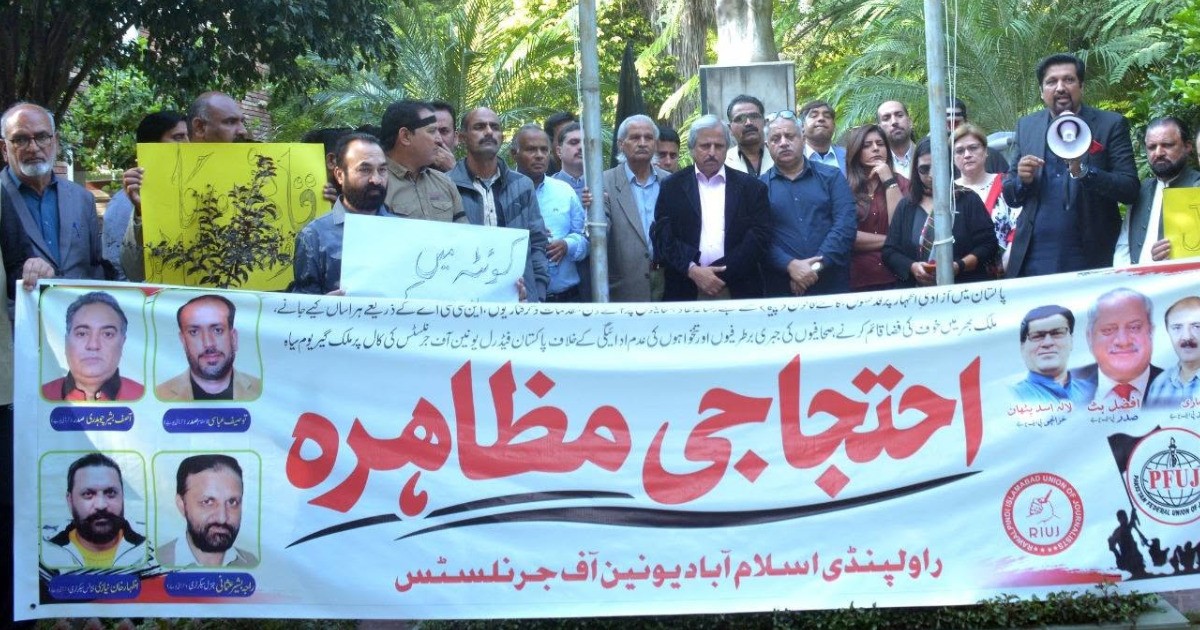
PAKISTAN — The National Cyber Crime Investigation Agency’s Rawalpindi office issued notices to three Chakwal journalists over reports about faculty complaints and a transfer dispute involving a junior clerk at the Government Graduate College for Women, Chakwal. The notices directed Dawn contributor Nabeel Anwar Dhakku, Minute Mirror correspondent Samandar Khan and 365 News journalist Qazi Waseem Jahangir to appear in response to a complaint by college principal Prof. Mehnaz Akhtar. The journalists said their reporting was supported by official records. No charges or findings against them had been reported at the time of publication. (Nabeel Anwar Dhakku/Facebook, Minute Mirror and Daily Pakistan, September 22, 2026)
Why it matters: Requiring journalists to answer a cybercrime complaint over reporting supported by documents can impose legal costs and encourage self-censorship even when no offense has been established.
PERU — CPJ, PEN International and 34 other organizations condemned a new criminal complaint filed against investigative journalist Paola Ugaz over her reporting on the Sodalitium of Christian Life. The complaint, filed on August 17 by the Asociación Civil San Juan Bautista, is the latest in a series of proceedings connected to Ugaz’s investigations into alleged corruption and abuse involving the religious organization. (Committee to Protect Journalists and PEN International joint statement, September 21, 2026)
Why it matters: Repeated criminal complaints can become a form of judicial harassment, consuming a journalist’s time and resources while deterring scrutiny of powerful institutions.
Attacks, threats, harassment, and killings
ROMANIA — Masked and other protesters attacked at least eight journalists and media workers covering a farmers’ protest in Bucharest on September 15, and at least three required medical treatment. Those targeted included Realitatea Plus reporter Cristiana Chițu and camera operator Ruben Lighezan, a Digi24 crew, București.ro reporter Gabriel Kolbay, Snoop journalist Ioana Moldoveanu, and Recorder journalists Anna Constantin and David Muntean. Police later sought protest footage from news organizations, raising separate source-protection concerns. (Committee to Protect Journalists and ActiveWatch, September 21, 2026)
Why it matters: Violence at public demonstrations prevents journalists from documenting events safely, while demands for newsroom footage risk compromising source protection and editorial independence.
PAKISTAN — Pakistan Peoples Party Chairman Bilawal Bhutto Zardari condemned the alleged assault on senior journalist and UNA News Agency bureau chief Naseer Ahmed Kakar and called for legal action. Press organizations said Kakar and four companions were assaulted and threatened after being invited to mediate a domestic dispute. Police reportedly registered a case at Gawalmandi Police Station, but available reporting has not established that the incident was connected to Kakar’s journalism. (JournalismPakistan.com, September 20, 2026; Daily Sadaqat International, UrduPoint and Daily Qudrat, September 16–20, 2026)
Why it matters: The alleged violence has prompted protests and demands for accountability across Balochistan. A transparent investigation is needed to establish the motive and determine whether Kakar was targeted because of his journalistic work.
Economic pressure and media viability
PUERTO RICO — GFR Media announced that El Nuevo Día and Primera Hora, two of Puerto Rico’s leading newspapers, would end their print editions and become digital-only. Primera Hora published its final print edition on September 24, while El Nuevo Día’s last print edition was scheduled for September 27. The company cited changing consumer habits; it did not disclose whether the transition would lead to layoffs. (GFR Media and The Associated Press, September 21–24, 2026)
Why it matters: The loss of two major print editions reflects the continuing financial strain on newspapers and may reduce access for readers who rely on print while creating uncertainty for newsroom and production jobs.
Policy and court developments
UNITED STATES — U.S. District Judge Timothy J. Kelly issued a 14-day temporary restraining order directing the White House to restore access for CNN, MS NOW and Politico after President Donald Trump barred the outlets over coverage he described as false or negative. Their reporters regained entry on September 24, and major television networks resumed pooled White House coverage the following day. The order found a likelihood of success on the outlets’ procedural due-process claim; their broader First Amendment challenge remains unresolved. (Reuters and The Associated Press, September 21–25, 2026; JournalismPakistan.com, September 26, 2026)
Why it matters: The ruling imposed an immediate check on the administration’s access restriction and restored essential reporting access, but the temporary order leaves unresolved whether similar restrictions may be attempted again.
MALAYSIA — CPJ urged Malaysia to substantially revise a draft freedom of information bill before it advances in Parliament. The organization said the bill contains broad exemptions, weak oversight and provisions that could expose applicants to fines or imprisonment if information is used for a purpose different from the one stated in the original request. A national town hall on the draft is scheduled for September 28. (Committee to Protect Journalists, September 24, 2026; ARTICLE 19, the Centre for Independent Journalism and the C4 Center analysis, September 2026)
Why it matters: A freedom of information law cannot strengthen accountability if journalists risk punishment for using public records to pursue new facts or if broad exemptions preserve official secrecy.
MALTA — Malta’s attorney general appealed the acquittal of businessman Yorgen Fenech on charges of complicity and criminal association in the 2017 car-bomb murder of investigative journalist Daphne Caruana Galizia. Fenech was acquitted by an 8–1 jury verdict earlier in September after a two-month trial. Under Maltese law, the appeals court may order a retrial if it finds that the interests of justice require one. (Reuters, September 22, 2026)
Why it matters: The appeal keeps open the question of accountability for one of Europe’s most consequential journalist killings and tests whether Malta’s justice system can address persistent concerns about impunity.
Media labor and union activity
GERMANY/GREECE — Deutsche Welle reversed its plan to close its Greek-language service and will retain it in reduced form from January 1, 2027, after a campaign by journalists’ unions in Greece and Germany. Most jobs are expected to remain, but annual funding for the service will fall from about €700,000 to roughly €400,000 as the broadcaster implements wider cuts. (International Federation of Journalists and European Federation of Journalists, September 25, 2026; JournalismPakistan.com, September 26, 2026)
Why it matters: Cross-border union action preserved jobs and a multilingual public-service news operation, but the reduced budget shows that financial pressure on international broadcasting remains acute.
Press freedom and journalist safety
SERBIA — CPJ warned that threats, assaults, police obstruction and smear campaigns against independent journalists are intensifying ahead of Serbia’s October 25 parliamentary election. The organization said recent attacks at political gatherings point to worsening conditions and reported that six Serbian journalists had relocated abroad by August because of security threats and years of unpunished intimidation. (Committee to Protect Journalists, September 22, 2026)
Why it matters: An election cannot be meaningfully scrutinized when reporters face violence, family threats and official hostility, particularly in an environment where attacks on the press routinely go unpunished.
Press freedom review
This edition records 15 developments spanning the Americas, Africa, Europe, Asia and the Middle East and North Africa. Detention was the most visible form of pressure: journalists were held in Cuba and the Democratic Republic of the Congo, briefly detained in Tunisia, and released after questionable custody in Cameroon and Djibouti. Legal pressure remained a parallel track, with cybercrime notices in Pakistan, another criminal complaint against Paola Ugaz in Peru and continued reliance on defamation and false-information laws in the DRC.
Physical danger was also prominent. The coordinated hostility encountered by journalists at the Bucharest protest shows how anti-media rhetoric can translate into assaults in the field. The alleged attack on Naseer Ahmed Kakar in Balochistan requires a transparent investigation, especially because the available record has not yet established whether his journalism was the motive.
The week also produced qualified gains. U.S. court intervention restored White House credentials and allowed pooled television coverage to resume, but only temporarily. Union pressure saved Deutsche Welle’s Greek service, though with substantially less funding. Malta’s appeal renewed the possibility of judicial scrutiny in the Caruana Galizia case, while Malaysia still has an opportunity to strengthen its proposed freedom of information law before enactment.
Global context
Across these cases, control over journalism was exercised through police custody, criminal law, accreditation, official access, public hostility and financial decisions. The tactics differed, but their effect was similar: reporters lost time, safety, mobility or the practical ability to reach audiences. The danger is that exceptional measures become routine, an interview becomes a defamation case, a summons becomes preventive detention, a press badge becomes a reward for favorable coverage, and a reporting assignment becomes grounds for interrogation.
This week also demonstrated that pressure can be contested. Courts can restrain executive retaliation, unions can preserve services and jobs, news organizations can act collectively, and sustained documentation can keep unresolved attacks and killings in public view. Those checks, however, remain fragile. Temporary court orders expire, funding cuts continue, and accountability mechanisms often move more slowly than the threats confronting journalists.
SUGGESTED TAGS: Press freedom, journalist safety, media law, arrests of journalists, attacks on journalists, criminal defamation, legal pressure, newsroom access, freedom of information, media viability, journalists’ unions, NCCIA, Pakistan media, White House press access, independent journalism
ATTRIBUTION: Compiled and analyzed by JournalismPakistan.
ABOUT THIS TRACKER: The Press Freedom Tracker is a weekly product of JournalismPakistan.com, published every Sunday. Read previous editions here.
Key Points
- Pressure on journalists came through arrests, detentions, legal complaints and credential withdrawals.
- Cases were reported in Cuba, Democratic Republic of the Congo, Tunisia, Cameroon, Romania, Pakistan and Peru.
- Physical attacks and alleged mistreatment hindered reporting in multiple countries.
- Judicial review, unions and newsroom solidarity sometimes restored access or challenged reprisals.
- Authorities increasingly use process-opaque rules, defamation and criminal complaints-as a form of punishment.
Key Questions & Answers
What main threats to press freedom does the Tracker highlight?
The Tracker highlights arrests, detentions, accreditation withdrawal, defamation and criminal complaints, plus physical attacks and opaque rules that obstruct reporting before final judgments.
Which countries had notable incidents this week?
Notable incidents were reported in Cuba, the Democratic Republic of the Congo, Tunisia, Cameroon, Romania, Pakistan and Peru, with a U.S. ruling affecting White House press access.
How do courts and unions affect these pressures?
Judicial review, legal appeals and union or newsroom solidarity have sometimes restored access, preserved services or checked abuses, showing resistance can matter.
What does "process as punishment" mean in this context?
It refers to using prolonged detentions, opaque accreditation rules, repeated questioning and legal complaints to punish and obstruct journalists without swift final rulings.
Relevant Topics
Ask AI: Understand this story your way
AI EnabledDig deeper, ask anything — get instant context, background, and clarity.
Disclaimer: This feature is powered by AI and is intended to help readers explore and understand news stories more easily. While we strive for accuracy, AI-generated responses may occasionally be incomplete or reflect limitations in the underlying model. This feature does not represent the editorial views of JournalismPakistan. For our full, verified reporting, please refer to the original article.