
Press freedom hit by detentions, bans and prosecutions
JournalismPakistan.com | Published: 20 September 2026 | JP News Desk
Join our WhatsApp channel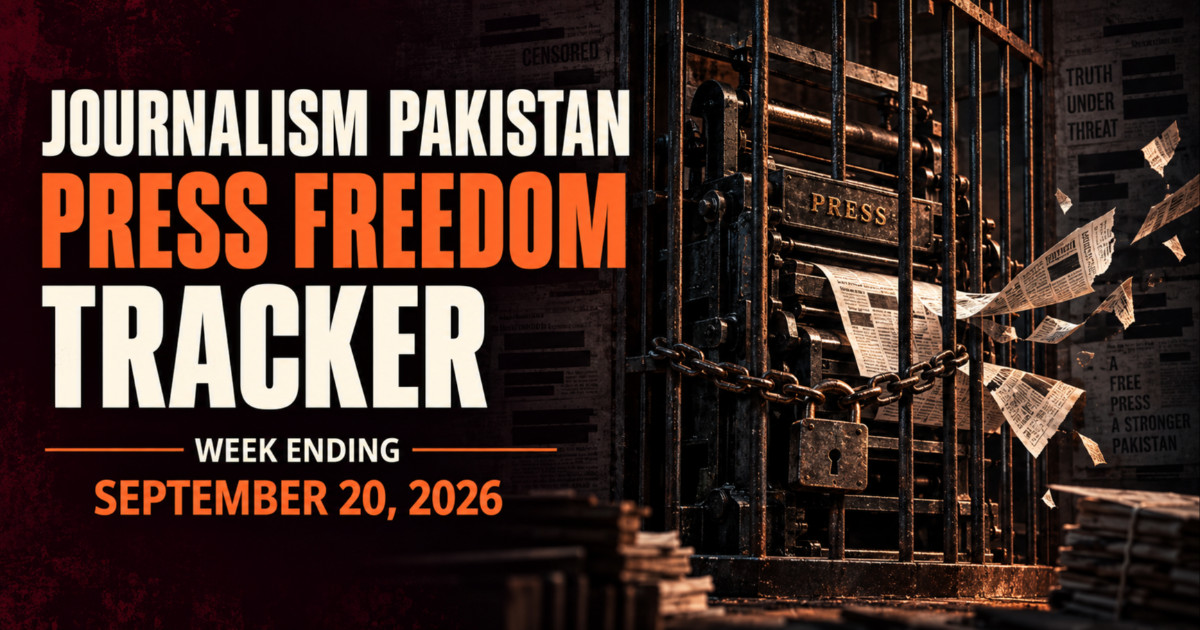
JournalismPakistan Press Freedom Tracker records 11 major developments across seven jurisdictions, showing detentions, bans and prosecutions are constraining journalism; journalists were detained in Turkey, the DRC and the US, while some courts granted limited relief amid ongoing legal pressure.Summary
Editor’s note
This week’s Tracker records 11 significant developments across seven jurisdictions, revealing how pressure on journalism moves through different institutions but often produces the same result: less scrutiny of power. Journalists were detained in Turkey, the Democratic Republic of the Congo and the United States; criminal and cyber laws remained tools of pressure; and the White House enforced a sweeping access ban against three major news organizations.
There were also important signs of resistance. Courts granted bail to Pakistani journalist Bilal Ghauri, released two Turkish journalists pending trial, and blocked proposed restrictions on foreign journalists’ visas in the United States. Yet those gains remain fragile. Prosecutions continue, one Turkish editor remains imprisoned, and institutional weakness is growing as the Philippines prepares to lose a press freedom organization that has monitored abuses for 37 years.
Arrests, detentions, and kidnappings
TURKEY — The Committee to Protect Journalists reported on September 18 that Kurdish-Turkish journalist Ahmet Polad had been transferred from Syria to Turkey and jailed following nearly eight months of enforced disappearance. Polad, whose birth name is Mehmet Nizam Aslan, was detained while reporting in Raqqa on January 18 and transferred to Turkey on September 8. A court ordered his arrest on September 11 in a classified case. His lawyer said he was in extremely poor health after alleged beatings, starvation, and prolonged confinement in Syria. (Committee to Protect Journalists, September 18, 2026)
Why it matters: Imprisoning a journalist after months of secret detention compounds concerns about enforced disappearance, denial of due process and the failure to provide urgent medical care.
UNITED STATES — U.S. Immigration and Customs Enforcement detained exiled Nicaraguan journalist Luis Galeano in Florida on September 14 while he was working as a rideshare driver. Galeano, who fled Nicaragua in 2018 after authorities raided his former outlet and sought his arrest, has continued reporting critically through his platform Café con Voz. His asylum application has been pending for about seven years, and Nicaragua stripped him of his citizenship in 2023. CPJ and the Inter-American Press Association called for his release. (Committee to Protect Journalists, September 15, 2026; The Guardian, September 16–17, 2026)
Why it matters: Detaining an exiled journalist with a pending asylum claim may place a reporter already targeted for his work at renewed risk and raises serious questions about protections for journalists seeking refuge.
Legal and regulatory pressure
BANGLADESH — More than 100 journalists formed a human chain outside the Lalmonirhat Superintendent of Police’s office on September 13, demanding the withdrawal of a Cyber Security Act case against reporters S K Sahed and Zubair Ahmed Khan Rohan. The case followed reports on alleged irregularities and corruption at the Teesta Comprehensive Village Development Cooperative Society Limited. Protesters described the legal action as harassment intended to discourage investigative reporting. (Daily Industry, September 13, 2026)
Why it matters: Using cyber legislation against reporters covering alleged corruption can deter public-interest investigations and expose journalists to retaliatory legal pressure.
Digital rights and online censorship
DEMOCRATIC REPUBLIC OF THE CONGO — Plainclothes officers detained Trésor Muntu, director general of Centrale Radio Télévision, in Likasi on September 15 after he shared another journalist’s X post in five WhatsApp groups. Prosecutors charged him with defamation and publishing false news, and he was transferred to Kasapa Central Prison in Lubumbashi on September 16. The case followed a complaint by a provincial assembly vice-president criticized in the post. Muntu could face up to five years in prison if convicted. (Committee to Protect Journalists, September 17, 2026)
Why it matters: Treating the sharing of a social media post as a criminal offense extends censorship into private messaging spaces and enables officials to use defamation laws against digital news circulation.
Attacks, threats, harassment, and killings
PALESTINE — Israeli forces raided Palestinian journalist Ali al-Samoudi’s home in Jenin, reportedly beat his son and ordered the journalist to surrender within an hour. Al-Samoudi was not home, and subsequent reports reviewed for this Tracker did not confirm whether he surrendered or was detained. He had been released on April 30 after spending 12 months in Israeli detention, where he said he experienced severe food deprivation, abuse, and denial of medical care. (Anadolu Agency, September 13, 2026; Committee to Protect Journalists; Palestinian Journalists Syndicate monitoring report, September 8, 2026)
Why it matters: The raid points to continuing pressure on Palestinian journalists through threats of renewed detention, home searches and alleged violence against relatives. It came as the Palestinian Journalists Syndicate documented 84 alleged violations against journalists in August.
Economic pressure and media viability
PHILIPPINES — The Center for Media Freedom and Responsibility announced that it would cease operations on September 30 after 37 years, citing difficulty securing the funding needed to continue. Founded in 1989, CMFR monitored attacks on journalists and impunity in media killings, reviewed news coverage, promoted professional ethics and supported investigative journalism. (Center for Media Freedom and Responsibility statement, September 18, 2026; GMA News and SunStar, September 18, 2026)
Why it matters: The closure will remove a long-standing independent institution that monitored press freedom while scrutinizing the media’s professional conduct, and it leaves uncertainty over the future of its archives and monitoring programs.
Access to information and reporting restrictions
UNITED STATES — Journalists from CNN, MS NOW and Politico were denied entry to the White House on September 19, a day after President Donald Trump announced that he was banning the three organizations over coverage he described as false. The outlets said their teams’ press passes were confiscated and pledged to defend their First Amendment rights. The National Press Club called for an immediate reversal, while Trump suggested that other news organizations could also be barred. (National Press Club statement, September 18, 2026; Reuters and Associated Press, September 19, 2026)
Why it matters: Revoking access because of editorial coverage restricts journalists’ ability to question the president and risks intimidating the wider White House press corps.
Policy and court developments
PAKISTAN — An Islamabad court granted journalist Bilal Ghauri post-arrest bail on September 16 against a Rs100,000 surety bond and ordered his release unless he was required in another case. His prosecution under Sections 20 and 26-A of the Prevention of Electronic Crimes Act remains pending. (Voicepk.net and Independent Urdu, September 16, 2026; Committee to Protect Journalists, September 9, 2026; JournalismPakistan reporting)
Why it matters: The ruling ended Ghauri’s detention but left him facing prosecution over commentary concerning a public appointment, illustrating how legal pressure can continue after release.
TURKEY — Three Etkin News Agency journalists appeared in separate Istanbul hearings between September 14 and 17 after spending more than seven months in pretrial detention on terrorism-related charges. Courts released editor Pınar Gayıp and reporter Elif Bayburt pending trial but kept editor Nadiye Gürbüz in prison until at least her next hearing in December. CPJ said the indictments relied on the journalists’ employment at ETHA and attendance at public events; all three denied membership in a terrorist organization. (Committee to Protect Journalists, September 17, 2026)
Why it matters: Presenting ordinary journalistic employment and attendance at public events as evidence of terrorism risks criminalizing newsgathering and prolonging punitive pretrial detention.
UNITED STATES — A federal judge issued an injunction on September 14 blocking the Trump administration from imposing new visa restrictions that would have required foreign journalists to renew their I visas every 240 days. The court found that the Department of Homeland Security had not identified a specific national security risk associated with foreign journalists holding the visas. Reporters Without Borders was among the plaintiffs challenging the restrictions. (U.S. District Court ruling, September 14, 2026; Freedom of the Press Foundation, September 15, 2026)
Why it matters: The injunction prevents a recurring renewal process that press freedom groups warned could invite content-based scrutiny and disrupt the work of foreign correspondents in the United States.
Media labor and union activity
PAKISTAN — BOL News reportedly removed anchor Absa Komal from the air, with some accounts saying she was dismissed, after she spoke at an RIUJ hunger strike camp about unpaid salaries, forced dismissals and PECA-related arrests. Journalists condemned the reported action and demanded her reinstatement, although BOL had not publicly clarified her employment status. (RIUJ and PFUJ public posts, September 14, 2026; Pakistani journalists’ public statements, September 15, 2026)
Why it matters: Punitive action against journalists who raise workplace grievances can weaken labor organizing and discourage media workers from challenging exploitative employment practices.
Press freedom review
The week’s cases show that detention is only one part of a widening pressure system. In Turkey, one journalist was jailed after months of disappearance and alleged abuse, while another remained imprisoned despite two colleagues being released. In the Democratic Republic of the Congo, sharing a post through WhatsApp led to detention and criminal charges. In the United States, immigration enforcement placed an exiled journalist in custody despite his pending asylum claim.
Legal and administrative controls were equally prominent. Bangladesh’s Cyber Security Act case targeted reporting on alleged corruption, Pakistan’s PECA prosecution of Bilal Ghauri continued after bail, and the White House used accreditation to punish organizations over their coverage. These cases differ sharply in law and political setting, but each demonstrates how official discretion can be used to raise the cost of independent reporting.
The week also brought limited but meaningful checks on state power. Courts released three journalists across Pakistan and Turkey and halted restrictive U.S. visa rules for foreign correspondents. Those outcomes underline the importance of judicial scrutiny, legal defense and sustained advocacy, even as unresolved prosecutions leave journalists exposed to future pressure.
Global context
This week’s developments span democracies, conflict zones and more restrictive political systems, challenging the assumption that press freedom declines through a single dramatic act. It can erode through visa rules, accreditation decisions, cybercrime complaints, terrorism prosecutions, labor retaliation and the financial collapse of watchdog institutions. Together, such measures narrow the space in which journalists can work, travel, question officials and sustain independent reporting.
The closure of CMFR adds an institutional warning to the individual cases. Press freedom depends not only on keeping journalists out of prison but also on preserving the organizations that document abuses, provide evidence and maintain public memory. When monitoring bodies disappear for lack of funding, violations become easier to deny and harder to challenge.
SUGGESTED TAGS: Press freedom, journalist safety, media censorship, journalist arrests, legal pressure, digital rights, online censorship, media access, White House press, PECA, Cyber Security Act, media labor, newsroom rights, media viability, Center for Media Freedom and Responsibility, Bilal Ghauri, Absa Komal, Ali al-Samoudi, Luis Galeano, Ahmet Polad
ATTRIBUTION: Compiled and analyzed by JournalismPakistan.
ABOUT THIS TRACKER: The Press Freedom Tracker is a weekly product of JournalismPakistan.com, published every Sunday. Read previous editions here.
Key Points
- Tracker records 11 significant developments across seven jurisdictions highlighting shrinking space for journalism.
- Journalists were detained in Turkey, the Democratic Republic of the Congo and the United States; Ahmet Polad was transferred from Syria to Turkey and jailed.
- Authorities employed criminal, cyber and administrative measures, and the White House enforced a sweeping access ban on three major news organisations.
- Courts in some countries granted bail or released journalists pending trial, such as Bilal Ghauri and two Turkish reporters, but prosecutions and at least one continued imprisonment persist.
Key Questions & Answers
What trends does the tracker highlight?
The tracker documents 11 significant developments across seven jurisdictions showing a pattern of detentions, bans and prosecutions that constrain journalism and reduce scrutiny of power.
Which countries were mentioned as sites of detention?
Journalists were reported detained in Turkey, the Democratic Republic of the Congo and the United States; the report also notes actions such as an access ban imposed by the White House.
Were there any legal wins for journalists?
Yes. Some courts granted limited relief-bail or releases pending trial-and blocked proposed restrictions in certain cases, but these gains remain fragile amid ongoing prosecutions.
What tools are being used to pressure media?
Authorities used criminal and cyber laws, administrative measures and access restrictions to pressure journalists and news organisations.
Relevant Topics
Ask AI: Understand this story your way
AI EnabledDig deeper, ask anything — get instant context, background, and clarity.
Disclaimer: This feature is powered by AI and is intended to help readers explore and understand news stories more easily. While we strive for accuracy, AI-generated responses may occasionally be incomplete or reflect limitations in the underlying model. This feature does not represent the editorial views of JournalismPakistan. For our full, verified reporting, please refer to the original article.