
Media boom and bust: How journalism in Pakistan has suffered
JournalismPakistan.com | Published: 24 November 2012 | The Communicator
Join our WhatsApp channel
The article discusses the decline in the quality of journalism in Pakistan since the media boom of 2003. It highlights issues such as lack of skill, credibility, and adherence to journalistic basics among reporters.Summary
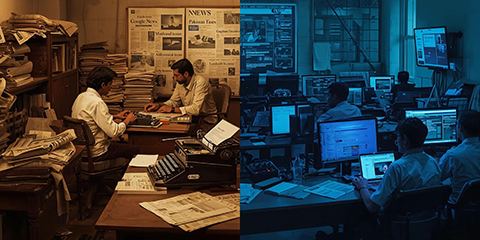
Certainly there are more reporters and journalists now than when I was in active journalism. But this doesn’t necessarily mean more is better. On the contrary, it has proved just the opposite. An indication of just how much the quality of Pakistan’s media has degenerated since the media boom of 2003 is embarrassing to say the least.
All you have to do is pick up any newspaper and you will see what I mean. Not only is the language quite inadequate in expression and composition, but also riddled with basic grammatical errors. Likewise, most stories are convoluted and lack conviction.
There is always an element of doubt in the reader’s mind about whether the story is genuine or planted. A reader is more likely to dwell on the writer’s political and religious affiliations and leanings rather than admit the story is what it is.
It is quite obvious that creditability has long been lost.
It’s not much different when it comes to the electronic media. Larger than life hosts noisily batter the senses of viewers alongside panels of pseudo experts and analysts all trying to outdo and outshout each other.
Miraculously these paragons of truth, who swear they are the voice of the people and upholders of journalistic morals and excellence, have all been involved in some kind of scam or scandal. Yet they shamelessly go about their business.
Agreed, not everybody can be a Z.A. Suleri, H.K. Burki, Meem Sheen, Maliha Lodhi, Khalid Hassan, Minhaj Barna or the like. However, all that is required is a knowledge of and adherence to journalistic basics. This sadly is lacking.
Nobody is asking for the perfect prose or a masterpiece; a simple, straightforward well-written account of an event will suffice. An honest TV report or package without melodramatics would be good.
Yet this somehow seems beyond the capabilities of our reporters and journalists who much rather rely on media workshops, overseas fellowships and such to bolster their resumes rather than produce actual evidence of their capability.
I was surprised to discover through JournalismPakistan’s current online poll that twice the number of journalists are of the opinion that they stand to benefit from media workshops and such events.
This means that they do not have the prerequisite skills to call themselves journalists in the first place. What I am saying is that certificates garnered from various media workshops and fellowships stints might look good on one’s resume and certainly will help bolster one’s job opportunities, but will it make one a better journalist?
I think not.
A journalist is recognized by what he writes or produces not by the number of fellowships he was part of or certificates. Journalism requires hard work and the ability to recognize and go after a story. It also requires one write with a purpose and with clarity, building a story, rather than putting a hodge-podge together and claiming it is a story.
It all depends on how hard one is ready to push oneself. The first step to being a good journalist is not proclaiming that you are one, but rather confessing that you are still learning the trade, a student. A little humbleness goes a long way.
Some years back a then ‘senior’ reporter came to me and said, “Ma’am can you help me write this story. I want it to be good.”
I was happy to oblige. The man still had the honesty to ask for help. So I helped him with putting the story together. I pointed out the weak spots and where he still had to do more work. He followed up on my suggestions. The end result was that he had a tight story. Not the best. Not a masterpiece, but a story that was hard to criticize. It covered all aspects. It was simply written, straightforward, and factually accurate. It had a beginning, middle, and an end.
Over time I frequently came across other stories this reporter did. I was pleasantly surprised to note that he had evolved from that initial story a blueprint for all his work.
So I called him up and told him he was doing well and then I gently advised him it was time for him to move up another notch and establish his own identity. The blueprint of his success was yet to come.
Earlier this year, my journalist friend published his first book. It was an excellent piece of writing.
What I wish to say is that such workshops and fellowships do help one understand the nature of the job, but quality comes from within and this is only possible if the basics are sound and there is a will to self-improvement through hard work.
(The writer is a senior journalist)
KEY POINTS:
- Increase in number of journalists but decline in quality of reporting.
- Credibility lost among readers due to inadequate language and convulsive stories.
- Media workshops do not guarantee better journalism skills.
- Successful journalism requires hard work, humility, and a focus on fundamentals.
- A few journalists have shown improvement through dedication and learning.