
From Pakistan Times to Google News: The story of journalism’s digital transformation
JournalismPakistan.com | Published: 26 October 2025 | Steve Manuel
Join our WhatsApp channel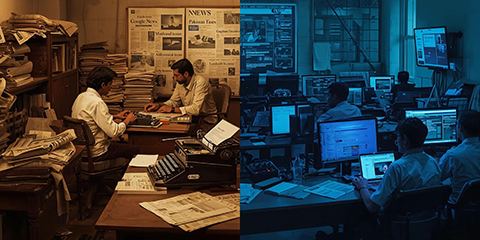
This article reflects on the transition from print newspapers to digital news platforms, emphasizing the significant decline in newspaper readership. It shares personal anecdotes and insights from a veteran journalist on the changing media landscape.Summary
ARIZONA, U.S. — Somewhere towards the mid-90s, reports began appearing in the international press warning that print media was under imminent threat from emerging online news platforms. I was part of the Khaleej Times news desk then, and such reports were scoffed at and dismissed as wishful thinking. “Newspapers will never cease to exist,” declared our opinionated chief sub with a shake of his head. Looking back now, he was dead wrong.
The Gradual Decline of Newspapers
While newspapers have not entirely vanished, their readership has fallen dramatically over the past decade and a half. Once a staple of daily life, print papers now appeal mainly to the diehard few who still cherish the rustle of newsprint.
The rise of Google, YouTube, web channels, and online news agencies has changed everything. News seekers no longer wait for the morning paper; a few taps on a phone or laptop deliver instant updates and satisfaction.
The Digital Convenience and the Missing Element
Like most, I now browse online news as I once did the newspaper. It’s convenient and efficient. Yet, there’s a lingering feeling of something missing, a sense of ritual and connection that digital screens can’t quite replicate.
Perhaps it’s generational. Having spent decades with print, the switch to screens feels impersonal, even forced by necessity.
A Childhood Shaped by Newspapers
My love for newspapers began at 6. Every morning, The Pakistan Times and Morning News would arrive around 5:30 am. After my father and grandfather read them, I would dive into the comic strips before school, a cherished routine that became a habit.
Later in the day, I would read crime reports aloud to my grandfather, unknowingly learning structure, flow, and the principles of storytelling — the who, what, when, where, and how — lessons many young journalists still struggle to grasp.
Lessons From Family and the Newsroom
My father and grandfather often debated the news, one a journalist, the other a police officer, and their contrasting views deepened my understanding of perspectives. As a teenager, I began waking early just to read first. It gave me a sense of empowerment and awareness.
At The Muslim, I gained firsthand insight into how newspapers came together, a meticulous process of precision and discipline. My true media education, however, happened at Khaleej Times and Dubai Television, where deadlines were tight, and the pace relentless.
Inside the Khaleej Times Newsroom
At Khaleej Times, we had no layout artists; sub-editors made the pages themselves. On heavy news days, our editions reached 72 pages, and each page felt like a masterpiece of labor and love. Readers often took the effort for granted, but we took pride in every line.
Our biggest rival, Gulf News, kept us sharp. The competition was fierce, yet fulfilling. But eventually, circulation began to dip, a slow and painful descent. One newspaper shifted to tabloid format, another went fully digital, and Khaleej Times followed suit.
Pakistan’s Newspapers Fade Away
The story was no different back home. Iconic Pakistani papers like The Pakistan Times, The Muslim, Morning News, and The Sun all disappeared with dwindling readership. Even The Muslim, once known for its fearless journalism and top talent, couldn’t survive.
The End of an Era
There was a time when newspapers shaped public discourse, readers referenced editorials to strengthen arguments, and every morning began with a cup of tea and fresh print. Now, that culture is fading fast.
Online news platforms and TV channels have pushed newspapers into the background, with many surviving only through loyal readers who are unwilling to break lifelong habits. But when they go… so too may the era of print.
Steve Manuel is a veteran journalist with more than 45 years of experience across print and electronic media. Now based in the United States, he spent his most dynamic years shaping newsrooms in Pakistan and Dubai.
Key Points
- The rise of digital platforms has dramatically reduced print newspaper readership.
- Personal experiences highlight a deep connection to print media and its rituals.
- The competitive nature of journalism shaped the quality and dedication in newsrooms.
- Many iconic newspapers in Pakistan have ceased publication due to declining audiences.
- The shift to digital news affects both media workers and loyal readers.
Relevant Topics
Ask AI: Understand this story your way
AI EnabledDig deeper, ask anything — get instant context, background, and clarity.
Disclaimer: This feature is powered by AI and is intended to help readers explore and understand news stories more easily. While we strive for accuracy, AI-generated responses may occasionally be incomplete or reflect limitations in the underlying model. This feature does not represent the editorial views of JournalismPakistan. For our full, verified reporting, please refer to the original article.