

The State of Pakistan Media: October 2026
JournalismPakistan.com | Published: 3 November 2026 | JP News Desk
Join our WhatsApp channel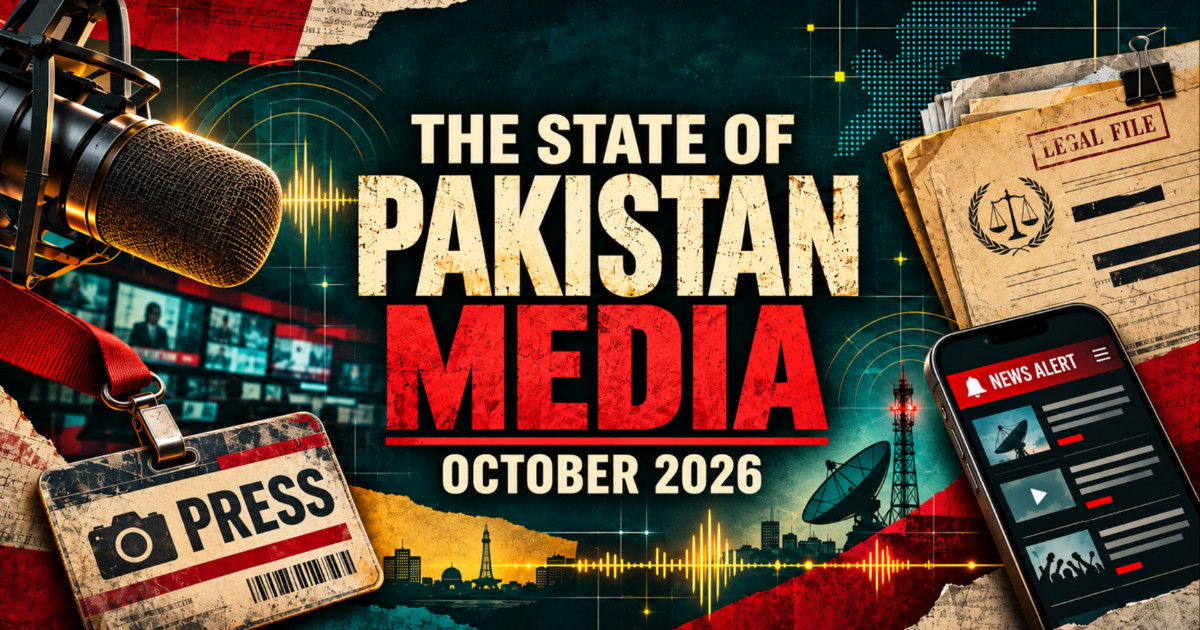
October 2026 saw expanded legal pressure on Pakistani journalism, with the NCCIA launching cyber-patrolling, journalists summoned and a prominent anchor detained, and PEMRA plus provincial orders tightening reporting rules. Safety and pay disputes increased concern.Summary
Cybercrime enforcement, official reporting restrictions, journalist safety concerns, and newsroom salary disputes shaped Pakistan's media environment in October, while unions demanded stronger protection for independent journalism.
Executive summary
October 2026 marked a significant expansion of regulatory and legal pressure on journalism in Pakistan. The National Cyber Crime Investigation Agency (NCCIA) activated nationwide cyber-patrolling units, journalists faced summonses and investigations over alleged online offenses, and a prominent television anchor spent much of the month in custody before securing bail.
At the same time, government directives tightened the conditions under which news organizations could report on security incidents. The Pakistan Electronic Media Regulatory Authority (PEMRA) renewed restrictions on television coverage of explosions, gunfire and terrorist attacks. At the same time, the Balochistan government required media organizations to obtain confirmation from designated official sources before reporting on security forces and police.
The combination of cybercrime enforcement, administrative controls and official verification requirements raised concerns about the independence of journalistic decision-making. These developments did not amount to a single nationwide censorship order, but they illustrated how different institutions can influence what journalists investigate, verify and publish.
Physical safety remained a serious concern. Reports of alleged police mistreatment, attacks on journalists, a disputed incident at a press club and an assault involving a journalist in Islamabad prompted demands for independent investigations. A confrontation outside a court in Jamshoro also left a journalist injured, although the available evidence did not establish that he was targeted because of his profession.
Economic insecurity emerged as another major challenge. Parliamentary journalists walked out of the National Assembly to protest unpaid salaries and forced dismissals, prompting the federal government to seek channel-wise information about outstanding dues and job losses. The sealing of a newspaper distribution market in Islamabad separately highlighted the vulnerability of print circulation and the livelihoods dependent on it.
The month also brought organized resistance. Editors, unions, senior journalists, and civil society representatives raised concerns about restrictions on independent reporting and called for greater coordination. A new initiative to establish a common platform against censorship, restrictive legislation, and deteriorating working conditions indicated a growing recognition that the profession's problems require collective action.
Freedom Network's Annual Impunity Report 2026 reinforced these concerns. Published in October, it documented 97 violations against journalists and media organizations between October 2025 and August 2026 and identified legal harassment as an increasingly important form of pressure.
October was therefore defined not simply by arrests or threats, but by the convergence of criminal investigations, regulatory restrictions, institutional uncertainty, economic instability and physical risks. The month's developments demonstrated the difficulty of sustaining independent journalism when pressures arise simultaneously from several directions.
October by the numbers
97 Violations documented by Freedom Network over its reporting period
32 Threats of legal action in the same report
13 Recorded legal actions in the same report
4 days' initial physical remand granted to NCCIA in Iqrarul Hassan's case
Rs200,000Surety bonds set for Hassan's October 31 bail
500+ Complainants met during NCCIA's Punjab inspection
Freedom Network's 97 violations cover October 2025 to August 2026, not October alone. These figures provide context and must not be interpreted as an October incident total. The remaining numbers relate to developments reported during the month.
Press freedom & journalist safety
Journalists continued to face physical threats, alleged police misconduct and uncertainty over whether official institutions would investigate complaints impartially.
In Karachi, police detained a suspect following allegations that senior journalist Kashif Hashmi had been assaulted and mistreated at Nazimabad police station. Hashmi, a former president of the Crime Reporters Association, had complained about his treatment, leading to an inquiry ordered by the district police chief. The reported detention on October 15 represented an initial enforcement response, but it did not establish the suspect's guilt or resolve questions surrounding the incident.
In Gojra, journalists' representatives demanded an impartial inquiry after reports that 92 News journalist Amjad Islam Amjad had been attacked, injured, and subsequently detained by city police. A criminal complaint was also registered against him. Faisalabad Press Club leaders sought medical treatment, protection of his legal rights and an examination of the allegations.
A separate confrontation emerged in Khyber district. Members of the Khyber District Press Club announced a boycott of police activities and police-related news following what they described as a raid on their premises on October 25. Journalists alleged that masked men wearing police uniforms had entered the club. However, the account was disputed in publicly available reporting, making an independent investigation necessary before responsibility could be established.
In Islamabad, journalist and anchor Rana Imran Latif was reportedly targeted by two unidentified individuals while accompanied by his family at F-10 Markaz on October 30. The reported incident highlighted concerns about journalists' personal security beyond newsrooms and assignments. The available account did not establish the suspects' identities or motive.
Another serious incident occurred in Jamshoro district on October 30, when journalist Azeem Barejo was injured during a confrontation outside a court in Kotri. The clash reportedly arose from a land dispute involving two communities and escalated into gunfire, leaving one person dead and three others wounded. Police later arrested Barejo and his brother, while an FIR named several family members.
The Jamshoro case requires a distinction between violence involving a journalist and an attack motivated by journalism. The available reports identify a land dispute as the background to the confrontation, and competing allegations have not been judicially established. It would therefore be premature to classify the incident as a confirmed work-related attack.
Together, these developments underlined the importance of transparent police investigations, adequate medical and legal assistance, and careful verification of the circumstances surrounding incidents involving media professionals.
Law, courts & regulatory control
October brought several developments that extended official influence over news gathering, broadcasting and online expression.
The NCCIA announced the activation of cyber-patrolling units across Pakistan and established special units to address what it described as fake news and anti-state propaganda. The announcement followed a five-day inspection of the agency's Punjab operations by Director General Syed Ali Nasir Rizvi.
Although authorities presented the expansion as a response to unlawful online activity, its implications for journalism were substantial. Expressions such as fake news and anti-state propaganda can raise questions about enforcement standards when their application to particular cases is unclear.
Journalists covering government conduct, public institutions and national security may face investigative scrutiny over the same digital platforms they use to distribute their reporting. Effective safeguards therefore depend on clear legal thresholds, due process, independent oversight and protections for legitimate public-interest journalism.
A high-profile example of the expanding cybercrime system involved television anchorperson Iqrarul Hassan, who was produced before a Karachi magistrate on October 13 in a case concerning alleged offenses arising from social media posts.
The court granted the NCCIA four days of physical remand rather than the 14 days investigators had requested. A sessions court rejected Hassan's challenge to that remand order on October 15. On October 19, a magistrate refused a request for further physical custody and sent him to judicial custody.
His attempts to obtain bail subsequently encountered further legal obstacles. A magistrate rejected his application on October 22, and another court rejected a bail challenge on October 29. On October 31, however, Judicial Magistrate Gulraiz Memon granted bail against surety bonds of Rs 200,000 after the NCCIA informed the court that no further investigation involving Hassan was required. A forensic report on his seized electronic devices remained pending.
The proceedings demonstrated how an investigation concerning social media content could involve arrest, successive remand hearings, imprisonment and repeated bail applications before an accused person secured release. The October 31 decision granted bail; it did not establish that the underlying allegations had been withdrawn or resolved.
Other journalists faced cybercrime scrutiny without the same sequence of court proceedings.
In Balochistan, the Balochistan Union of Journalists condemned a PECA case against 92 News reporter Hamad Ali and expressed concern over an NCCIA notice issued in connection with a report he had produced professionally.
In Karachi, journalist Alifya Sohail disclosed that the NCCIA had summoned her to appear on October 16 with relevant digital devices over allegations involving anti-state social media content. She said the notice did not identify a specific post, complainant, or supporting evidence.
These cases raised questions about the information provided to journalists when they are summoned, the scope of requests for electronic devices and the safeguards available to protect confidential reporting material.
Broadcasting and security reporting
PEMRA's October 13 directive renewed restrictions on live television coverage of explosions, gunfire and terrorist attacks. It also referred more broadly to unfortunate or unpleasant incidents and directed channels to broadcast only information verified by relevant departments or law-enforcement agencies.
The regulator's stated objective of preventing misinformation and irresponsible coverage must be considered alongside the obligation of broadcasters to verify sensitive information independently.
Requirements that effectively make official confirmation a prerequisite for reporting can delay coverage, narrow the range of available sources and leave independent accounts dependent on government approval.
A related measure emerged in Balochistan, where the provincial government required information concerning the armed forces to be verified through Inter-Services Public Relations and police-related reporting through the provincial inspector general's office.
The directive was issued on October 18 and reported on October 21. Authorities argued that it would prevent inaccurate information from creating confusion and public anxiety. Journalists, however, expressed concern that the requirement would make timely reporting increasingly difficult.
The implications extended beyond security coverage. Where the organization being scrutinized is also designated as the authoritative source of confirmation, independent reporting may become more difficult, particularly when official information is unavailable, delayed or disputed.
Court access and documentation
The Lahore High Court also restricted photography, video recording and TikTok filming across much of its premises. The October measure followed similar restrictions imposed by the Sindh High Court in September.
The Lahore restrictions covered courtrooms, corridors, waiting areas, offices and other areas, applying to journalists as well as lawyers, litigants, staff and visitors. Violations could result in legal action or confiscation of recording equipment where permitted by law.
Court administrators have legitimate responsibilities to protect proceedings, privacy, security and judicial decorum. However, broad restrictions on visual documentation can affect legitimate court reporting, especially when public appearances and other events outside courtrooms are involved.
The development reinforced a continuing debate over how courts can maintain order without unnecessarily restricting public-interest documentation.
Digital access, censorship & AI
October demonstrated that digital pressure on journalism can arise from government enforcement, communications disruptions, online abuse and the misuse of artificial intelligence.
The expansion of NCCIA cyber-patrolling was the month's most consequential development in digital enforcement. By establishing monitoring capabilities across its regional operations, the agency increased its capacity to identify and investigate online material.
That expansion occurred alongside complaints from journalists who said cybercrime proceedings were being initiated against professional reporting or commentary. The central question was not whether genuine cybercrime should be investigated, but whether the distinction between unlawful conduct and protected journalism would be consistently maintained.
In Khyber Pakhtunkhwa, internet and mobile communications were disrupted in parts of the province following the imposition of emergency rule on October 11. Internet monitoring organization NetBlocks reported a significant connectivity disruption but did not identify every affected location or quantify the full extent of the outage.
The incident highlighted the consequences of communications restrictions for journalists working during political emergencies. Disrupted connectivity can interfere with verification, live reporting, source communication, access to official information, and the publication of urgent updates.
Artificial intelligence introduced a different challenge. Dawn News bureau chief Ali Akbar complained to the NCCIA about videos allegedly using AI-generated visuals and a voice resembling his own to make allegations against public officials.
Akbar said the material damaged his professional credibility and raised concerns about personal safety. His complaint sought action against unidentified individuals responsible for circulating the videos.
Unlike the cybercrime cases involving journalists' own reporting, the complaint illustrated how digital manipulation can target a journalist directly. AI-generated impersonation threatens professional credibility and public trust, particularly where audiences cannot immediately distinguish authentic statements from fabricated material.
There was also an example of cybercrime enforcement being used in response to alleged harassment of a journalist. The NCCIA arrested a TikToker in Sialkot after a female journalist complained about abusive and humiliating social media content. Authorities identified the suspect as Muhammad Shahzaib, also known as Shahzaib Sialkoti, and registered a PECA case.
The arrest showed the dual nature of cybercrime enforcement: laws that generate concerns about pressure on legitimate journalism can also offer remedies for journalists facing online abuse.
The challenge for regulators and investigators is to protect individuals against genuine threats, harassment and impersonation without criminalizing criticism, commentary or reporting that serves the public interest.
Media business & labor rights
Economic insecurity returned to the forefront of Pakistan's media debate when parliamentary journalists staged a walkout from the National Assembly on October 27 over unpaid salaries and forced dismissals.
The protest prompted Minister of State for Finance Bilal Azhar Kiani to seek detailed information about television channels withholding salaries, the number of affected employees, the duration of payment delays and the total amounts outstanding.
The government's request represented an acknowledgment of the issue, but the available reporting did not establish that the outstanding payments had been recovered or that dismissed workers had received relief.
Delayed salaries and employment insecurity can undermine journalists' independence by increasing their financial vulnerability and discouraging challenges to employers or influential institutions.
The issue is particularly significant because newsroom employment conditions shape the capacity of journalists to perform their work. Financial insecurity can weaken investigative reporting, restrict professional mobility, and make journalists less willing to contest editorial interference.
Pressure on newspaper distribution
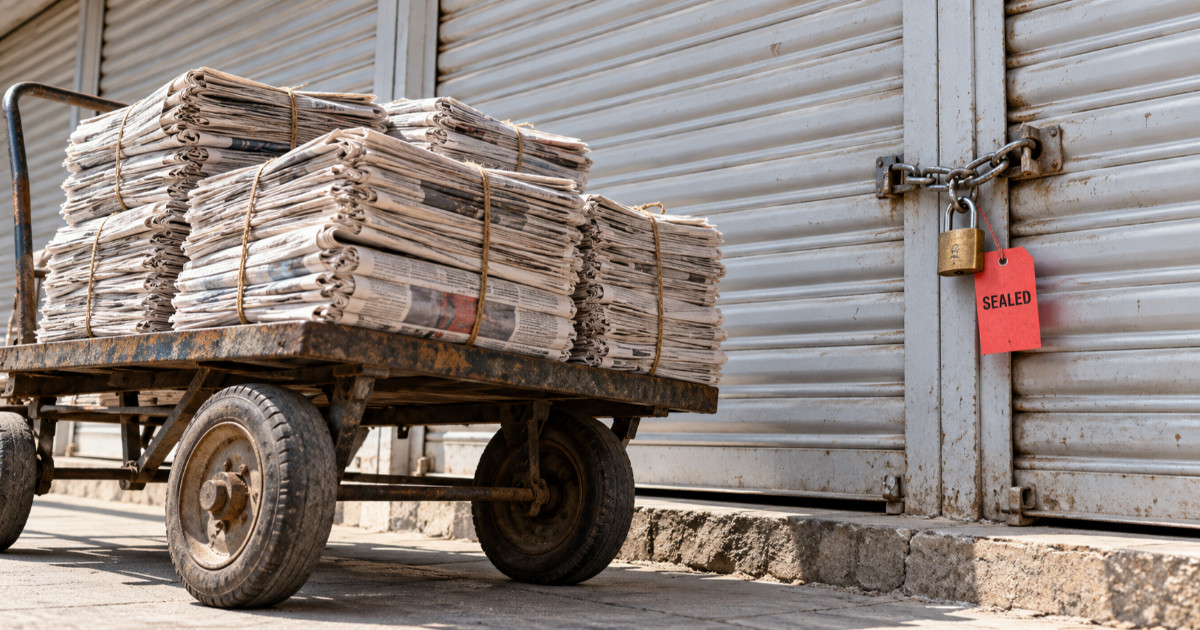
The sealing of Akhbar Market in Islamabad's Aabpara area on October 16 exposed a different dimension of the industry's economic vulnerability.
Municipal authorities cited outstanding charges, while newspaper distributors disputed the demand. The All Pakistan Newspapers Society warned that the closure threatened newspaper circulation and the livelihoods of hawkers.
The dispute highlighted how administrative decisions affecting distribution infrastructure can have consequences beyond the immediate parties. Print newspapers remain dependent on networks of distributors, vendors and delivery workers, many of whom operate with limited financial protection.
At a time when print circulation is already challenged by changing audience habits and digital competition, interruptions to established distribution networks can intensify economic pressures.
The October developments demonstrated that media sustainability is not solely a question of advertising revenue or digital subscriptions. It also depends on predictable employment conditions, functioning distribution systems, and mechanisms that protect workers from prolonged salary delays.
Institutional response & accountability
October produced several examples of collective action by journalists and media organizations, reflecting growing concern about the pressures confronting the profession.
The Association of Electronic Media Editors and News Directors elected Geo News Managing Director Azhar Abbas as president and Tariq Mahmood as general secretary on October 17.
Alongside the leadership change, the association's General Council expressed concern about deteriorating press freedom and what it described as the growing use of government powers and state institutions to restrict independent journalism.
It specifically raised concerns about the alleged misuse of PECA and actions by the NCCIA, bringing the position of newsroom editors into the wider debate over cybercrime enforcement.
On October 26, a roundtable in Lahore involving journalists, press unions, political figures and civil society representatives agreed to establish a committee to coordinate a united response to censorship, restrictive legislation and worsening working conditions.
The proposed initiative included documenting violations of freedom of expression and preparing a charter of demands.
The development suggested that professional organizations were increasingly treating legal pressure, censorship, online harassment and labor insecurity as interconnected problems rather than separate grievances.
The Khyber District Press Club's response to the disputed incident at its premises offered another example of collective action at the local level. However, the unresolved facts surrounding that case also demonstrated the importance of independent verification before institutional allegations are accepted as established.
The month's strongest statistical assessment came from Freedom Network's Annual Impunity Report 2026.
The watchdog documented 97 violations against journalists and media organizations between October 2025 and August 2026. The recorded incidents included one work-related killing, three attempted assassinations, 18 threats of murder or physical harm, 11 assaults, 13 legal actions and 32 threats of legal action.
Freedom Network identified legal harassment as a growing source of pressure, warning that summonses, cybercrime investigations and prolonged legal proceedings can burden journalists even when they do not result in convictions.
The findings placed October's individual developments in a longer context. They also underscored the need to examine not only the number of attacks or arrests, but the cumulative effects of investigations, court appearances, legal expenses and uncertainty on journalistic independence.
JournalismPakistan originals
JournalismPakistan's October coverage extended beyond reporting individual cases to examine the institutional and practical challenges facing Pakistani journalism.
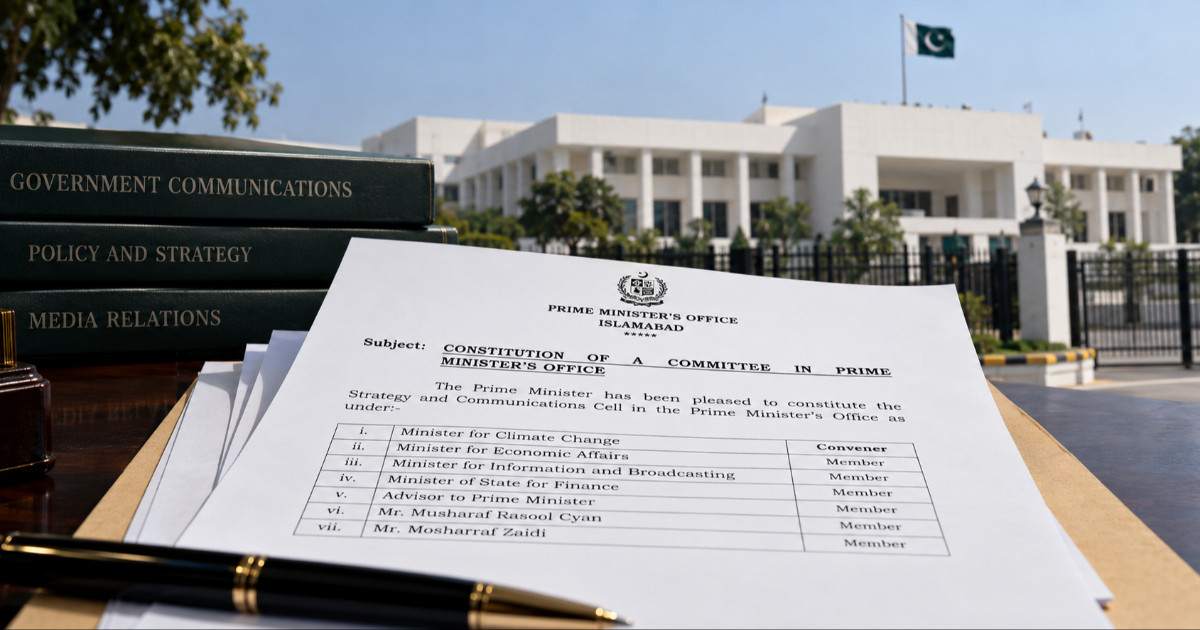
A report on the federal government's new Strategy and Communications Cell raised questions about the expansion of official communications machinery.
The cell was established through a September 28 notification identifying its members but providing no published terms of reference defining its responsibilities, authority, staffing or financing.
The lack of publicly specified responsibilities raised questions about duplication, accountability and the relationship between official communications structures and independent news organizations.
In a separate public-interest explainer, JournalismPakistan examined the options available to journalists threatened by politicians, clerics or other public figures.
The report distinguished immediate safety planning from longer-term legal action, emphasizing that preserving evidence, obtaining professional advice and seeking protection may need to proceed together.
It also cautioned that legal notices or public rebuttals should not be mistaken for substitutes for personal safety measures.
The two reports reflected an important aspect of JournalismPakistan's editorial role: documenting developments while explaining their implications for newsroom independence, institutional accountability and the practical protection of journalists.
Media leadership and institutional change
An important editorial transition came into view when JournalismPakistan reported that Dawn editor Zaffar Abbas was expected to retire by the end of 2026 after 16 years leading the newspaper.
Several possible successors were reportedly under consideration, with The News editor Behzad Alam mentioned as a leading candidate. No appointment was confirmed in the supplied reporting.
The prospective transition was significant for one of Pakistan's most established English-language newspapers. Changes at the top of major news organizations can influence editorial direction, institutional continuity and newsroom priorities.
The development also highlighted a broader question facing Pakistan's traditional media institutions: how to preserve editorial independence and professional standards while adapting to financial pressures, digital competition and changing audience expectations.
Journalists we lost
Pakistan's media community mourned the death of award-winning caricaturist and political cartoonist Shujaat Ali, who suffered a fatal heart attack near his home in Bhara Kahu, Islamabad, on October 6.
Ali had worked across newspaper cartooning, digital animation, courtroom illustration and aviation art. His professional associations included The News in Rawalpindi, Al Jazeera in Doha, the Pakistan Air Force and Pakistan Punch, a publication dedicated to cartoons and satire.
His death represented the loss of a journalist and artist whose career crossed several forms of visual storytelling.
Political cartooning remains an important part of editorial expression, using humor, illustration and satire to challenge authority and examine public affairs. Ali's work demonstrated the contribution that visual journalists make to the wider profession, often outside the prominence given to television anchors and newspaper columnists.
Quote of the month
“Fake news” and “anti-state propaganda”
— Terms used by the NCCIA in announcing its expanded cyber-patrolling and enforcement operations in October 2026.
The terminology captured one of the month's central debates: how authorities distinguish deliberately harmful or unlawful online activity from legitimate reporting, criticism and public-interest commentary. The distinction matters because broad or inconsistently applied enforcement standards can create uncertainty for journalists even before formal charges are brought.
Timeline
October 5: NCCIA announces nationwide cyber-patrolling units and special enforcement teams.
October 6: Award-winning political cartoonist Shujaat Ali dies near Islamabad.
October 11: Internet and mobile services are disrupted in parts of Khyber Pakhtunkhwa following the imposition of emergency rule.
October 12: Journalist Alifya Sohail discloses an NCCIA summons requiring her to bring digital devices to its Karachi office.
October 13: A Karachi court grants the NCCIA four days of physical remand of Iqrarul Hassan. PEMRA issues renewed restrictions on live television coverage of security incidents.
October 15: A Karachi sessions court upholds Iqrarul Hassan's physical remand. Police report detaining a suspect in the alleged mistreatment of Kashif Hashmi.
October 16: The sealing of Akhbar Market disrupts newspaper distribution in Islamabad.
October 17: AEMEND elects new office-bearers and raises concerns about restrictions on independent journalism.
October 18–21: Balochistan's directive requiring official confirmation of security-related reporting becomes public. Iqrarul Hassan is sent to judicial custody on October 19.
October 22–23: Iqrarul Hassan's bail application is refused. The NCCIA announces the arrest of a suspect accused of online harassment of a female journalist.
October 25–26: A disputed alleged raid at Khyber District Press Club prompts a boycott. A Lahore roundtable agrees to coordinate opposition to restrictions on journalism.
October 27: Parliamentary journalists walk out of the National Assembly over unpaid salaries and dismissals.
October 28–29: A suspect in the 2019 Mureed Abbas murder case is sent to judicial custody. Freedom Network reports 97 violations over its monitoring period. Iqrarul Hassan suffers another bail setback.
October 30: Journalist Azeem Barejo is injured during a confrontation in Jamshoro. Rana Imran Latif is reportedly targeted in Islamabad.
October 31: A Karachi magistrate grants Iqrarul Hassan bail against Rs200,000 surety bonds.
Five trends JournalismPakistan identified
1. Legal pressure is becoming an enduring challenge. Cybercrime investigations, summonses, custody proceedings and repeated court hearings can impose substantial burdens without a conviction.
2. Official verification requirements are narrowing editorial discretion. Broadcast restrictions and security-reporting directives increasingly place government institutions at the center of decisions about what can be reported.
3. Digital tools create both protection and vulnerability. Cybercrime enforcement can provide remedies against harassment and impersonation, but it also raises concerns about surveillance, device access and investigations involving journalism.
4. Journalist safety and economic security are closely connected. Physical threats, employment uncertainty, delayed salaries and interruptions to distribution systems can collectively weaken independent reporting.
5. Professional organizations are seeking more coordinated responses. Statements, protests, legal challenges and proposals for a common charter reflect growing recognition that the pressures facing Pakistani journalism are interconnected.
Looking ahead
Several developments from October will require close attention in November and beyond.
The proceedings against Iqrarul Hassan remain important following his October 31 bail order. The status of the investigation, any subsequent court proceedings and the pending forensic report will help determine whether the case continues to impose legal restrictions on him.
The NCCIA's expanded cyber-patrolling operations also warrant continued scrutiny. Journalists and press freedom organizations will need to assess how the new units operate, which standards guide their investigations and whether safeguards protect reporting and commentary involving public-interest matters.
The cases involving Hamad Ali and Alifya Sohail raise related questions about the use of PECA, the disclosure of allegations to journalists and the handling of electronic devices that may contain confidential sources or unpublished material.
PEMRA's October 13 directive and Balochistan's official-verification requirements should be monitored for their practical consequences. The most important test will be whether journalists can continue obtaining and publishing independently verified information about security-related developments without unreasonable delays or restrictions.
The incidents involving Kashif Hashmi, Amjad Islam Amjad, Rana Imran Latif and Khyber District Press Club require transparent investigation and publicly available findings. The Jamshoro confrontation similarly demands scrutiny of the competing allegations without assuming a journalism-related motive.
On the economic front, the government's request for channel-wise details of unpaid salaries and dismissals must be followed by an assessment of whether the information produces meaningful relief for affected media workers. The future operation of Akhbar Market also remains important to newspaper distribution and the livelihoods of vendors.
The committee proposed at the Lahore journalists' roundtable will face an early test in translating professional solidarity into a coherent charter of demands and a sustained campaign for stronger safeguards.
Finally, Dawn's expected editorial transition will be worth following as one of Pakistan's most established newspapers prepares for a possible leadership change.
October demonstrated that independent journalism in Pakistan faces challenges extending far beyond individual arrests or acts of censorship. The growing intersection of law, regulation, digital enforcement, physical safety and newsroom economics is reshaping the conditions under which journalists work.
The month's most important lesson is that relief in individual cases, including bail, the detention of suspects or official acknowledgment of grievances, does not by itself address structural weaknesses. Sustainable press freedom requires accountable institutions, transparent enforcement, effective safety protections, editorial independence, and economic conditions that allow journalists to perform their duties without undue pressure.
Why this matters
The developments of October 2026 reveal how restrictions on journalism can accumulate without a single dramatic act of censorship. A cybercrime summons, an official-verification requirement, a disrupted communications network, an unpaid salary, or an unresolved assault complaint may appear to be separate problems. Together, they can reduce the freedom and capacity of journalists to investigate and report matters of public interest.
For Pakistan's media industry, the challenge is not simply to defend journalists after an incident occurs. It is to establish legal, institutional and economic protections that allow independent reporting to continue without fear of arbitrary punishment or professional retaliation.
The effectiveness of those protections will depend on whether authorities, media owners, courts and professional organizations move beyond statements and isolated interventions toward measurable accountability.
The State of Pakistan Media: September 2026
ATTRIBUTION: The State of Pakistan Media is JournalismPakistan.com's flagship monthly assessment of the developments, challenges and emerging trends shaping journalism and the media industry across Pakistan. This October 2026 edition draws on JournalismPakistan's published reporting, statements by official institutions and journalists' organizations, court developments and monitoring findings cited in those reports. It identifies significant developments and patterns but is not intended as an exhaustive count of every media-related incident during the month. Freedom Network's annual figures relate to its October 2025–August 2026 monitoring period.
Key Points
- NCCIA activated nationwide cyber-patrolling and investigations into online reporting.
- PEMRA renewed limits on television coverage of explosions, gunfire and attacks.
- Provincial orders, notably in Balochistan, required official confirmation before reporting on security forces.
- Journalists faced summonses and a prominent anchor spent weeks in custody before bail.
- Physical safety incidents and newsroom salary disputes further strained independent reporting.
Key Questions & Answers
What new enforcement actions occurred in October 2026?
The NCCIA launched cyber-patrolling units and pursued online investigations, while authorities issued summonses and detained at least one prominent anchor pending legal proceedings.
How did regulators affect reporting on security incidents?
PEMRA renewed restrictions on broadcast coverage of explosions, gunfire and terrorist incidents, and some provincial governments required confirmation from designated official sources before reporting on security forces.
Did these developments amount to a nationwide censorship order?
No single nationwide censorship order was issued, but combined legal, administrative and verification measures constrained editorial decision-making and reporting practices.
What other issues affected journalists in October?
Reports of attacks and alleged police mistreatment, along with newsroom salary disputes and union demands for stronger protections, exacerbated concerns about press independence and safety.
Relevant Topics
Ask AI: Understand this story your way
AI EnabledDig deeper, ask anything — get instant context, background, and clarity.
Disclaimer: This feature is powered by AI and is intended to help readers explore and understand news stories more easily. While we strive for accuracy, AI-generated responses may occasionally be incomplete or reflect limitations in the underlying model. This feature does not represent the editorial views of JournalismPakistan. For our full, verified reporting, please refer to the original article.