
Three Palestinian photojournalists injured covering Gaza protests
JournalismPakistan.com | Published: 22 December 2018
Join our WhatsApp channel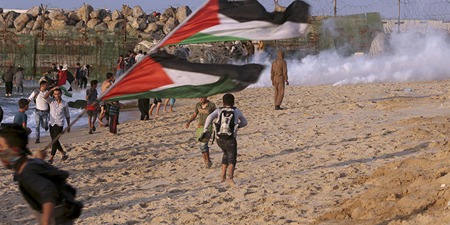
Three Palestinian photojournalists were injured during protests in Gaza. The incidents raise concerns about the safety of journalists covering conflict.Summary
Rashid Rasheed, a photojournalist and cameraman for the Associated Press news agency, was hit in his left leg by a live round fired by the Israel Defense Forces while covering a protest on a beach near the border fence west of the northern Gazan city of Beit Lahia on November 19, 2018.
Saber Nureldine, a Palestinian photographer who was at the scene and the managing director of the European Pressphoto Agency in Gaza, told the Committee to Protect Journalists (CPJ) that the demonstration was coming to an end, and most of the protesters and journalists were leaving the scene when they were surprised by the sound of sniper fire.
"There were only a few photographers left, and we heard a sniper shooting in the direction of some young men, some of whom were injured. Our colleague Rasheed was about 700 meters away from the border fence when he was hit in his left leg. We rushed him to the Al-Shifa Hospital in Gaza for treatment. With the help of AP, he was subsequently transferred for surgery to the Hadassah Hospital in Jerusalem. He had been previously injured while covering protests and had been on leave for six months. He had returned to work barely a week earlier," Nureldine added.
Videos and pictures shared by journalists on the scene on social media show that Rasheed was wearing protective gear that identified him as a journalist when he was shot.
According to his employer, Rasheed, who has been working for the AP since 2002, was operating a live camera on an elevated area overlooking the protest and was identified as a journalist.
In a separate incident, Attiya Darwish, a photographer for the Palestinian National Authority-affiliated Al-Rai News Agency, and Mustafa Hassouna, a photographer for the Turkish state-run news agency Anadolu, were hit by a gas canister and a rubber bullet in the face and the right leg, respectively. They were covering protests against the Israeli occupation in the Malika area, east of Gaza City, on December 14, 2018.
Hassouna told CPJ that he was covering the clashes between the Israeli Army and Palestinian protesters near the border fence when the Israeli troops began to fire tear gas on the protesters.
"I was suddenly hit by rubber bullet fired by the Israeli Army and fell down. I could no longer stand on my leg. I was taken to an ambulance that took me to Al-Shifa Hospital in Gaza for treatment. I had a wound and a bruise and a sharp pain. After two hours I was discharged," he added.
The Israel Defense Forces did not reply to CPJ's email requesting comment.
Since the protests began on March 30, 2018, CPJ has documented at least 20 journalists hit by live rounds fired by Israel Defense Forces, two of whom - Yaser Murtaja and Ahmed Abu Hussein - later died of injuries.
Photo: AP
KEY POINTS:
- Rashid Rasheed was shot in the leg by Israeli forces while filming protests in Beit Lahia.
- Attiya Darwish and Mustafa Hassouna were injured by gas canisters and rubber bullets in Gaza City.
- At least 20 journalists have been hit by live rounds since protests began in March 2018.
- Rasheed was wearing protective gear at the time of his injury, identifying him as a journalist.
- The Israel Defense Forces did not respond to inquiries regarding these incidents.