
Why publishers want AI companies to pay Amar Guriro: Journalism's future is human-AI partnership The JournalismPakistan Global Media Brief | Edition 23 | June 5, 2026 As AI reshapes news, publishers seek a sustainable future Every frame at a cost: The safety crisis facing Pakistan's camerapersons Why journalists are increasingly targeted in conflict zones What the 60 Minutes controversy means for TV journalism Zee secures FIFA World Cup rights in India through 2030 How fact-checkers verify viral videos during breaking news Pentagon restrictions on reporters draw media backlash Israel-Lebanon talks proceed as conflict hinders reporting Why governments are tightening controls on foreign journalists China condemns US restrictions on Xinhua reporter Taiwan condemns China over New York Times reporter expulsion The biggest threats facing journalism in Asia today Why publishers want AI companies to pay Amar Guriro: Journalism's future is human-AI partnership The JournalismPakistan Global Media Brief | Edition 23 | June 5, 2026 As AI reshapes news, publishers seek a sustainable future Every frame at a cost: The safety crisis facing Pakistan's camerapersons Why journalists are increasingly targeted in conflict zones What the 60 Minutes controversy means for TV journalism Zee secures FIFA World Cup rights in India through 2030 How fact-checkers verify viral videos during breaking news Pentagon restrictions on reporters draw media backlash Israel-Lebanon talks proceed as conflict hinders reporting Why governments are tightening controls on foreign journalists China condemns US restrictions on Xinhua reporter Taiwan condemns China over New York Times reporter expulsion The biggest threats facing journalism in Asia today
Logo
Janu
Press Freedom Tracker

Myanmar army, government aim to silence independent journalism: UN

 JournalismPakistan.com |  Published: 12 September 2018

Join our WhatsApp channel
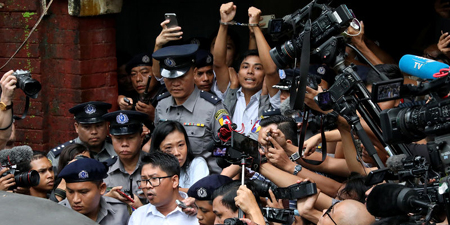
Myanmar army, government aim to silence independent journalism: UN
The UN highlights a campaign in Myanmar aimed at silencing independent journalism through arrests and legal measures. Reports indicate ongoing judicial harassment faced by journalists, notably the case of two Reuters reporters.

GENEVA: Military and government officials in Myanmar have waged a “political campaign” to quash independent journalism, arresting and prosecuting many through the use of vague and overly broad laws, the UN human rights office said on Tuesday.

Its report examined five cases, including that of Reuters journalists Wa Lone and Kyaw Soe, found guilty last week of breaching the law on state secrets and sentenced to seven years in prison after investigating a massacre of 10 Rohingya men.

The UN report called it a “particularly outrageous and high-profile example of judicial harassment against the media in Myanmar” and illustrative of how arrests and prosecutions are conducted “in violation of the right to freedom of expression”.

Myanmar has said the court that convicted the two Reuters journalists under the colonial-era Official Secrets Act was independent and followed due process, after international calls for the pair to be released.

Ministry of Information spokesman Myint Kyaw declined to comment on the report when reached by Reuters on Tuesday. Yangon officials have rejected claims that press freedom was shrinking under the administration of Nobel laureate Aung San Suu Kui.

“The report refers to the ‘instrumentalization of the law and of the courts by the Government and the military in what constitutes a political campaign against independent journalism’,” UN human rights spokeswoman Ravina Shamdasani told a Geneva briefing.

Laws on telecommunications, official secrets and import-export acts have been invoked against journalists, she said.

The group Reporters Without Borders estimates that around 20 journalists were prosecuted last year in Myanmar, Shamdasani said.

The UN report entitled “The Invisible Boundary – Criminal prosecutions of journalism in Myanmar”, which examined freedom of the press since Suu Kyi’s National League for Democracy (NLD) came to power in 2015, said it had become “impossible for journalists do to their job without fear or favor”. - Agencies

Key Points

  • Myanmar government targets independent journalism
  • UN report identifies judicial harassment
  • Two Reuters journalists sentenced to seven years
  • Legal measures include vague laws and arrests
  • Press freedom deteriorating under Aung San Suu Kyi's administration

Ask AI: Understand this story your way

AI Enabled

Dig deeper, ask anything — get instant context, background, and clarity.

Not sure what to choose? Try one of these.

The AI generates results based on your selected options
Your AI-generated results will appear here after you click the button.

Disclaimer: This feature is powered by AI and is intended to help readers explore and understand news stories more easily. While we strive for accuracy, AI-generated responses may occasionally be incomplete or reflect limitations in the underlying model. This feature does not represent the editorial views of JournalismPakistan. For our full, verified reporting, please refer to the original article.

Explore Further

Newsroom
Why publishers want AI companies to pay

Why publishers want AI companies to pay

 June 06, 2026 Publishers want AI firms to pay for using their news to train models and power chatbots, arguing they deserve licensing fees and stronger copyright protection.


Amar Guriro: Journalism's future is human-AI partnership

Amar Guriro: Journalism's future is human-AI partnership

 June 05, 2026 Amar Guriro, founder of Pakistan's first AI-powered news platform, says journalism's future rests on human-AI collaboration to improve reporting while preserving editorial oversight.


The JournalismPakistan Global Media Brief | Edition 23 | June 5, 2026

The JournalismPakistan Global Media Brief | Edition 23 | June 5, 2026

 June 05, 2026 Global Media Brief reviews pressures reshaping journalism, press freedom, AI and platform power, and reports BBC's Emmy, 60 Minutes turmoil and Taiwan's protest.


As AI reshapes news, publishers seek a sustainable future

As AI reshapes news, publishers seek a sustainable future

 June 05, 2026 At the World News Media Congress in Marseille, publishers discussed how generative AI is altering newsroom workflows, audience engagement and content licensing.


Why journalists are increasingly targeted in conflict zones

Why journalists are increasingly targeted in conflict zones

 June 04, 2026 Journalists in conflict zones face rising danger as combatants, states and militias increasingly target independent reporting to control narratives.


Popular Stories