
Chief Minister's 300 photos, 60 pages: Punjab's advertising excess
JournalismPakistan.com | Published: 26 February 2025 | JP Special Report
Join our WhatsApp channel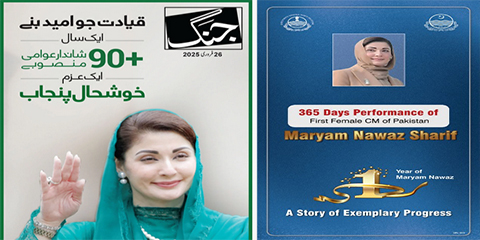
The Punjab Government's recent advertisement campaigns, featuring extensive promotions of Chief Minister Maryam Nawaz, have sparked controversy. Critics argue that funds diverted to publicity undermine essential public services.Summary
ISLAMABAD—In an era where digital governance promises efficiency and transparency, the Punjab Government seems to have discovered an alternative approach: saturating print media with self-congratulatory advertisements at the taxpayers' expense.
This week witnessed unprecedented political vanity as the provincial administration first "hijacked" the front pages of leading Urdu dailies with what could only be described as advertisements disguised as news. Not satisfied with this initial display, the government followed up with a staggering 60-page supplement celebrating Chief Minister Maryam Nawaz's first year in office – a production featuring over 300 photographs of the Chief Minister herself.
The supplement, emblazoned with the slogan "Leadership that provides hope...90-plus grand public projects. Our aim: Khushal Punjab," represents the pinnacle of a troubling trend where governance is increasingly conflated with publicity. What the administration fails to recognize is that true leadership doesn't require constant self-proclamation. When governments resort to purchasing visibility rather than earning recognition through tangible improvements in citizens' lives, it signals a fundamental misunderstanding of public service.
The financial implications cannot be overlooked. Each full-color page in these publications comes with a significant price tag. The cumulative cost of these advertising campaigns – especially the lavish 60-page supplement – represents funds diverted from essential public services. Schools lacking basic facilities, hospitals struggling with medicine shortages, and infrastructure in disrepair across the province stand as silent witnesses to this misallocation of resources.
This pattern of media manipulation raises serious questions about the independence of our press. When government advertisements form a substantial revenue stream for media houses, the line between journalism and propaganda becomes dangerously blurred. The "hijacking" of front pages – traditionally reserved for the most important news of the day – represents a concerning erosion of editorial autonomy.
Perhaps most troubling is the underlying assumption that citizens can be swayed by glossy presentations rather than substantive achievements. The focus on quantity – 90-plus projects, 300-plus photographs – over quality assessment speaks volumes about how the administration views public intelligence.
The irony of promoting a "Khushal Punjab" through such wasteful expenditure cannot be overstated. True prosperity requires fiscal responsibility, transparent allocation of resources, and investments that yield tangible benefits for citizens – not elaborate exercises in image management.
As this supplement circulates through the province, each page turned represents another opportunity cost – another school that could have received books, another rural clinic that could have been supplied with medicines, and another road that could have been repaired.
The path to genuine governance lies not in colonizing media space but in delivering results that speak for themselves. Until Punjab's leadership recognizes this fundamental truth, taxpayers will continue to fund political fantasy at the expense of their own reality.
KEY POINTS:
- Punjab Government's 60-page supplement features over 300 photos of Chief Minister.
- Criticism arises over the use of taxpayer funds for self-promotional advertising.
- Concerns about the blurred lines between journalism and government propaganda.
- The financial implications divert important resources from public services.
- True governance should focus on results rather than image management.