
India bars journalists in Jammu and Kashmir from covering event
JournalismPakistan.com | Published: 29 January 2019
Join our WhatsApp channel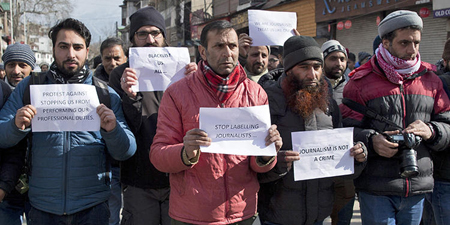
The Indian government has barred journalists from covering a Republic Day event in Jammu and Kashmir, citing security concerns. This action has drawn criticism from the Committee to Protect Journalists for undermining press freedom.Summary
NEW DELHI - The Committee to Protect Journalists has called on authorities in the Indian-controlled state of Jammu and Kashmir to stop restricting press coverage of events in the restive state.
Ten photo and video journalists from local, national, and international media organizations were barred from covering a government function marking India's Republic Day in Srinagar on January 26, according to media reports.
Six of the 10 journalists were given media passes to the event but were then barred by police from attending because their names were included on a list of potential security threats; the other four were not granted passes at all, according to one of the journalists, who spoke to CPJ on the condition of anonymity fearing further retaliation.
"Barring journalists from covering events in Jammu and Kashmir on the basis of vague and unspecified allegations is an unreasonable restraint on the freedom of the press," said Steven Butler, CPJ's Asia program coordinator, in Washington, D.C.
"These kinds of restrictions on journalists only serve to undermine public trust at a time of heightened tensions in the region." Those who were granted credentials but then barred were Tauseef Mustafa of AFP, Danish Ismail Wani of Reuters, Mehraj ud Din and Umar Mehraj of The Associated Press, Bilal Ahmad Bhat of Indian news agency Asian News International, and Amaan Farooq from the Srinagar-based newspaper Greater Kashmir, according to media reports.
CPJ's 1996 International Press Freedom Award winner and freelance columnist Yusuf Jameel, Ashraf Wani of Hindi news channel Aaj Tak, Firdous Wani of English news channel NewsX, and Habib Naqash of Greater Kashmir were not granted credentials at all, according to the journalist who spoke to CPJ.
A report in the daily newspaper Indian Express said the journalists who were given credentials but then barred were named in an "adverse report" filed by the Jammu and Kashmir police Crime Investigation Department.
According to another journalist who asked not to be named fearing retaliation, and who is based in Jammu and Kashmir, an adverse report is an unfavorable assessment of a journalist made by authorities who object to the journalist's previous news coverage, allege they are involved in activities critical of the state government, or judge that the journalist is too close to separatists. "It is confusing.
They are not telling us anything clearly. Kashmiri photojournalists are used to beatings and injuries during protests and gunfights, but this a completely different thing," Mustafa, of AFP, told the online publication Scroll.
The Jammu and Kashmir state government's barring of journalists and refusal to grant press credentials sparked a boycott of the Republic Day event by other journalists, according to Scroll. K.
Vijay Kumar, an adviser to the governor of Jammu and Kashmir, blamed the incident on a procedural lapse between the state government and the local police and promised that the security clearance process would be reviewed for better coordination, according to Press Trust of India.
CPJ reached out to Kumar via text, and he responded: "I have expressed concern and regret, and have asked the Additional Director General of CID [the Crime Investigation Department] to enquire" about the situation. CPJ has been documenting continued violations of press freedom in Jammu and Kashmir over the last few months.
Earlier this month, security forces fired pellet guns at photojournalists covering a clash between protestors and security forces. In October 2018, journalists were barred and assaulted while covering local elections, and in August, reporter Aasif Sultan was arrested by Jammu and Kashmir police and remains in prison. – A CPJ News Alert/Photo: AP
Key Points
- Ten journalists were barred from covering a government event in Jammu and Kashmir.
- Restrictions were based on vague security threat assessments.
- The incident sparked a boycott of the event by other journalists.
- Authorities promised to review the security clearance process.
- CPJ has documented ongoing violations of press freedom in the region.
Relevant Topics
Ask AI: Understand this story your way
AI EnabledDig deeper, ask anything — get instant context, background, and clarity.
Disclaimer: This feature is powered by AI and is intended to help readers explore and understand news stories more easily. While we strive for accuracy, AI-generated responses may occasionally be incomplete or reflect limitations in the underlying model. This feature does not represent the editorial views of JournalismPakistan. For our full, verified reporting, please refer to the original article.