
PEMRA launches interactive learning program on code of conduct
JournalismPakistan.com | Published: 9 January 2017
Join our WhatsApp channel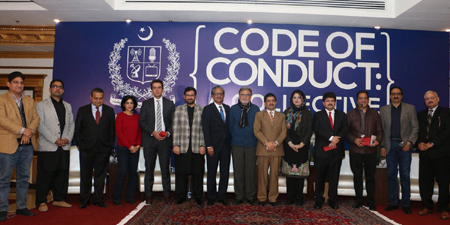
The Pakistan Electronic Media Regulatory Authority (PEMRA) has initiated an interactive program aimed at educating media personnel about the code of conduct. This includes workshops that encourage discussions on media responsibilities and ethical standards.Summary
ISLAMABAD - Pakistan Electronic Media Regulatory Authority (PEMRA) Monday launched its interactive learning program with media houses and journalists with a workshop to create awareness about the code of conduct for electronic media.
The topic of the first workshop of the series of the interactive program was ‘Code of Conduct: A Collective Responsibility’.
Leading journalists and television anchors participated in the interactive panel discussion. The topics included ‘Media: independent but less responsible?, ‘Fake images and fake news: How social media is affecting journalism’, and ‘Ratings vs truth: Does Pakistani electronic media follow professional standards?’
Addressing the workshop, PEMRA Chairman Absar Alam said the purpose of the initiative was to have an open discussion on electronic media code of conduct 2015, and to get feedback from relevant stakeholders on improving the regulatory function of PEMRA and to bridge the gap between the regulatory authority and relevant stakeholders.
He said in next few months PEMRA teams would go to all the four provinces for interactive sessions and press clubs would also be involved in the process.
Absar said the purpose of the initiative was to mold public opinion about the code of conduct so that the channels should stop violations on public pressure and PEMRA might not be forced to take punitive action against the violating channels.
He said civil society members, reporters and students would also be invited in PEMRA panel discussions to share their concerns and to give their feedback on the effective implementation of electronic media code of conduct.
The PEMRA chairman said people were getting fed up with sensationalism on news and current affairs channels, and they were switching to entertainment, sports and religious affairs channels instead.
He said as per a latest study, 65 percent people preferred to watch Pakistani drama channels, 36 percent Islamic channels, 34 percent sports, 28 percent morning shows and only 21 percent news and current affairs channels.
Alam said that due to verbal brawls in political talk-shows, the channels were losing credibility and their viewers were switching to other channels, which should be alarming for their management.
Panelist Murtaza Solangi said media’s responsibility was to provide information on public interest but unfortunately the profession had become a business as the objective of most of the proprietors was to earn profit.
Media, he said, provided information which suited the ruling elite or upper class of the society and neglected the rest of the population completely. He urged the government to issue news channel licenses to cooperative parties which would fulfill the vacuum of public interest media.
Matiullah Jan of Waqt News said the code of conduct should be implemented on all segments of the society as one section could not be reformed in isolation. He said PEMRA should create awareness among the masses so that channels should stop violating code under public pressure.
Amber Shamsi said whenever a journalist joined BBC, he or she was given a booklet on the ethics and training was given to them but unfortunately here in Pakistan no such thing existed for the new entrants to the profession.
Director Public Relations PEMRA Tahir Sheikh said proper homework is not done before airing breaking news which results in broadcast of unauthentic news like the plane crash audio.
Geo TV’s Rana Jawad said social media was one reason of pressure on the mainstream media news desk. “When news goes viral on the social media and nobody from the relevant departments verifies the news, the channels are forced to carry the news.”
Hamid Mir, also from Geo said social media’s positive role should also be acknowledged though mostly its negatives were highlighted. He said if 50 percent clauses of the code of conduct were implemented, PEMRA would practically become irrelevant.
Another Geo anchor Salim Safi said as in Pakistan the culture of accountability could not be promoted, character assassination of opponents had become a norm.
Javed Chaudhry representing Express News said rating system of the TV channels was very faulty as it was being calculated on the basis of only 850 meters in the entire country which should be remodeled according to the European model. - APP/Image couretsy: PEMRA
KEY POINTS:
- PEMRA launched an interactive learning program for media awareness.
- The first workshop focused on the 'Code of Conduct: A Collective Responsibility'.
- Leading journalists participated in discussions on media ethics and accountability.
- PEMRA aims to involve civil society and students in future discussions.
- Concerns were raised about the credibility loss due to sensationalism in media.