
Mohammad Ilyas: Pakistani cricket legend dies at 79 leaving defiant legacy
JournalismPakistan.com | Published: 14 January 2026 | Dr. Nauman Niaz (TI)
Join our WhatsApp channel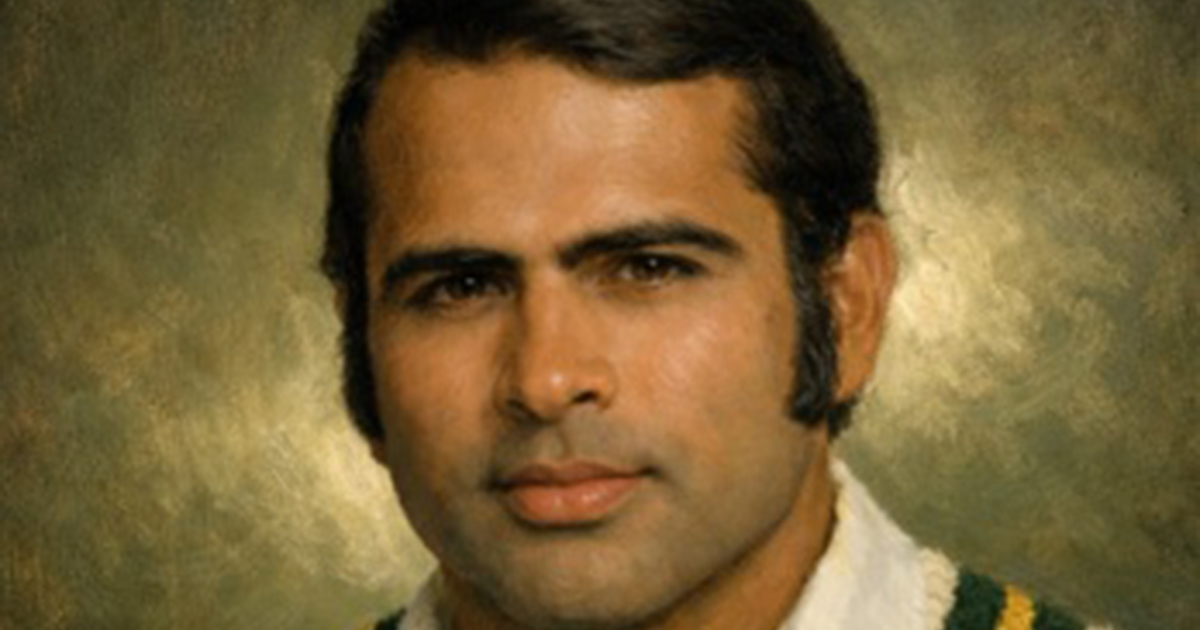
Mohammad Ilyas, Pakistan's combative opening batsman who scored a match-winning Test century and later clashed with cricket authorities, has died at 79 after a prolonged illness.Summary
MELBOURNE — Do not ask where he has gone. Ask instead where he has arrived. Some souls are not born to bargain with noise. They walk among shouting men carrying a cup of silence, and when it spills, the world calls them difficult.
He had a clean heart, so clean it startled those who lived by dust. He spoke plainly in rooms that thrived on echoes, and his honesty bruised the furniture of power. For this, they named him temperamental, as if fire were at fault for being warm.
Do not confuse gentleness with weakness. The mountain does not shout, yet it stands. The river does not argue, yet it wears stone into prayer. He was enormously ordained, not by councils or corridors, but by the quiet essence of conscience. He knew that to live rightly is to be misunderstood, and to refuse crooked paths is to walk alone for a while.
House politics circled him like winter birds. They pecked, they whispered, they waited. He did not peck back. He fed the sky instead. Some men survive by bending. He survived by remaining.
He lived in style, not the style of display, but of alignment. His outer walk matched his inner weather. What he said was what he meant. What he believed, he lived. What he loved, he defended, even when love demanded cost. And when the final door opened, he did not knock loudly. He did not announce his leaving. He went without a whimper, as one who has already said everything necessary through the way he stood. Grief asks, Why him? Wisdom answers, Why not light return to light? Do not mourn him as broken.
Mourn the rooms that could not hold his clarity. Mourn the ears that mistook truth for noise. Mourn the age that confuses cleverness with wisdom. He has not vanished. He has only changed rooms. Where he is now, there are no committees, no temper tests, no politics of small hearts. Only a vast listening. Only mercy without paperwork. Only a welcome that says: You lived clean. You walked straight. Now rest inside the truth you never abandoned. And if you miss him, do not look for his shadow. Look for his courage in yourself; that is where such men go when they leave the body.
A Storm in Cricket's Sky
Some men pass through cricket as others pass through weather, noticed, measured, discussed, and forgotten. Their numbers are logged, their photographs fade, and their names settle politely into footnotes. And then some men inhabit the game the way a storm inhabits the sky: not always welcome, never quiet, often disruptive, and impossible to ignore. Mohammad Ilyas belonged irrevocably to the latter kinfolk.
Brazen, upfront, uncouth to some, endearing to many, and irreversibly himself, he rose from the hard-packed lanes and unlit courtyards of Lahore with his heart worn openly upon his sleeve. He carried that heart into Test cricket, into the domestic grind, into selection rooms thick with intrigue, into boardrooms allergic to candor, and finally into old age, where memory outlived muscle and conversation replaced competition. If cricket is often romanticized as a gentleman's pursuit, Mohammad Ilyas stood as proof that it is also a rebellion against origin, authority, silence, and sometimes even good sense.
He is no more now. At 79, after a prolonged illness, the body finally asked what the spirit never did: rest. Yet rest never sat easily with Mohammad Ilyas, and even in his absence, he remains restless, his life resisting the calm of tidy summation. From Lahore's Streets to Test Cricket Stardom
Lahore, in the years of Mohammad Ilyas's youth, was a city learning to carry the burden of a new nation. The trauma of partition lingered in its streets, and poverty was not only economic but historical. The slums were not just places; they were conditions, zones where boys learned early that survival required voice, elbow-room, and defiance.
Mohammad Ilyas emerged from these quarters not with polish but with presence. He did not arrive bearing refinement; he arrived bearing force. Cricket, for him, was not first an aesthetic pursuit but an assertion of existence. The bat in his hands was not just an instrument of elegance; it was a declaration that he belonged, that he would not be overlooked, that anonymity would not be his inheritance. He learned the game in spaces where there was little margin for gentleness. He learned to play shots that spoke loudly, to occupy the crease as if it were contested territory. Even in youth, there was something unyielding about him, a refusal to shrink, a resistance to submission. That quality would define both his rise and his undoing.
Unreserved, Unabashed, Unrestrained
Unreserved. Unabashed. Unrestrained. These were not adjectives applied retrospectively by admirers eager to mythologize. They were embedded in the very grain of his batting and in the posture of his life. He opened the batting as he lived without apology. If subtlety was required, he resisted it. If patience was demanded, he supplied it on his own terms. At his best, he was charming not because he sought charm, but because he was fully, dangerously alive to the moment.
Mohammad Ilyas played 10 Test matches for Pakistan between 1964 and 1969, a span brief in calendar years yet dense with significance. He represented his country at a time when Pakistan's batting order was still finding its historical spine, when opening the innings was not just a technical assignment but an act of exposure.
The new ball in that era was a living thing, swinging late, seaming sharply, devouring reputations. Opening batsmen were asked not just to score but to survive, not just to endure bowlers but to protect those who followed. It was into this role that Ilyas walked, chest forward, eyes level, uninterested in shrinking his ambition to suit convention. A right-hand opening batsman, with the secondary craft of right-arm leg-spin, he played the dual role of aggressor and absorber. His Test career yielded one century, but that lone hundred carries a weight disproportionate to its numerical solitude. Some centuries pad careers; others define them. He belonged firmly to the latter category.
The Century That Defined a Career
It came in Karachi, in March-April 1965, against New Zealand, in the third Test of a home series already leaning Pakistan's way. The target was 202, modest in numbers yet heavy with expectation. In that chase, Mohammad Ilyas struck 126, an innings that not only secured victory but sealed the series 2-0. It was an innings of command rather than caution, of control forged through confrontation. There was nothing furtive about it. He did not nibble at the target; he claimed it. He did not negotiate survival; he imposed himself. That hundred remains a distillation of the man, decisive, muscular, uninterested in incremental safety. He did not accumulate; he announced.
Across his career, he scored 4,607 first-class runs, registering 12 centuries in 82 first-class matches between 1961 and 1976. He played only two List-A matches, his career unfolding largely before limited-overs cricket rearranged the rhythms of the game. His cricket belonged to longer afternoons, to sessions where temperament mattered as much as technique, where character was tested not in bursts but in endurance.
Domestically, he represented teams such as Pakistan International Airlines (PIA), sides that demanded reliability but often received volatility instead. Yet volatility, in Ilyas's case, was not a flaw; it was his currency.
The 1972-73 Australia Tour That Changed Everything
If fate had a single hinge upon which Mohammad Ilyas's cricketing life turned, it was the 1972-73 tour of Australia. Tours to Australia have always been burdensome, the trials, and for Ilyas, this one proved decisive. Early in the tour, he was struck in the face, a physical blow that seemed to foreshadow the metaphoric ones soon to follow. Accusations of indiscipline surfaced, and where compromise was expected, Ilyas offered confrontation. Where apology was desired, he delivered principle, sometimes clumsily, sometimes defiantly, but always sincerely. The management responded not with reconciliation but with punishment. His passport was confiscated.
This act was not just administrative; it was existential. To be rendered immobile, undocumented, and voiceless in a foreign land is to be reminded brutally that the game does not belong to the player, no matter how fiercely he believes it does. Authority, in that moment, spoke louder than talent. Rather than return subdued, Mohammad Ilyas chose rebellion. He applied for Australian citizenship, stayed on, played grade cricket for Waverley in Sydney, and lived, fully and stubbornly, outside the approved narrative of Pakistani cricket. It was a decision that ended his international career. He never represented Pakistan again. Some would call it self-sabotage. Others would call it integrity. Ilyas himself would likely have called it inevitability. For a man unwilling to bend, fracture was always the likely outcome.
Life After International Cricket
Eventually, he returned to Pakistan, not as a prodigal seeking absolution, but as a veteran unwilling to disappear quietly. The bat had been put away, but the voice remained. He coached. He advised.
He talked. And talked. And talked. Conversation, for Mohammad Ilyas, was not a pastime; it was oxygen. He loved recounting cricketing stories not to center himself, but to reanimate the past. He remembered details others forgot: the smell of damp turf in the morning, the silence of dressing rooms after defeat, the slight tilt of authority's head when it had already decided against you.
Chairman of Selectors: Speaking Truth to Power
He assumed administrative roles and eventually rose to become Chairman of Selectors. It was a position ill-suited to his temperament and perfectly suited to his convictions. He believed selection was moral as much as technical. He believed bias existed. He believed it should be named aloud. That belief would cost him again.
In 2011, Mohammad Ilyas found himself suspended by the Pakistan Cricket Board (PCB) for violating the code of conduct, appearing on a television talk show alongside Salman Butt, a banned former captain, and for his role in the Shahid Afridi dispute. Show-cause notices were issued. Replies were deemed unsatisfactory. Suspension followed.
Afridi accused him of regional bias. Ilyas accused Afridi of undue influence. The dispute ballooned, entangled with allegations involving Imran Farhat, Ilyas's son-in-law. Heated words were exchanged. Complaints were filed. Disciplinary committees convened. To the institution, this was chaos.
To Mohammad Ilyas, it was continuity. He had opposed Afridi's selection for years, not quietly, not diplomatically, but consistently. He believed selection should not bow to stardom. Whether right or wrong, he refused silence. When he reportedly ended an altercation with the words, "the war is now on," it was not a threat but foresight. For Mohammad Ilyas, cricket had always been war against erasure, against hierarchy, against forgetting.
The Man Behind the Controversy
For all his abrasiveness, there was a tenderness in Mohammad Ilyas that surfaced in private. He was affectionate in conversation, often the first to call. He narrated his stories with warmth rather than bitterness. He idolized Majid Khan, his contemporary, speaking of him with reverence unmarred by rivalry. Whenever they met, it was warmly and affectionately, without residue of ego or competition. This contradiction defined him: publicly combative, privately generous; institutionally difficult, personally delightful. A charmer to the core.
A Legacy Beyond Statistics
The PCB expressed grief upon his passing. Condolences were offered. Homage was paid. But institutions remember selectively. They recall statistics, roles, and disputes. They archive what is convenient. What lingers beyond the archive is presence. Mohammad Ilyas's life resists simplification. He cannot be reduced to his lone Test century, nor to his suspensions, nor even to his rebellions. He was a product of a time when Pakistani cricket was raw, unresolved, and still discovering how much dissent it could tolerate.
He lived loudly. He argued sincerely. He loved deeply. He failed publicly. He succeeded defiantly. Like many men of spirit, he paid for being early, outspoken, and unwilling to fold himself into neat categories. What remains of Mohammad Ilyas is not just the 126 in Karachi, nor the 4,607 first-class runs, nor the 10 Test caps, nor even the controversies that followed him like shadows. What remains is an example. That cricket is not only about averages, but about attitude. That obedience is not always virtue. That rebellion, even when costly, can be honest. That charm and conflict may inhabit the same soul.
He rose from Lahore's margins and refused to return quietly. Now, at last, he rests. And the game, argumentative, beautiful, ungrateful, and endlessly alive, moves on, carrying echoes of his voice in its long, unfinished conversation. Mohammad Ilyas has left the crease. But he did not go gently.
Dr. Nauman Niaz is a civil award winner (Tamagha-i-Imtiaz) in Sports Broadcasting & Journalism, and is the sports editor at JournalismPakistan.com. He is a regular cricket correspondent, having covered 54 tours and three ICC World Cups, and having written over 3500 articles. He has authored 15 books and is the official historian of Pakistan Cricket (Fluctuating Fortunes IV Volumes - 2005). His signature show, Game On Hai, has been the highest in ratings and acclaim.
Key Points
- Mohammad Ilyas, Pakistan's opening batsman and former chairman of selectors, died at 79 after a prolonged illness
- Scored a memorable 126 against New Zealand in Karachi (1965), securing a 2-0 series victory for Pakistan
- His career ended after the 1972-73 Australia tour controversy, when his passport was confiscated
- Played 10 Test matches (1964-1969) and 82 first-class matches, scoring 4,607 runs with 12 centuries
- Suspended by PCB in 2011 for code of conduct violations involving banned captain Salman Butt and Shahid Afridi dispute
- Rose from Lahore's impoverished neighborhoods to Test cricket, known for uncompromising honesty and defiant spirit
Ask AI: Understand this story your way
AI EnabledDig deeper, ask anything — get instant context, background, and clarity.
Disclaimer: This feature is powered by AI and is intended to help readers explore and understand news stories more easily. While we strive for accuracy, AI-generated responses may occasionally be incomplete or reflect limitations in the underlying model. This feature does not represent the editorial views of JournalismPakistan. For our full, verified reporting, please refer to the original article.