
When telling the story becomes a crime: A warning shot for Pakistani journalism Breaking news alerts then and now: from urgency to overload AI reduces publisher traffic but not newsroom jobs, study finds Palestinian journalists face a wave of detentions in 2025 Islamabad court sentences journalists in digital terrorism case Global media unite as WAN‑IFRA and FIPP complete merger Pakistan's most embarrassing media moments of 2025 Indian Punjab Journalists Union condemns cybercrime FIRs against media The JournalismPakistan Global Media Brief | Edition 1 | January 2, 2026 now live TikTok becomes top news platform for young Americans When telling the story becomes a crime: A warning shot for Pakistani journalism Breaking news alerts then and now: from urgency to overload AI reduces publisher traffic but not newsroom jobs, study finds Palestinian journalists face a wave of detentions in 2025 Islamabad court sentences journalists in digital terrorism case Global media unite as WAN‑IFRA and FIPP complete merger Pakistan's most embarrassing media moments of 2025 Indian Punjab Journalists Union condemns cybercrime FIRs against media The JournalismPakistan Global Media Brief | Edition 1 | January 2, 2026 now live TikTok becomes top news platform for young Americans
Logo
Janu
Where media reporting began

Kashmir journalists accuse Indian police of muzzling press

 JournalismPakistan.com |  Published: 10 February 2020

Join our WhatsApp channel
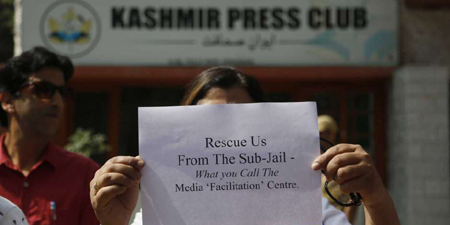
Kashmir journalists accuse Indian police of muzzling press
In Kashmir, journalists are facing increased police intimidation since the revocation of the region's autonomy. The Kashmir Press Club urges the government to uphold constitutional freedoms for the media.

NEW DELHI—Journalists in disputed Kashmir urged the Indian government on Monday to allow them to report freely and expressed concern about alleged police harassment since the region’s semi-autonomy was rescinded in August amid an unprecedented lockdown.

The Kashmir Press Club, an elected body of journalists in the region, said security agencies were using physical attacks, threats and summons to intimidate journalists. The group said the government should “ensure freedom of speech and expression as guaranteed in the constitution instead of muzzling the press.”

On Saturday, police summoned two journalists for questioning in Srinagar for reporting about a strike call issued by the pro-independence Jammu-Kashmir Liberation Front. The Kashmir Press Club denounced the police action.

“The harassment and questioning of journalists in Kashmir on flimsy grounds” by the police is “a damning verdict on the appalling condition in which media is operating,” the group said in a statement.

It also criticized restrictions on the internet and surveillance by police, calling them “tools designed and aimed to ensure only the government-promoted version is heard.”

India’s decision to strip the region of its special status in August brought journalism to a near halt in Kashmir. A communications shutdown affected media operations, and most newspapers published in Srinagar, the region’s main city, have been unable to issue online editions.

Foreign journalists have been denied permission to visit the Himalayan region.

India is ranked 140th out of 180 countries in the World Press Freedom Index published by Reporters Without Borders, a global media watchdog.

About 70,000 people have been killed in the uprising and an Indian military crackdown.—AP

KEY POINTS:

  • Kashmir journalists claim police are targeting them to suppress reporting.
  • Recent police summons interrogated journalists over a strike call report.
  • The Kashmir Press Club denounces police action as a violation of press freedom.
  • Communication shutdowns have severely affected media operations in Kashmir.
  • India ranks low on the World Press Freedom Index, indicating serious concerns.
Read Next

Newsroom
Breaking news alerts then and now: from urgency to overload

Breaking news alerts then and now: from urgency to overload

 January 03, 2026 Breaking news alerts have evolved over the past five years, from rare, urgent signals to constant, fragmented updates. Explore why this matters for journalism and audience trust in 2026.


AI reduces publisher traffic but not newsroom jobs, study finds

AI reduces publisher traffic but not newsroom jobs, study finds

 January 02, 2026 A new study finds that generative AI reduced news publisher traffic after mid-2024 but did not trigger widespread newsroom layoffs, reshaping discovery, design, and monetization strategies.


Palestinian journalists face a wave of detentions in 2025

Palestinian journalists face a wave of detentions in 2025

 January 02, 2026 At least 42 Palestinian journalists were detained in 2025, according to the Palestinian Journalists Syndicate, raising renewed concerns over press freedom and media safety.


Global media unite as WAN-IFRA and FIPP complete merger

Global media unite as WAN-IFRA and FIPP complete merger

 January 02, 2026 The World Association of News Publishers and FIPP complete their merger, forming a global alliance of more than 20,000 media brands to boost advocacy, collaboration, and shared industry growth.


Indian Punjab Journalists Union condemns cybercrime FIRs against media

Indian Punjab Journalists Union condemns cybercrime FIRs against media

 January 01, 2026 Indian Punjab and Chandigarh Journalists Union denounces cybercrime FIRs against media and activists as a threat to press freedom and urges authorities to withdraw or quash cases.


Popular Stories