.png)
Malaysian cartoonist charged with 9 counts of sedition over critical tweets
JournalismPakistan.com | Published: 3 April 2015
Join our WhatsApp channel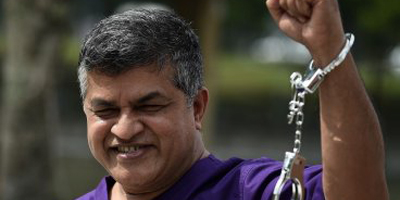
Zunar, a Malaysian cartoonist, has been charged with nine counts of sedition linked to his tweets criticizing the judiciary. This move is part of a wider government crackdown on dissent.Summary
KUALA LUMPUR, Malaysia: A Malaysian cartoonist known for lampooning the ruling coalition was charged Friday with nine counts of sedition over a series of tweets criticizing the country's judiciary.
The charges against Zulkiflee Anwar Alhaque (pictured), better known as Zunar, came amid a widening government crackdown on opposition politicians and the media using the colonial-era law, slammed by critics as a move to stifle freedom of expression.
"This is a record, being charged nine times and using the sedition law. It is excessive and targeted at silencing vocal critics," said Zunar's lawyer, Latheefa Koya.
Zunar faces up to 43 years in jail if found guilty on all nine charges, she said.
The nine tweets criticizing the judiciary were posted Feb. 10 when opposition leader Anwar Ibrahim began serving a five-year prison sentence after losing his final appeal on a sodomy charge.
"The lackeys in black robes are proud of their sentence. The rewards from the political masters must be plenty," said one of the tweets. "Today Malaysia is seen as a country without law," said another.
Anwar's arrest was widely seen at home and abroad as politically motivated to eliminate any threat to the ruling coalition, whose popularity has slowly been eroding since 2008 after more than five decades of unquestioned dominance. Anwar and his three-member opposition alliance were seen as the most potent political threat to Prime Minister Najib Razak's coalition.
Anwar led his alliance to unprecedented gains in 2008 elections and made further inroads in polls in 2013 when Najib's National Front coalition won with a slimmer majority and lost the popular vote to the opposition.
A defiant Zunar posted a new cartoon on Twitter after his release on bail, vowing to "draw until the last drop of ink." The cartoon showed Zunar being cuffed and with a metal chain on his neck, but still drawing with a brush in his mouth.
Sedition as defined by Malaysian law includes promoting hatred against the government.
Scores of people including opposition politicians, activists, academicians and journalists are being investigated or have been charged under the Sedition Act since last year, mostly for criticizing the government or ruling officials.
Prime Minister Najib Razak has said the government planned to eventually abolish the Sedition Act, which was introduced in 1949 during British colonial rule. But he backtracked after the 2013 elections. - AP
Key Points
- Zunar faces up to 43 years in jail if convicted on all charges.
- The charges are seen as an effort to silence government critics.
- His tweets were posted when opposition leader Anwar Ibrahim began serving a prison sentence.
- The sedition law has been criticized for stifling freedom of expression.
- Zunar vowed to continue creating art despite the charges.
Relevant Topics
Ask AI: Understand this story your way
AI EnabledDig deeper, ask anything — get instant context, background, and clarity.
Disclaimer: This feature is powered by AI and is intended to help readers explore and understand news stories more easily. While we strive for accuracy, AI-generated responses may occasionally be incomplete or reflect limitations in the underlying model. This feature does not represent the editorial views of JournalismPakistan. For our full, verified reporting, please refer to the original article.