
Unions must be at the heart of fight for decent working conditions and quality media, says IFJ
JournalismPakistan.com | Published: 28 April 2017
Join our WhatsApp channel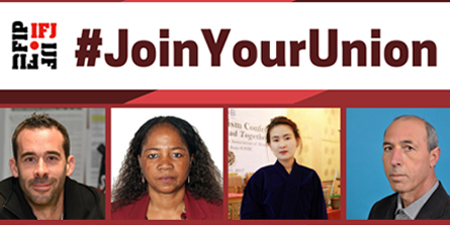
On International Workers' Day, the IFJ calls for unions to lead the fight for fair working conditions in the journalism sector. The organization highlights the benefits of union representation for journalists amidst growing challenges in the field.Summary
BRUSSELS - Unions must be at the forefront of the fight for decent work and at the heart of the debate on the future of the media, the IFJ said to mark International Workers' Day on May 1.
Pointing to global research that workers covered by union agreements enjoy, on average, higher wages, better conditions, and improved health, safety and welfare rights the IFJ has backed journalists organizations building stronger, more representative unions.
Journalism is increasingly precarious and the challenges resulting from growing concentration of media ownership and corrupt and dictatorial governments put freedom of speech and ethical journalism under threat. Today, unions are at the forefront of the struggle to uphold strong ethical standards and decent working conditions - which go hand in hand - through comprehensive collective agreements covering journalists across the globe.
“For journalism to retain its role as the fourth pillar of democracy, we need strong unions to defend our rights,” said Philippe Leruth, IFJ president. “May Day is an opportunity for the IFJ to stand by its affiliates and reaffirm the advantages of being part of a union. We encourage all our affiliates to mark May Day by demonstrating the importance of being part of a union and making recruitment of all journalists a priority”.
The IFJ has highlighted the current challenges facing journalism, including increasingly precarious work, safety hazards, lack of training, gender inequality, breaches of authors’ rights, attacks on public service broadcasting and the increasing threat posed by the fake news to quality journalism.
It has also highlighted the benefits enjoyed by journalists represented by strong unions, including higher wages, collective bargaining, legal support, representation, education, and training.
It pointed in particular that in the UK, 16-to-24-year-old union members earn 38% more than their non-union counterparts (ONS Labour Force Survey 2013). In the US, among full-time wage and salary workers, union members had median usual weekly earnings of $1,004 in 2016, while those who were not union members had median weekly earnings of $802 (Bureau of Labor statistics, US).
The IFJ also condemned those countries that deny workers their rights to freedom of association and collective bargaining in violation of ILO conventions. It condemned in particular Iran, Egypt, and Somalia, where journalists’ unions and associations are subject to ongoing attacks from public authorities.
“To win back credibility in the news, we need a workforce that is defended by strong, representative unions ,” said IFJ General Secretary Anthony Bellanger. “We need a workforce that is fairly paid, well trained and properly protected. And we need to invest in the new generation of journalists. This is the role of the unions. It is time to put the unions at the heart of the debate about the kind of media we want”. - IFJ media release/Image: IFJ
KEY POINTS:
- Unions are essential for improving working conditions in journalism.
- IFJ supports building strong, representative unions for journalists.
- Workers in unions earn higher wages and enjoy better job security.
- The growing concentration of media ownership threatens freedom of speech.
- IFJ condemns violations of workers' rights in countries like Iran and Egypt.